Need help?
Do you have a question about the CHCNAV i90 GNSS and is the answer not in the manual?
Provides general safety warnings and cautions for using the GNSS receiver.
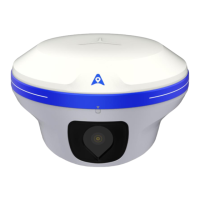
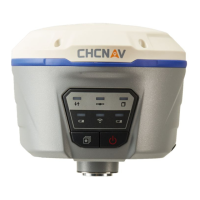
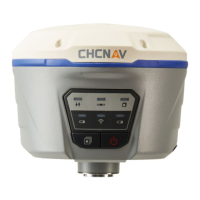
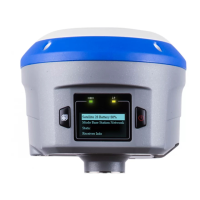
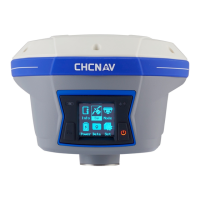
Introduces the i90 GNSS receiver, its IMU-RTK technology, and capabilities.
Information on the rechargeable Lithium-ion batteries and their charging process.
Guidelines for safe handling and usage of Lithium-ion batteries to prevent damage or injury.
Steps to connect the receiver to a controller using Wi-Fi and LandStar 7 software.
Steps to connect the receiver to a controller using Bluetooth and LandStar 7 software.
Guide on downloading logged GNSS data from the receiver using FTP.
Steps to download logged GNSS data using a USB connection.
Details the 7 working modes for setting up RTK base or rover stations via the front panel.
Guidelines and components for setting up a post-processing base station.
Guidelines for setting up real-time base stations.
Guidelines for setting up a real-time rover station.
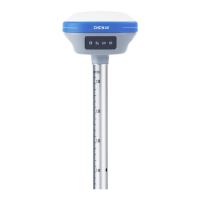
Steps and notes for operating tilt measurement for accurate positioning.
Step-by-step guide on how to operate tilt measurement in LandStar 7 software.
Steps to connect to the i90 receiver using a web browser via Wi-Fi.
Details the default login credentials for accessing the receiver's web interface.
Overview of the status menu, including position, satellites, and runtime data.
View satellite tracking details and manage constellations (GPS, GLONASS, etc.).
Configure antenna, reference station, language, and user management settings.
Configure GNSS antenna settings like type, height, elevation mask, and PDOP mask.
Configure reference station mode, coordinates, and averaging settings.
Set up static GNSS data logging and control FTP push features.
Set up receiver inputs and outputs, including RTK, TCP/IP, serial, and Bluetooth.
Check firmware, download logs, update firmware, and manage configuration files.
Load new firmware to the receiver across the network.
 General
| Type | GNSS Receiver |
|---|---|
| IRNSS | L5 |
| RTK Positioning Accuracy (Horizontal) | 8 mm + 1 ppm |
| RTK Positioning Accuracy (Vertical) | 15 mm + 1 ppm |
| Static Positioning Accuracy (Horizontal) | 2.5 mm + 0.5 ppm |
| Static Positioning Accuracy (Vertical) | 5 mm + 0.5 ppm |
| Operating Temperature | -40°C to +65°C |
| Humidity | 100% condensing |
| IP Rating | IP67 |
| Weight | 1.2 kg |
| Tilt sensor | Yes |
| Internal memory | 8 GB |
| GPS | L1, L2, L5 |
| GLONASS | L1, L2 |
| BeiDou | B1, B2, B3 |
| Galileo | E1, E5a, E5b |
| QZSS | L1, L2, L5 |
| SBAS | L1 |
| Communication Interfaces | Bluetooth, Wi-Fi |
| Data format | CMR, CMR+ |
| Shock | 2 m drop test |

 To Next Page