Need help?
Do you have a question about the CHCNAV i50 and is the answer not in the manual?
Provides essential safety information, including warnings and cautions for safe operation.
Information on how to get assistance and contact CHC technical support for troubleshooting.
Legal notice regarding the use of the user guide and CHC's responsibilities.
Instructions for providing feedback to improve future revisions of the user guide.
Provides a comprehensive overview of the CHC i50 GNSS receiver's features and capabilities.
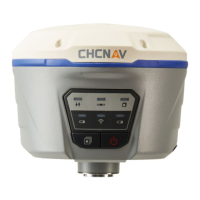
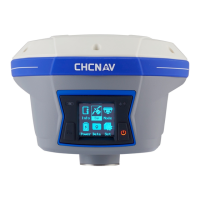
Details the physical components and layout of the CHC i50 GNSS receiver.
Explains the internal and external power options, including charging and safety precautions for batteries.
Step-by-step instructions for correctly inserting the battery and SIM card into the receiver.
Lists and illustrates the essential accessories included in the base and rover kits for the CHC i50.
Guides on connecting the receiver to a computer for data transfer and settings management.
Instructions on establishing connections to a controller via Wi-Fi and Bluetooth for operation.
Details the process of downloading logged GNSS measurement data from the receiver to a computer.
Provides recommendations for optimal placement and environmental considerations for base station setup.
Explains the procedure for setting up the base station to output corrections using its internal radio modem.
Details the steps for outputting corrections using an external radio for base station operation.
Offers essential guidelines for positioning and operating the rover receiver for accurate measurements.
Step-by-step instructions for physically setting up the rover receiver in the field.
Provides an overview of the receiver's current position, satellite tracking, and operational status.
Displays detailed position information, DOP values, and satellite usage for the receiver.
Shows current operating conditions, including tracked satellites, storage usage, and battery status.
Visualizes the receiver's current location on a Google Map interface.
Allows viewing satellite tracking details, enabling/disabling constellations, and graphical displays.
Presents tabular data on tracked satellites, including ID, SNR, and status.
Displays satellite track information, including SNR for L-band carriers.
Shows a graphical representation of satellite positions in the sky relative to the receiver.
Enables or disables specific satellites for tracking to optimize performance or conserve resources.
Allows enabling or disabling tracking signals for different GNSS constellations and frequencies.
Menu for configuring antenna settings, reference station, receiver reset, and web interface language.
Displays detailed receiver information and reference station setup details.
Configure antenna parameters like type, height, and masks to ensure accurate data logging.
Configure reference station mode, coordinates, and broadcast identifiers for RTK operations.
Options to reboot, reset to factory defaults, or clear satellite data for the receiver.
Allows selection of the preferred language for the web interface.
Manage user accounts, including adding, deleting, and modifying user credentials.
Switch the USB function between personal area network and multimedia storage modes.
Configure the parameters for the HCPPP protocol, specifying the range.
Set up and manage GNSS data logging, including observable rates and FTP push features.
Configure logging parameters like name, location, storage limit, format, and start time for data recording.
Configure settings to push stored GNSS data files to an FTP server.
View information about files pushed via FTP and clear the FTP push log.
Download recorded data files from the receiver's internal storage via the internal FTP site.
Configure receiver outputs and inputs, including CMR, RTCM, and serial/Bluetooth ports.
Details the input and output settings for various connection protocols like NTRIP, APIS, TCP, UDP, and Serial Port.
Configure mobile network, email alerts, HTTP/HTTPS ports, and FTP site credentials.
Provides information on the receiver's network status, signal strength, and SIM card status.
Configure GPRS model, network mode, and dialing parameters for mobile network connectivity.
Set up email alerts for specific receiver events like low battery or failed FTP pushes.
Configure the HTTP port for web-based communication with the receiver.
Configure the HTTPS port for secure web-based communication with the receiver.
Configure the username and password for accessing the receiver's internal FTP site.
Check module information and configure WiFi, Bluetooth, and radio settings.
Provides information on the status and parameters of WiFi, Bluetooth, and radio modules.
Turn WiFi on/off, modify the password, and configure access point details.
Turn Bluetooth on/off and modify the PIN number for Bluetooth connectivity.
Configure radio function, parameters, and transmission settings for radio communication.
Manage firmware, download logs, update software, and register the receiver.
Displays the current firmware version and release date of the receiver.
Shows the hardware information, including main board and core board versions.
Download current configuration files or update the receiver with a new configuration file.
Download system logs for troubleshooting and diagnostic purposes.
Select and download user log settings to track receiver activities and status changes.
Load new firmware onto the receiver via the network, ensuring up-to-date software.
Upgrade the GNSS board firmware to improve performance or add new features.
Browse for and upgrade the radio firmware for the receiver.
Input server address to perform online firmware upgrades and retrieve file lists.
Register the receiver by entering the registration code for activation and full functionality.
Configure Cloud Service, Auto Start, Remote Control, and other related settings.
Manage Cloud Service states, auto start, remote control, and upload position settings.
Detailed definition of the pins and functions for the 7-pin Lemo IO port on the CHC i50 receiver.
 General
| Type | GNSS Receiver |
|---|---|
| Frequency Bands | L1, L2, L5 |
| Real-Time Kinematic (RTK) Positioning Accuracy Horizontal | 8 mm + 1 ppm |
| Real-Time Kinematic (RTK) Positioning Accuracy Vertical | 15 mm + 1 ppm |
| Static Positioning Accuracy Horizontal | 2.5 mm + 0.5 ppm |
| Static Positioning Accuracy Vertical | 5 mm + 0.5 ppm |
| Internal Memory | 8 GB |
| Humidity | 95% non-condensing |
| Ingress Protection | IP67 |
| Battery Life | Up to 10 hours |
| GNSS Signals Tracked | GPS, GLONASS, Galileo, BeiDou |
| Data Format | NMEA-0183, RTCM 3.2, CMR, CMR+ |
| Communication Ports | USB, RS232, Bluetooth |
| Wireless Communication | Bluetooth, Wi-Fi |
| Operating Temperature | -40°C to 65°C |
| Storage Temperature | -40°C to 85°C |

 To Next Page