Theory of Operation
4.5 CPU
The CPU, A board, uses a 64180 CPU to control the circuit. A microprocessor circuit
accepts commands from the GPIB or RS-232C controller, or from the front panel keyboard.
It sends digital programming information to DSP controller to set the output parameters of
the power source. Data from measurement circuits are accepted and reported to the display
and GPIB. Setup parameters and one key operation data are stored in EEPROM.
4.6 Measurement & Sine wave Generator (B Board)
Measurement circuits on B board monitor voltage, current, power etc. Voltage from the
output is scaled, and sent to the DSP processor by the analog-to-digital converter.
Current sensed by the current shunt is scaled, and sent to the DSP processor by the
analog-to-digital converter.
The true-RMS measurement is made by software of the DSP processor, and so is the
power.
The digital-to-analog converter on B board sets the DC voltages that are used for the
programmable voltage function. Low pass filter is applied to smooth the reference input
signal.
4.7 Keyboard & Display
The keyboard is designated as K board, which is connected through a short flat ribbon
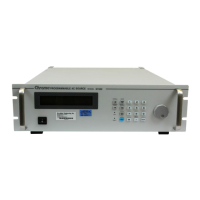
cable. It has 16 key switches and 2 LED indicators. The display is also connected from A
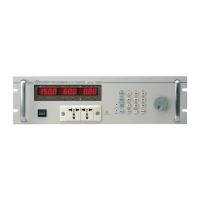
board through a short flat ribbon cable. It comprises of three 4-digit seven-segment LEDs.
Programming of V, F can also be done by rotary knob on the front panel.
4.8 GPIB/RS-232C/External reference
The remote control is done through the GPIB or RS-232C interface on the optional board,
which is connected through the flat ribbon cable from A board. External reference is for the
user to use DC reference to control the amplitude of output AC voltage.


 To Next Page