39
Français
EnglishDeutsch
Italiano
2-2-8.1 Protecting your system
To protect your heating system and avoid all risks of it freezing in case it is intentionally or accidentally
turned off, we strongly advise that you:
z Either drain the water circuit by disconnecting the unit inlet and outlet),
z Or take the following precautions:
Protect your indoor water circuit with a mix of water, antifreeze and corrosion
inhibitor (and, possibly, a biocide). Using a corrosion inhibitor will
also prevent the formation of sludge caused primarily by corrosion.
You may use refrigerants made with monopropylene glycol or a natural compound containing one or more corro-
sion inhibitors (never use monopropylene glycol by itself; always mix it with corrosion inhibitors).
) Do not use products made with monoethylene glycol, which is toxic.
You may use:
z ready-to-use solutions
z dilutable products
If you use a concentrated dilutable solution, following the instructions below:
z Always dilute the antifreeze with water before adding it to the system. Never add them separately.
z Always mix the correct amounts of water, antifreeze and corrosion inhibitor in a container before adding them
to the system.
2-2-8.2 Procedure
1- Rinse and drain the system
z Always flush the system completely and blow it out to remove any remaining water.
z Washing the system with a suitable cleaner is recommended (the type of cleaner depends on the system’s
materials).
z Follow up the final rinse with a complete drain of the system.
L If you have a radiant floor heating system, only use pressurised neutral gas
(compressed air, nitrogen) to blow out the water remaining in the water loops.
2- Add the water, antifreeze, corrosion inhibitor and pressurise with the hydraulic pump
z Drain the system thoroughly.
z Allow the mixture to run through the entire system for at least 2 hours before starting the heat pump.
z Use a hydrometer or a refractometer to check the final proportion obtained.
3- Using litmus paper or a pH meter, check the pH obtained.
4- Affix, in a visible location, a label stating:
z that the system contains antifreeze,
z the name of the product and its supplier,
z the proportion and the pH at commissioning.
L Always top up with the same type of mix initially used.
L Annual maintenance: check the proportion and the pH.
2-2-8 Frost protection (for the account of installer)
Base outdoor
temperature (*)
MPG content
to be used
Freezing
temperature
Setting P1
adjustment
Setting P93
adjustment
-5°C 20% -8°C 1 0
-10°C 30% -15°C 1 -5
-15°C 40% -25°C 1 -10
2-2-8.3 Adjusting settings P1 and P93 based on the glycol content
Table of correspondences among the: base outdoor temperature for the system location
Monopropylene glycol (MPG) content
adjustment values for settings P1 and P93
* Base outdoor temperature: minimum daily temperature recorded at least five times over the course of the year.
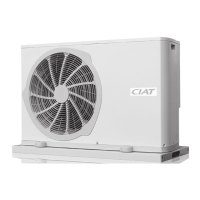
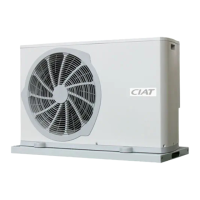
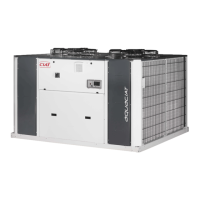
If your Aqualis 2 system is located in an area subjected to below-freezing
temperatures, you must add glycol to the water in it.




 To Next Page