8 9
EN EN
Handing over the unit to the operator:
If there is a delay between the installation/startup of
the unit and transfer to the operator, a manual re-
generation must be performed. The operator must
be told how the unit works as well as how to opera-
te and inspect it. Ensure that the operator receives
the installation and operating manual.
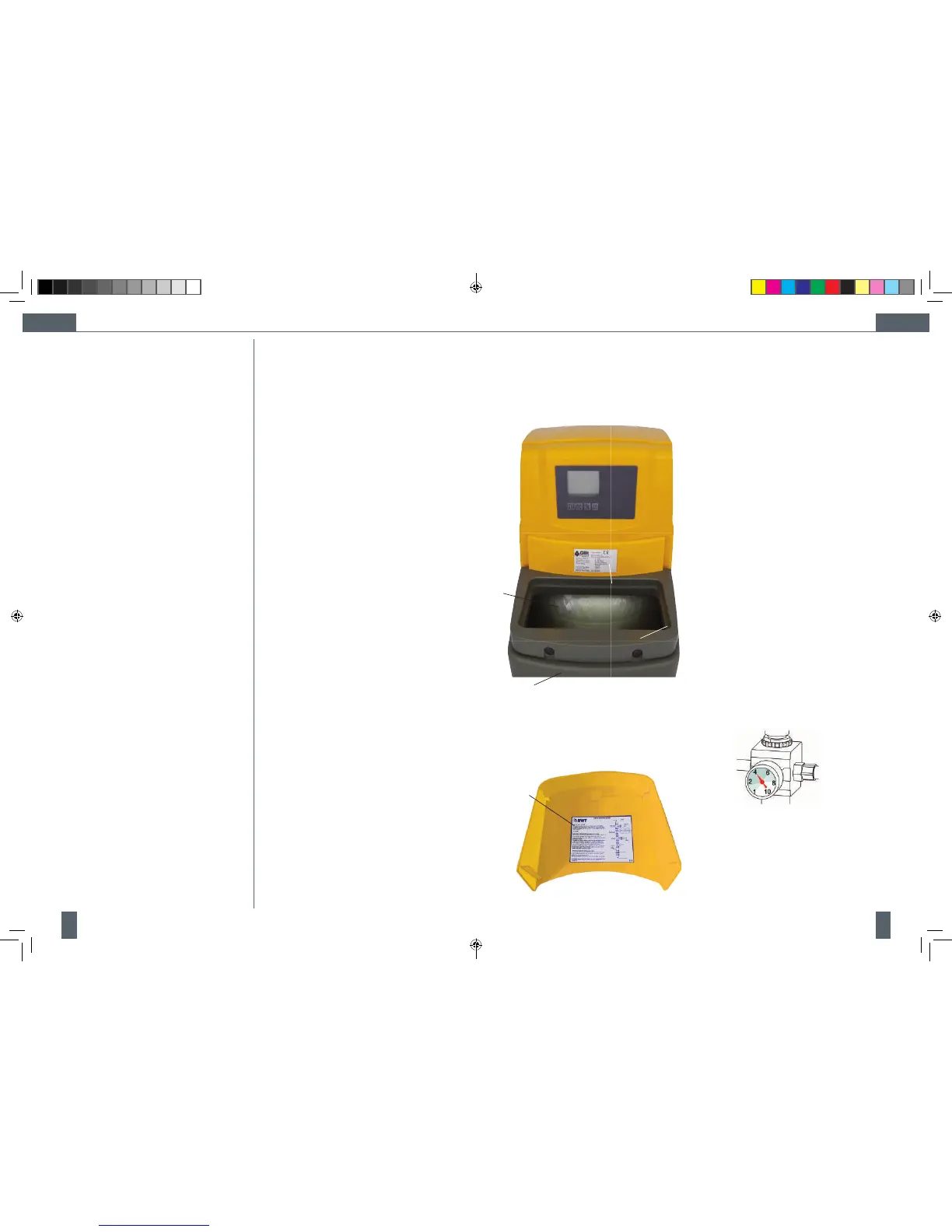
Please open the cover (12):
14. Salt storage
15. Cabinet
16. Fixing material
17. Rating plate and serial number
3.3 Installation and operation conside-
rations
1. Before you begin
The installation of your new water softener is rela-
tively straightforward. However, we would recom-
mend that either a quali ed plumber or a person
with relevant plumbing experience carries out the
installation.
Before embarking on the installation, please ensu-
re you have familiarised yourself with both these
instructions and the components required to com-
plete the installation.
2. Positioning the water softener
Please measure your water softener to ensure that
it will t into the area you are placing the unit into.
PLEASE remember to include additional space for
connecting pipe work in your calculations along
with the regular access that is needed for topping
the unit up with salt and future service.
Where possible, the distance of both the incoming
water supply and nearest drain should be kept to
a minimum. Two metres is an ideal distance, how-
ever, longer distances are permissible, dependant
on the incoming water pressure.
Please remember the weight of your new water
softener will considerably increase once installed
and lled with salt. Therefore, please ensure your
chosen location is strong enough to support an ap-
proximate total weight of (see table). Your new wa-
ter softener has been designed to operate ef cient-
ly and effectively with an incoming water pressure
of between 1.7 to 5.0 bar UK, 1.0 to 8.0 bar EU. If
your water supply is likely to fall outside these
limits, then we would recommend that a boos-
ter pump or pressure reducing valve should be
tted respectively.
Important - Never install the water softener where
it, or its connections (including the drain over ow
lines) will be subject to temperatures under 0°C or
above 40°C.
If you are planning to install the water softener abo-
ve ground level e.g. In the loft,the following instruc-
tions should be strictly adhered to.
3. Installation
3.1 Installation requirements
National guidelines and regulations:
Observe all applicable installation regulations,
general guidelines, hygiene requirements, and tech-
nical speci cations. The hard water to be fed into the
unit must always meet the speci cations of the natio-
nal Drinking Water Ordinance or EU Directive 98/83/
EC. The total dissolved iron and manganese may not
exceed 0.1 mg/l. The hard water to be fed into the unit
must always be free of air bubbles.
Frost protection and ambient temperature:
The installation site must be free of frost and kept
free of chemicals, paint, solvents and fumes. The am-
bient temperature should not exceed 40°C, even
before the machine is started. Please avoid direct heat
sources, e.g. radiators and exposure to sunlight.
General safety:
The rated mains power (see technical data) and the
requisite inlet water pressure must be present at all
times. No protection against a lack of water is provi-
ded. This must be installed on-site if required.
Overpressure and uctuation protection:
Attention: Water pressure must never exceed
the unit‘s maximum of 5.0 bar UK, 8.0 bar EU.
If the network water-pressure is higher than 4.0 bar
UK, 6.0 bar EU (or you are unsure about pressure), a
pressure reducer (pressure reducing valve) must be
installed upstream of the unit.
During pressure fuctuations or surges, the
sum of the pressure surge and the standing
pressure is not to exceed the nominal pressure.
Electrical interference:
The emission of interference (voltage peaks, high-fre-
quency electromagnetic elds, interference voltages,
voltage fuctuations…) by the surrounding electrical
systems may not exceed the maximum values speci-
ed in EN 61000-6-3.
Data analysis of the hard water in your area:
Continuous operation of the water softener with water
containing chlorine or chlorine dioxide is possible if the
concentration of free chlorine/chlorine dioxide does
not exceed 0.5 mg/l.
The type of pre-treatment must be determined in-
dividually.
Principle of intelligent regeneration:
The unit should be sized according your current
water consuption. If water consumption is reduced,e.g.
during holidays, a shut-off device must be fully opened
for at least 5 minutes before water can be used again.
Inlet- and outlet connections:
When installing the unit, select a location where the
unit can easily be connected to the water supply
network. A connection to the waste water system
(at least DN 50), a oor drain and a separate mains
socket (see technical data) must be nearby.
Over ow hose connection:
A suitable over ow hose connection is required to re-
move the waste water.
Preconditions for the hydraulic installation:
Observe the hydraulic and electrical requirements for
installation for rst commission. (see “chapter 5”)
Exclusion of warranty:
Non-compliance with the installation conditions and
the operator responsibilities voids the warranty.
Guarantee:
In the event of a malfunction of the unit during the
guarantee period, please contact your after-sales
service department and quote the model type and
the production number (see technical data or the
rating plate on unit).
Note: Only your local after-sales service staff may
perform any works under the guarantee.
Any work performed by a third party must be
directly commissioned by your after-sales service.
3.2 Initial commissioning
for professional installation by a quali ed tter.
• Has all packaging material (16) been removed
from the brine cabinet?
• Is there a protective lter upstream from the unit
in the immediate vicinity?
• Is the water and power supply to the unit conti-
nuous (network pressure of at least 1.7 bar UK
/1 bar EU)
• Have you opened the pressure reducing valve to
the limit stop?
• Have the water hoses been properly connected?
• (Observe the ow direction arrows and hard
water inlet at the non-return valve of the unit).
• Have the drain water hose and the over ow been
routed separately to the waste water system and
connected? (See Installation)
• Have you informed the operator of the inspection
schedule? (Check supply of salt and hardness of
blended water at least every two months)
• Have you informed the operator of the main-
tenance schedule? (Tasks in accordance with
manufacturer’s instructions. Interval annually,
every 6 months with communal units)
Please check connections and pipeline
junctions for leaks.
Do not operate with a
pressure less than:
1.7 bar UK / 1.0 bar EU
If pressure more than:
5.0 bar UK / 8.0 bar EU
install pressure
reducing valve
Operating
pressure
3.5 bar UK /
4.5 bar EU
17
16
15
14
12
OPM - Cillit Access 10-25 vOrange - EN, DEv4.indd 8-9 02/10/2012 09:48


 To Next Page
 Loading...