
 Need help?
Do you have a question about the Cisco IP 7800 Series and is the answer not in the manual?
Indicates incoming call (flashing red) or new voicemail (solid red).
Access your phone lines, features, and call sessions.
Access to functions and services.
Navigate menus, highlight items, select items, and end calls.
Manage call transfers, holds, resumes, and conference calls.
Enable hands-free calls, mute microphone, and use headset.
Access contacts, applications, messages, and voicemail.
Adjusts the volume of the handset, headset, speaker, and ringer.
Instructions for making internal, on-island, mainland, toll-free, and international calls.
Steps for initiating calls using the handset, speakerphone, or headset.
Methods to terminate calls using the handset, speakerphone, or headset.
Procedures for receiving calls via handset, speakerphone, or headset.
Enables setting up call forwarding to another number or voicemail.
Accessing and reviewing recent calls or call history.
Enabling and disabling the Do Not Disturb feature.
Includes consultative, blind, and direct-to-voicemail transfer methods.
Steps to create a conference call with multiple participants.
Instructions for accessing and managing voicemail messages.
Procedure to select and set a new ring tone for the phone.
The Cisco IP 7800 Series phone is a sophisticated communication device designed for business environments, offering a comprehensive suite of features for efficient call management and collaboration. It serves as a primary tool for making and receiving calls, managing voicemails, and accessing various communication services.
The core function of the Cisco IP 7800 Series phone is to facilitate voice communication. It supports internal calls, allowing users to dial a 4-digit extension for colleagues within the same organization. For external calls, it handles both on-island and neighbor island calls using a 7-digit number, as well as mainland calls requiring a 10-digit number (area code + number). Toll-free calls also follow the 10-digit format. International calls are supported by dialing "011" followed by the country code, city code, and local number.
The phone provides multiple methods for placing and answering calls, catering to different user preferences and situations. Calls can be placed using the handset, speakerphone, or an optional headset. When using the handset, a number is entered, and the handset is picked up. For speakerphone use, the number is entered, and the speakerphone button is pressed. With a headset connected, the number is entered, and the headset button is pressed. Answering calls follows a similar pattern: picking up the handset, pressing the speakerphone button, or pressing the headset button.
Call management features are extensive. The phone allows users to transfer calls in two ways: consultative transfer (with announcement) and blind transfer (without announcement). Consultative transfer involves placing the active call on hold, dialing the contact number, announcing the call to the new party, and then pressing the transfer button again. Blind transfer, on the other hand, involves pressing the "Blind Xfer" softkey, dialing the contact number, and the call is transferred without an announcement. Calls can also be transferred directly to voicemail by pressing the transfer button, dialing "*55," and following the voice prompts.
Conference calling is another key feature, enabling users to set up 3-way conferences. To create a conference, an active call is placed on hold by tapping the "Conference" softkey. The number of the party to be added is then dialed, and once they answer, the "Conference" softkey is tapped again to connect the conference call.
Voicemail access is integrated, allowing users to retrieve messages by pressing the "Messages" button and following the voice prompts. For specific lines, messages can be checked by pressing the corresponding line button first.
Call forwarding is available, allowing users to redirect incoming calls. This can be set up by pressing the softkey until "Forward" appears, then pressing "Forward" again, entering the destination number, or pressing "*55" to send all calls directly to voicemail. To disable call forwarding, the "Clr fwd" softkey is pressed.
The phone also includes a "Do Not Disturb" (DND) feature, which can be enabled by scrolling to DND and pressing the softkey or dialing "*78." To disable DND, the "Clr DND" softkey is pressed or "*79" is dialed.
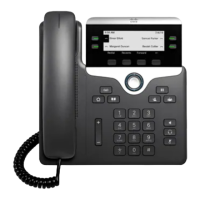
The Cisco IP 7800 Series phone is designed for intuitive use with a clear display and well-organized buttons. The handset light strip serves as a visual indicator for incoming calls (flashing red) or new voicemails (solid red). Line keys and feature buttons provide quick access to phone lines, features, and call sessions. Softkey buttons, located below the display, offer context-sensitive functions and services, changing based on the current activity.
Navigation through menus and options is facilitated by the navigation ring, which allows users to scroll through items, highlight them, and select them. The "Back" button returns to the previous screen or menu, while the "Release" button ends a connected call or session.
Dedicated buttons for common functions enhance usability. The "Transfer" button initiates call transfers, while the "Hold/Resume" button places an active call on hold and resumes held calls. The "Conference" button is used to create conference calls.
For hands-free communication, the speakerphone button allows users to make and receive calls without using the handset or headset. The mute button enables or disables the microphone during an active call, indicated by the button being lit when enabled. The headset button allows users to receive and make calls using an optional headset.
The phone also provides access to "Contacts" for personal and company directories, "Applications" for recent calls, user preferences, and phone settings, and "Messages" for automatically connecting to the voicemail box.
The volume button, located on the side of the phone, adjusts the volume of the handset, headset, speaker, and ringer, allowing users to customize their audio experience.
Users can view their call history by selecting a line, pressing the "Recents" button or softkey, and then scrolling through and selecting "Recents."
Personalization options include changing the ring tone. This is done by pressing the "Applications" button, selecting "User preferences," then "Audio preferences," and finally "Ext (n) - Ring tone." Users can scroll through a list of ringtones, press "Play" to hear a sample, and then "Select" and "Set" to save their selection. The back arrow button is used to exit these settings.
While the manual primarily focuses on operational features, some aspects can be considered related to user-level maintenance or troubleshooting. For instance, the "Phone Guides & Online Training" available at hawaiiantel.com/VoiceSupport serves as a resource for users to understand and troubleshoot common issues or learn advanced features. The "Customer Support" line (808) 643-0778 provides direct assistance for any problems encountered. The "Web Portal" at https://bvoip.hawaiiantel.com likely offers additional resources, account management, and possibly firmware updates or service information, which contribute to the overall maintenance and optimal functioning of the device.
The note regarding call forwarding for the office main line ("To call forward the office main line, contact your administrator") indicates that certain administrative functions are managed centrally, ensuring system integrity and proper configuration. This implies that complex system-level maintenance and configuration are handled by IT administrators rather than individual users, simplifying user experience and preventing accidental misconfigurations.
The device's design, with clear button labels and a logical menu structure, inherently reduces the likelihood of user errors, contributing to its ease of use and minimizing the need for frequent troubleshooting. The visual indicators, such as the handset light strip and lit buttons for speakerphone and mute, provide immediate feedback on the phone's status, helping users to quickly identify and resolve minor operational issues.
 General
| Signaling Protocol | SIP |
|---|---|
| Full-duplex speakerphone | Yes |
| Wall-mountable | Yes |
| Bluetooth | No |
| Wireless | No |
| Ethernet | 10/100/1000 Mbps |
| PoE | IEEE 802.3af Power over Ethernet (PoE) |
| Security | Secure boot |
| Supported Protocols | SIP |
| Codecs | G.711, G.722, G.729, iLBC |
| Power Options | PoE |




 To Next Page