27
Section 1 - Furnace Installation
Radiant Floor System Installations
Installing radiant oor (ceiling) heating is a very viable
heating option when either remodeling or building new.
Radiant oor heat can also be added to an existing home
easily if the oor joists are exposed (as in an unnished
basement). Piping may be installed in a wide variety of
congurations and locations including, but not limited
to, the following:
• In a concrete slab
• Within the suboor system (e.g., Gyp-Crete
®
)
• Within the oor joist system
• Within the walls or ceilings
When installing tubing between oor joists (16" on
center) run two 1/2" tubes between each joist. Insulate
below the piping to prevent excessive heat in the lower
level.
Proper insulation is key to effective radiant heating
and controlling large heat demands. Heat from this
type of system radiates equally in all directions. As
an example, if piping is installed in a slab, the ground
below the slab must be dry and well-insulated. If not
properly insulated, nearly 50% of the heat will be
wasted warming the ground below the slab. Two inches
of blueboard insulation is recommended. Two 1" layers
of blueboard can be used. This allows lapping of the
joints in the 4' x 8' sheets.
NOTE: Do not use beadboard (expanded
polystyrene), bubble foil or roll-out foam
insulation.
NOTE: A minimum of one inch of insulation should
be used. Two inches of insulation and vapor
barrier below the insulation is recommended.
Areas with high water tables need to be prepared
properly to prevent contact between the ground water
and insulation.
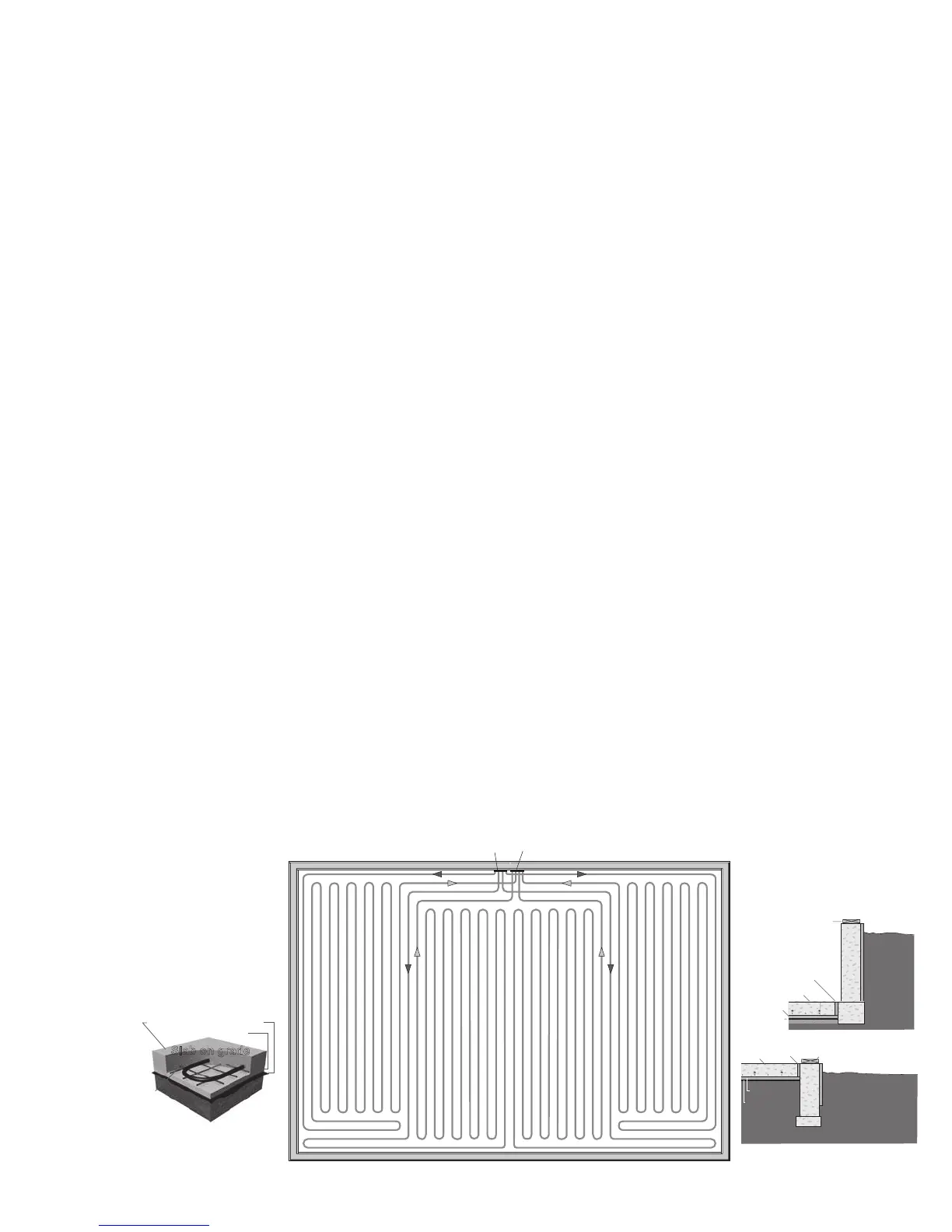
For examples of radiant heating systems using 1/2"
tubing in the loops, refer to Fig. 33 through Fig. 36.
The spacing of each circuit should be 12" between tubes.
The water circulates in opposite directions to provide an
even distribution of heat. The mixing valve regulates
the temperature of the water circulating through the
loops by mixing return water with the hot supply water.
In applications where high heat loss is expected, loop
spacing may be reduced to 10" or less. If additional
information is desired, contact your dealer.
NOTE: The longer the loop length, the lower the
ow rate and the lower the heating capacity.
Loop lengths greater than 350 feet (107 m) are
not recommended.
NOTE: The temperature of the water used in
radiant heating should be determined by the
installer in accordance with the application.
NOTE: It is not uncommon that it can be very
difcult to get a concrete slab up to temperature
in late fall or early winter in a new building that
is not completely sealed and not well insulated.
Once the building is completely sealed and well
insulated, bringing the slab up to temperature
can still take a considerable amount of time and
wood; however, once warm, wood consumption
will be reduced if the concrete slab and building
are insulated properly .
NOTE: For zone installations, refer to Fig. 34
(multi-zone) or Fig. 36 (single zone).
Insulation
Insulation
Poly Vapor
Barrier
Soil/Sand
Slab
Footing
Ground Level
Plate
Slab on grade
Slab
Wire
Mesh
Insulation
Vapor Barrier
2" Blueboard Styrofoam
®
is recommended (minimum
of 1" Blueboard Styrofoam
®
).
Basement
Insulation
Insulation
Poly Vapor
Barrier
Soil/Sand
Slab
Footing
Ground
Level
Plate
(For Slab on Grade or Basement)
Hot Supply
Return
© 2013 Central Boiler
NOTE: If the temperature of the
concrete slab is below freezing
(32˚F), there must be adequate
antifreeze in the system, or the
slab must be pre-heated, before
water is circulated through the
radiant slab system.
Fig. 33


 To Next Page