31
Section 1 - Furnace Installation
FINALIZING THE INSTALLATION
Before ring the outdoor furnace for the rst time,
perform the following important steps:
1. Remove the strapping securing the vent cap. The
vent cap must t loosely over the outdoor furnace
vent.
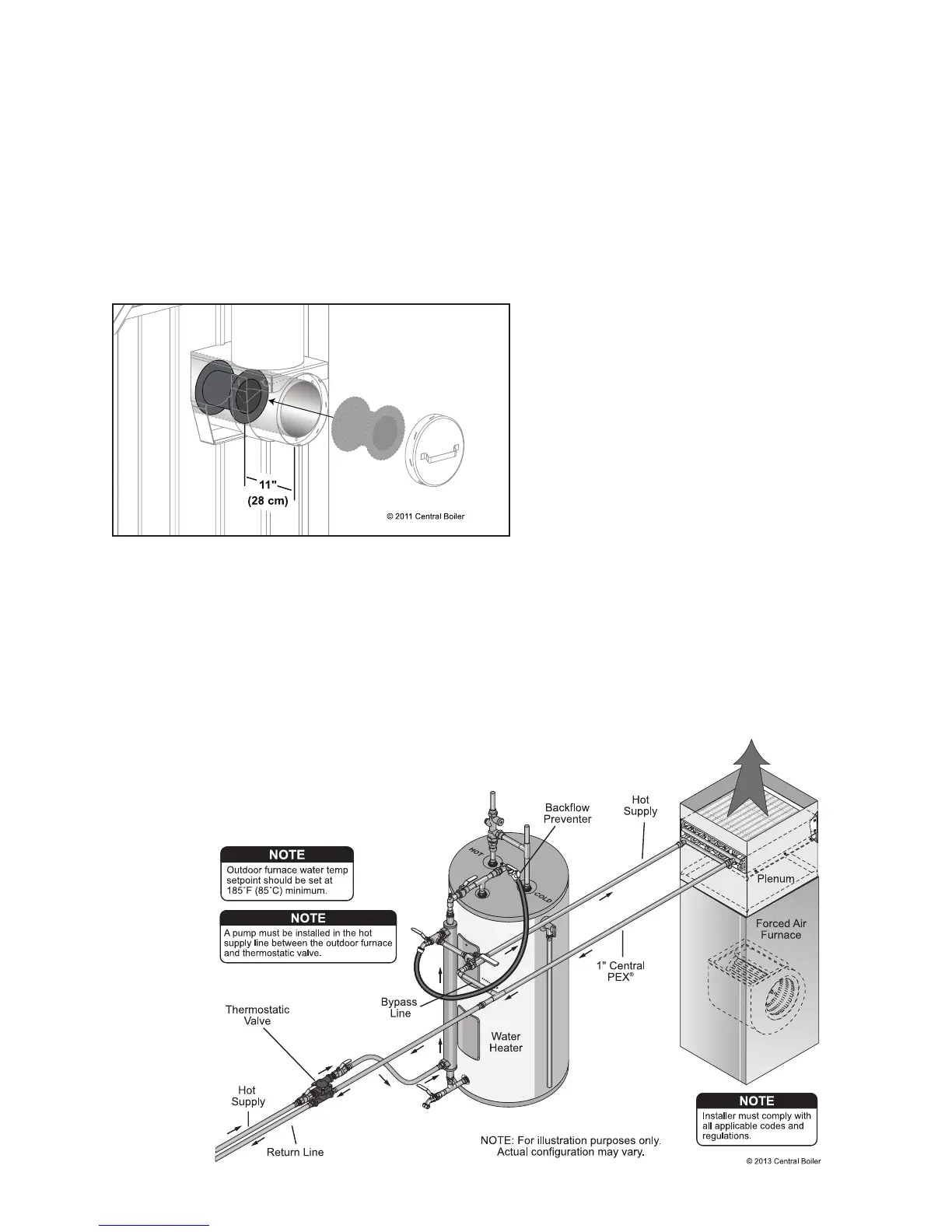
2. 4030 Models Only - Remove and discard the
shipping tape securing the chimney restrictor; then
position the chimney restrictor about 11" in from the
end of the chimney tee as shown in Fig. 39.
Fig. 39
3. Check for leaks. Close the valves on the outdoor
furnace before checking for leaks. Do not pressurize
the outdoor furnace. Pressure-test the entire plumbing
system. Apply 50 psi (3.5 kg/cm
2
) of air pressure for
thirty minutes and closely monitor for any pressure
loss. Inspect all ttings and hose ends for any signs
of leakage using leak detection solution (leak soap);
repair as necessary.
4. Cover Supply and Return Lines. Backll the
trench for the supply and return lines. Enclose the
area where the supply and return lines enter the
outdoor furnace. Do not leave the PEX hot supply
and return lines exposed to sunlight as exposure to
UV rays will damage them.
5. Add Corrosion Inhibitor Plus™. Add Corrosion
Inhibitor Plus™ (p/n 1650) through the 2-inch vent
pipe on the outdoor furnace before lling with water
to immediately begin to protect the steel. Refer to
Water Quality and Maintenance.
6. Fill with water, purge air from system and verify
ow direction of the water. See Filling Outdoor
Furnace with Water and Purging Air for details.
FILLING OUTDOOR FURNACE WITH WATER
AND PURGING AIR
All air must be purged from the water lines when lling
the system. Also, the circulation pump(s) must be
installed in the hot supply line(s).
NOTE: Refer to Fig. 40 when performing these
steps.
NOTE: If using the valve on the water heater to
ll the outdoor furnace, ush the water heater
to remove all sediment before lling the outdoor
furnace.
NOTE: If the outdoor furnace is being lled with
water when the temperature is below freezing,
circulate the water immediately after lling to
prevent freezing the water lines.
Fig. 40


 To Next Page