4
Part Number: 02805 Rev AA February 2017
SAFETY PRECAUTIONS
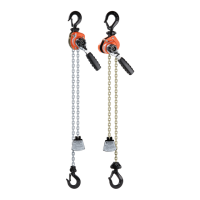
Each Series 602/603 Manually Operated Lever Hoist is built in accordance with the specifications contained herein and at the time of
manufacture complies with our interpretation of applicable sections of *ASME B30.21, *ANSI/ASME HST-3M and the Occupational Safety
and Health Act-1970.
The safety laws for elevators and for dumbwaiters specify construction details that are not incorporated in CM industrial hoists. We
recommend the use of equipment that meets state and national safety codes for such use. Columbus McKinnon Corporation cannot be
responsible for applications other than those for which CM equipment is recommended.
THIS SYMBOL POINTS OUT IMPORTANT SAFETY INSTRUCTIONS WHICH IF NOT FOLLOWED COULD ENDANGER THE PERSONAL SAFETY AND/OR
PROPERTY OF YOURSELF AND OTHERS. READ AND FOLLOW ALL INSTRUCTIONS IN THIS MANUAL AND ANY PROVIDED WITH THE EQUIPMENT
BEFORE ATTEMPTING TO OPERATE YOUR SERIES 602/603 LEVER HOIST.
*Copies of this standard can be obtained from ASME Order Department, 22 Law Drive, Box 2300, Fairfield, NJ 07007-2300, U.S.A.
Improper operation of a hoist can create a potentially hazardous situation which,
if NOT avoided, could result in death or serious injury. To avoid such a potentially
hazardous situation, the operator shall:
1. NOT operate a malfunctioning or unusually performing hoist.
2. NOT operate the hoist until you have thoroughly read and understood this
manual.
3. NOT operate a hoist which has been modified without the manufacturer’s
approval or certification to be in conformity with applicable oSHA
regulations.
4. NOT lift or pull more than rated load for the hoist.
5. NOT use damaged hoist or hoist that is NOT working properly.
6. NOT use hoist with twisted, kinked, damaged, or worn load chain.
7. NOT operate with any lever extension (cheater bar).
8. NOT attempt to “free chain” the hoist while a load is applied.
9. NOT use the hoist to lift, support, or transport people.
10. NOT lift loads over people and make sure all personnel remain clear of
supported load.
11. NOT attempt to lengthen the load chain or repair damaged load chain.
12. Protect the hoists load chain from weld splatter or other damaging
contaminants.
13. NOT operate a hoist when it is restricted from forming a straight line from
hook to hook in the direction of loading.
14. NOT use load chain as a sling or wrap load chain around load.
15. NOT apply the load to the tip of the hook or to the hook latch.
16. NOT apply load unless load chain is properly seated in the chain wheel(s) or
sprocket(s).
17. NOT apply load if bearing prevents equal loading on all load supporting
chains.
18. NOT operate beyond the limits of the load chain travel.
19. NOT leave load supported by the hoist unattended unless specific
precautions have been taken.
20. NOT allow the chain or hook to be used as an electrical or welding ground.
21. NOT allow the chain or hook to be touched zby a live welding electrode.
22. NOT remove or obscure the warnings on the hoist.
23. NOT operate a hoist which has NOT been securely attached to a suitable
support.
24. NOT operate a hoist unless load slings or other approved single
attachments are properly sized and seated in the hook saddle.
25. NOT lift loads that are NOT balanced and the holding action is NOT secure,
taking up slack carefully.
26. NOT operate a hoist unless all persons are and remain clear of the
supported load.
27. Report malfunctions or unusual performances of a hoist, after it has
been shut down until repaired.
28. NOT operate a hoist on which the safety placards or decals are
missing or illegible.
29. Be favmiliar with operating controls, procedures and warnings.
Improper operation of a hoist can create a potentially hazardous situation
which, if not avoided, could result in minor or moderate injury. To avoid
such a potentially hazardous situation, the operator shall:
1. Maintain a firm footing or be otherwise secured when operating the
hoist.
2. Check brake function by tensioning the hoist prior to each
lift operation.
3. Use hook latches. Latches are to retain slings, chains, etc. under
slack conditions only.
4. Make sure the hook latches are closed and not supporting any parts
of the load.
5. Make sure the load is free to move and will clear
all obstructions.
6. Avoid swinging the load or hook.
7. Make sure hook travel is in the same direction as shown
on the controls.
8. Inspect the hoist regularly, replace damaged or worn parts, and keep
appropriate records of maintenance.
9. Use the hoist manufacturer’s recommended parts
when repairing the unit.
10. Lubricate load chain per hoist manufacturer’s recommendations.
11. NOT use the hoist load limiting or warning device
to measure load.
12. NOT use limit switches as routine operating stops unless allowed by
manufacturer. They are emergency devices only.
13. NOT allow your attention to be diverted from operating
the hoist.
14. NOT allow the hoist to be subjected to sharp contact with other
hoists, structures, or objects through misuse.
15. NOT adjust or repair the hoist unless qualified to perform such
adjustments or repairs.
The hoists are intended for general industrial use for moving loads
within their load ratings. prior to installation and operation, the user
should review the application for abnormal environmental or handling
conditions.
GENERAL SAFETY INFORMATION
ADVERSE ENVIRONMENTAL CONDITIONS
Do not use the hoists in areas containing flammable vapors, liquids,
gasses or any combustible dust or fibers. Do not use the hoist
in highly corrosive, abrasive, wet environments or in applications
involving exposure to temperatures below -10ºF or above 130ºF.
MOVING HAZARDOUS LOADS
The hoists are not recommended for lifting materials that could
cause widespread damage if dropped. The lifting or moving of
materials that could explode or cause chemical or radioactive
contamination requires fail-safe, redundant supporting devices
that are not incorporated into these hoists.


 To Next Page
 Loading...