CMT2310A
Rev 1.0E | Page22/50
4.3.6 Received Signal Strength Indicator(RSSI)
RSSI is used to evaluate the signal strength inside the channel with a detection range of -127 to 20 dBm. On RFPDK tool, users
can configure the parameter RSSI Detect Mode to choose whether output real-time RSSI value or latch the RSSI values in
different data packet processing states.
CMT2310A allows users to configure RSSI detection threshold through RFPDK parameter RSSI Compare TH. This threshold
value will be compared with the RSSI detection value. If the RSSI detection value is larger than the threshold it outputs logic 1,
otherwise outputs logic 0.The comparison result output can be used as a source of the RSSI VLD interrupt,or used to support
internal super-low power (SLP) mode operating.
4.3.7 Phase Jump Detector(PJD)
PJD is Phase Jump Detector. When the chip is in 2-FSK demodulation, it can automatically observe the phase jump
characteristics of the received signal to determine whether it is a noise or useful signal.
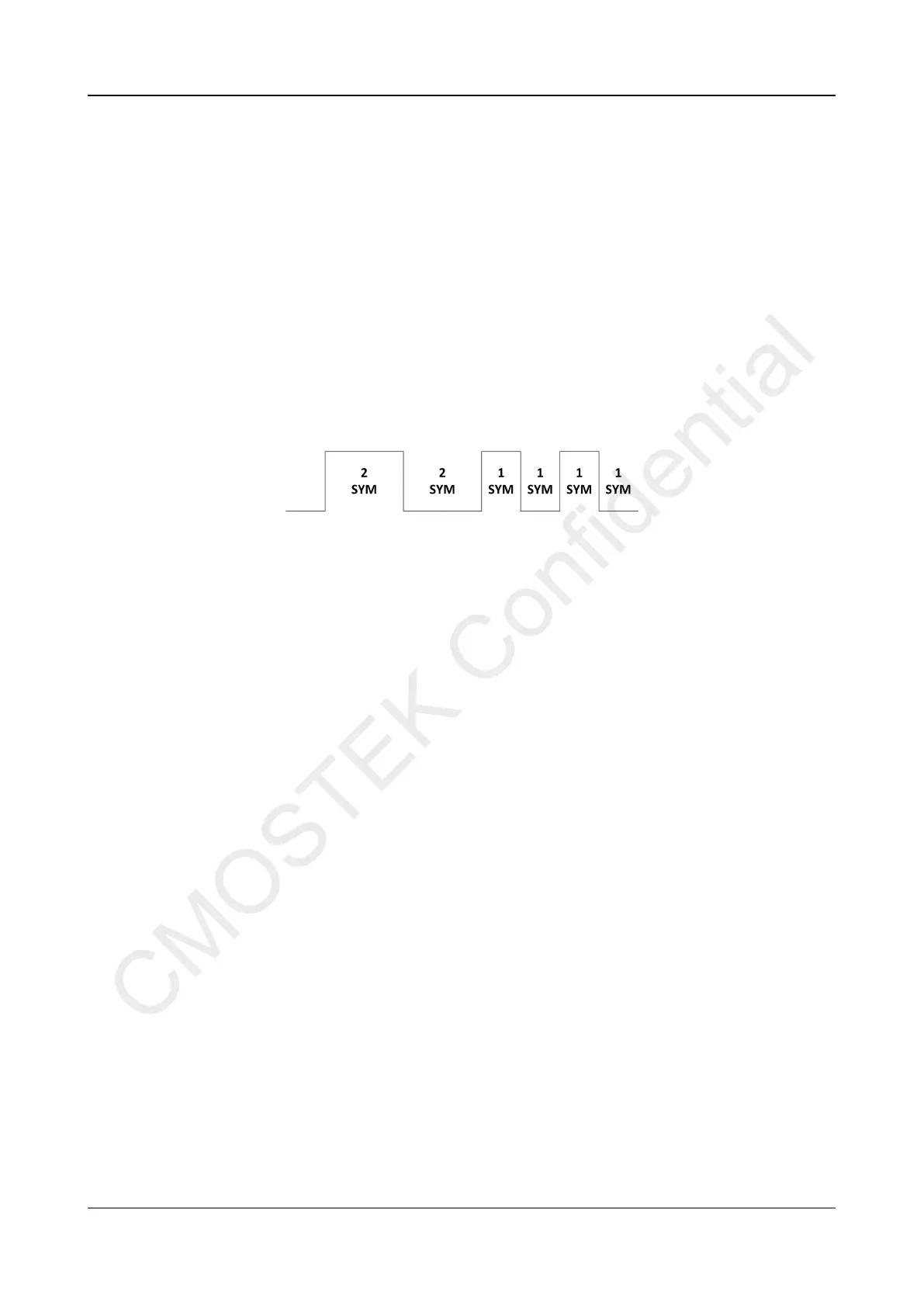
Figure 8. Received Signal Jump Diagram
The PJD mechanism regards input signals witching from 0 to 1 or from 1 to 0 as a phase jump. Users can configure
PJD_WIN_SEL<1:0> to determine the number of detected jumps for the PJD to identify a wanted signal. As shown in the figure
above, in total 8 symbols received, the phase jump appears only 6 times. Therefore, the number of jumps is not equal to the
number of symbols received. Only in the preamble receiving period they are equal.In general, the more jumps are used to identify
the signal, the more reliable the result; the less jumps are used, the faster the result is obtained. If the RX time is set to a relatively
short period, it is necessary to reduce the number of jumps to meet the timing requirements.Normally,4 jumps allow pretty reliable
result, namely the chip will not mistakenly treat an incoming noise as a wanted signal, and will not treat a wanted signal as noise
either.
To detect signal phase jump is actually to detect whether the signal has the expected data rate. Meanwhile, the PJD will also
automatically detect the signal deviation to see if it meets the valid signal value criteria, as well as to see if the SNR is over 7 dB.
Then by considering data rate, deviation, and SNR detecting results, the PJD makes judgment.If a signal is judged as a reliable
signal, it outputs logic 1, otherwise outputs logic 0.The output can be used as a source of the RSSI VLD interrupt, or output
internally to support the super-low power (SLP) mode operating.In direct data mode, when setting the DOUT_MUTE register bit to
1, the PJD mechanism can be utilized to fulfill the mute function of FSK demodulation output.
The PJD technique is similar to traditional carrier sense (CS) technique but more reliable. By combining PJD technique with RSSI
detection, users can accurately identify the idle/busy status of the current channel.
4.3.8 Automatic Frequency Control (AFC)
The AFC mechanism allows the receiver to minimize the frequency error between the TX and RX in a very short time once a
wanted signal come in.This helps the receiver to maintain an optimized sensitivity performance. CMT2310A provides an
competitive AFC technology in the industry, that is, within the same bandwidth, the CMT2310A can identify larger frequency error,
and remove the error in a much shorter time ( 8-10 symbols ).
Normally the frequency variance between the TX and RX is caused by the frequency variance of the crystal oscillators used in
the both sides. The CMT2310A allows users to fill in the crystal tolerance value (in PPM) of TX and RX on RFPDK. Based on the
crystal tolerance value, the RFPDK configures the AFC detecting range meanwhile trying to minimize the bandwidth used by the
receiver. With the excellent performance of the AFC, the product offers a favorable solution to the crystal aging problem which
will lead to more frequency variance as time goes on.Therefore, comparing with other similar transceiver chips in the industry, the
CMT2310A can settle down more severe crystal aging problems and extend product life time effectively.


 To Next Page