COLASIT AG
Plastic construction
CH-3700 Spiez
Phone +41 (0)33 655 61 61 Fax +41 (0)33 654 81 61
TD-000 796-E
Edition 10/2019, Subject to alteration
Copyright by COLASIT AG Spiez
7 Maintenance, repair, cleaning
7.1 Preparation
Before any work is carried out on the fan, the fan must be set to its "safety
position".
The „safety position“ is defined as follows:
- The drive must be currentless and the main switch secured against switching on,
- The fan impeller can be manually rotated,
- Fan must be flushed with fresh air and be condensate-free,
- Fan must be at room temperature,
- Personal protective equipment must be available and it must be worn. (Use of protective gloves
because of sharp edges, ear protectors if necessary).
- A sign, e.g. „Under-repair“, must be attached to the system,
- The safety devices may be removed,
- The work to be carried out must not be done under time pressure,
- The general and specific regulations on accident prevention as well as the EKAS guidelines
(Switzerland) must be observed,
- The safety officer must be informed about the nature and course of the work,
If the intake and delivery ducts of the fan are dismounted for a longer period of time, the openings must be
closed off.
7.2 Performance
The fan must be maintained in accordance with the Maintenance Plan below. The maintenance work carried
out must be noted down in the logbook (see the section on Logbook).
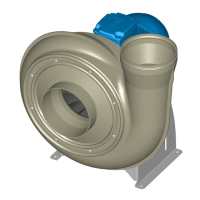
• Make a visual inspection of fan for
damage, leaks, corrosion and
attachment.
• Check the smooth running of the fan
and electric motor.
• Check state and tension of the V-
belt and replace if necessary.
• Check the impeller and casing for
deposits and clean if necessary.
• Check the shaft bearing for smooth
running and vibrations. Bearing
maintenance -> see chart below
for regreasing intervals.
• Remove any dust deposits on the
fan and motor.
• Check the flexible transitions from
fan to duct system for leaks and
state.
• Check the function of the
condensate nozzle.
• Check the state of the vibration
dampers.
• Check the state of the hub gasket
(if fitted).
• Carry out a thorough cleaning of
the entire fan (including impeller).
• Check the parts in contact with the
conveyed medium for corrosion.
• Check the minimum clearance
between the impeller and casing
(minimum 1% of intake diameter,
maximum 20mm).
• Measure the vibrations at bearings
(KA) or motor (DA). Alarm
according to ISO 14694: ≤ 3.7 kW,
categorie BV-2: 14.0 mm/s (r.m.s.)
or ≤ 300 kW, categorie BV-3: 11.8
mm/s (r.m.s.).
• Check the safety devices (e.g.
splinter protection or intake
grating) for condition and function.
• Check the stands for damage and
stability.
• Check all screw unions for firm
seating.
Normally the bearings are designed for a service life of 40,000 hrs. After this
period the bearings must be replaced. The service life of the bearings is reduced
when subjected to increased requirements (e.g. high temperature, aggressive
ambient air or operation with frequency converter).
On drives with V-belts, check the tension regularly and monitor the belts closely particularly during the first
weeks of operation. This also applies after long periods of downtime. Excessive tension leads to bearing
damage, insufficient tension leads to slip, wear and frictional heat.



 To Next Page