Need help?
Do you have a question about the Comelit 1406 and is the answer not in the manual?
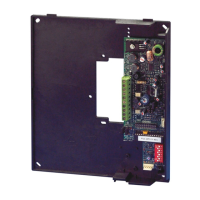
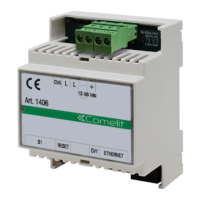
The Comelit Simplebus2 module, identified as Art. 1406, is a versatile device designed for integration into video intercom systems, particularly those utilizing the Simplebus2 protocol. It serves as a core component for managing and distributing audio, video, and data signals within residential, commercial, and industrial settings. The module facilitates communication between various system elements, including external units, internal monitors, and other Simplebus2 devices. Its primary function is to expand the capabilities of a Simplebus2 system, allowing for the connection of multiple apartments or users and enabling advanced features such as video streaming to smartphones/tablets via the SimpleApp.
The Art. 1406 module acts as a central hub for Simplebus2 installations, enabling the connection of up to 50 apartments or users. It supports both Simplebus2 and Simplebus2 Top systems, ensuring compatibility with a wide range of Comelit products. The module processes and routes audio and video signals, ensuring clear communication throughout the system. It also manages data for various functions, including call forwarding, door opening commands, and system configuration.
A key feature of the Art. 1406 is its integration with the Comelit SimpleApp. This application allows users to receive video intercom calls directly on their smartphones or tablets, view live streaming from the external unit, and manage other system functions remotely. The module facilitates the necessary data exchange to enable this functionality, providing enhanced convenience and accessibility for users.
The device supports multi-user configurations, meaning that multiple apartments can be connected to a single module, each with its own internal units. This makes it suitable for multi-dwelling units and larger installations. The module also includes an Ethernet port, allowing for network connectivity and integration with IP-based systems, further expanding its versatility.
The Art. 1406 module operates within a power supply range of 12-56 VDC, making it adaptable to various power infrastructures. Its power consumption is relatively low, with a minimum consumption of 0.96 W at 12VDC and a maximum consumption of 3.7 W at 56VDC. This efficiency contributes to lower operating costs and reduced environmental impact.
For audio signals, the maximum absorption is 3 W at 12VDC and 1.6 W at 56VDC. For video signals, the maximum absorption is 3.7 W at 56VDC. These specifications ensure stable performance even under heavy load conditions.
The module features two Simplebus2 bus line connections:
The operating temperature range for the module is between -5°C and 50°C, making it suitable for installation in various indoor environments. The relative humidity (RH max.) is 95%, indicating its resilience to humid conditions. The module's dimensions are 4 DIN modules, measuring 90x70x59 mm, which allows for compact installation in standard electrical panels.
The Art. 1406 module offers flexible configuration options to adapt to different system requirements. It includes DIP-switches (S1) for setting the Simplebus address, allowing for precise identification and communication within the system. These switches enable installers to assign unique addresses to each module, supporting complex multi-apartment configurations.
The module provides visual feedback through LED indicators, which display the operating status, such as power on, data transmission, and error conditions. These LEDs help in quick diagnostics and troubleshooting during installation and operation. The module also features a reset button, which can be used to restore factory settings or restart the device.
Configuration of the module is typically performed through a combination of DIP-switch settings and software-based tools. The SimpleApp, for instance, can be used to register new accounts, link devices, and manage call forwarding settings. This dual approach provides both granular hardware control and user-friendly software management.
The module supports various types of internal units, including those with audio-only and audio/video capabilities. It ensures seamless integration with these units, providing a consistent user experience across the system. The Ethernet port allows for remote access and management, facilitating maintenance and updates without requiring physical presence at the installation site.
Maintenance of the Art. 1406 module primarily involves periodic checks of its operational status and ensuring proper connectivity. The LED indicators provide immediate visual cues for any anomalies, allowing technicians to quickly identify and address issues.
The reset button can be used to restore the module to its factory default settings, which can be useful for troubleshooting or reconfiguring the device. This feature helps in resolving software-related issues or preparing the module for a new installation.
Firmware updates can be performed to enhance functionality, improve performance, or address security vulnerabilities. These updates are typically managed through the Comelit technical support channels or via the SimpleApp, ensuring the module remains up-to-date with the latest features and improvements.
The module's robust design and adherence to international standards contribute to its long-term reliability, minimizing the need for frequent maintenance. In case of hardware failure, the modular design allows for easy replacement of the unit, reducing downtime and service costs. The availability of comprehensive documentation, including technical manuals and configuration guides, further supports maintenance efforts, providing detailed instructions for installation, configuration, and troubleshooting.
 General
| Brand | Comelit |
|---|---|
| Model | 1406 |
| Category | Control Unit |
| Language | English |

 To Next Page