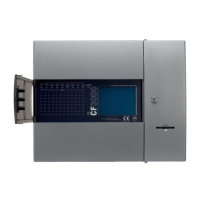
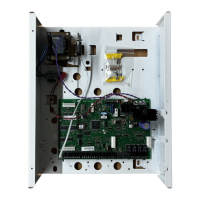
Removal of Front Panel
Assembly
Refer to Figure 3 for part locations. The view may differ
slightly for different versions of the Form 4C control.
Proceed as follows:
1. Remove the control from service. Follow all locally
approved safety regulations, practices, and proce-
dures. Refer to S280-77-1 Kyle Form 4C
Microprocessor-Based Recloser Control Installation
and Operation Instructions prior to removal of panel.
A. Set Ground Trip Block switch to BLOCK.
B. Disconnect control cable from the control.
C. De-energize/disconnect ac power from the control.
D. Unplug the control battery.
2. Disconnect the battery connector.
3. Disconnect the front panel ground strap by removing
the grounding nut on the back panel. Discard ground
strap.
4. Disconnect cable plug from the standard I/O Board
socket P7. Release the cable from the ty-wraps and
cable clamps.
Note: Newer Form 4C controls also use cable clamps.
5. Disconnect the cable plug from power supply plug
P12. Release the cable back panel cable clamps.
6. If the control is equipped with an optional I/O board,
disconnect the cable plug from socket P15 on the
optional I/O board. Release the cable from the ty-
wraps and cable clamps if present.
7. Remove and retain the cable clamp hardware from
the top right corner of the front panel assembly.
Disconnect the cable plug from socket P2.
8. Disconnect the panel door-stop link by removing the
spring clip and hinge pin. Retain for later use.
9. Remove the existing control panel by lifting the panel
off it’s slide hinges.
S280-77-13
5
CAUTION: Recloser misoperation. The control
must be removed from service before discon-
necting the control battery. Disconnecting the control
battery from an in-service control may cause recloser
misoperation (unintentional operation). Failure to com-
ply can result in equipment damage and personal
injury. T213.4
CAUTION: Equipment damage. Always wear a
grounding wrist strap to control static electricity before
handling circuit boards. Failure to use this strap may
result in circuit board damage. T253.1
CAUTION: Control damage. De-energize both
ac and dc power prior to removing or installing
any internal connections or circuit boards in the con-
trol. Failure to comply can result in damage to the con-
trol. T241.1
IMPORTANT: Electro-static discharge. All micro-
processor equipment is subject to electrostatic dis-
charge (ESD) damage which can affect programming
or result in component degradation or failure.
To prevent possible ESD damage to circuit boards,
make sure of the following when removing, handling,
or installing circuit boards:
• Make sure the control is grounded.
• Use a grounding wrist strap connected to the con-
trol ground connection.
• Always transport and store circuit boards in static-
free packaging.


 To Next Page