attics, that consist of a single space, the air is most easily taken in at one end and evacuated at the
other. For more complex attics with several spaces as the images above illustrate, ensure that the air
can pass between the spaces. Seal unnecessarily long air gaps in order to control the flow optimally.
If there are no gable vents, or, if for aesthetic reasons you do not want to use them, or if they are
positioned so that any noise can be disturbing, ventilation can instead occur through a roof hood. A
hood is not supplied and must be purchased separately. Install according to its instructions. In these
cases a diameter equal to the supply air fan's duct is recommended to achieve the correct air flows.
Electrical socket
An earthed electrical socket, 1-phase 230VAC, fused up to 16A with earth-fault breaker must be
available, and if such is to be installed new, place it near the entrance to the attic for easy access to
the control unit. NOTE! Check the location of the control unit in relation to the fan and sensors so
that the 15m long cables are long enough for the intended installation.
Sealing the attic.
This should of course be done in different ways for different houses and house constructions. The
principle works best the better sealed the attic is against outdoor air. The idea is that all air that
ventilates the attic should be controlled by the equipment to create the best conditions to keep the
moisture levels down. The following is only a general description intended to give an understanding
of what has to be achieved and knowledge of some different materials that may come into question.
If in doubt about what kind of material and which principle is best suited for the relevant house,
consult a professional.
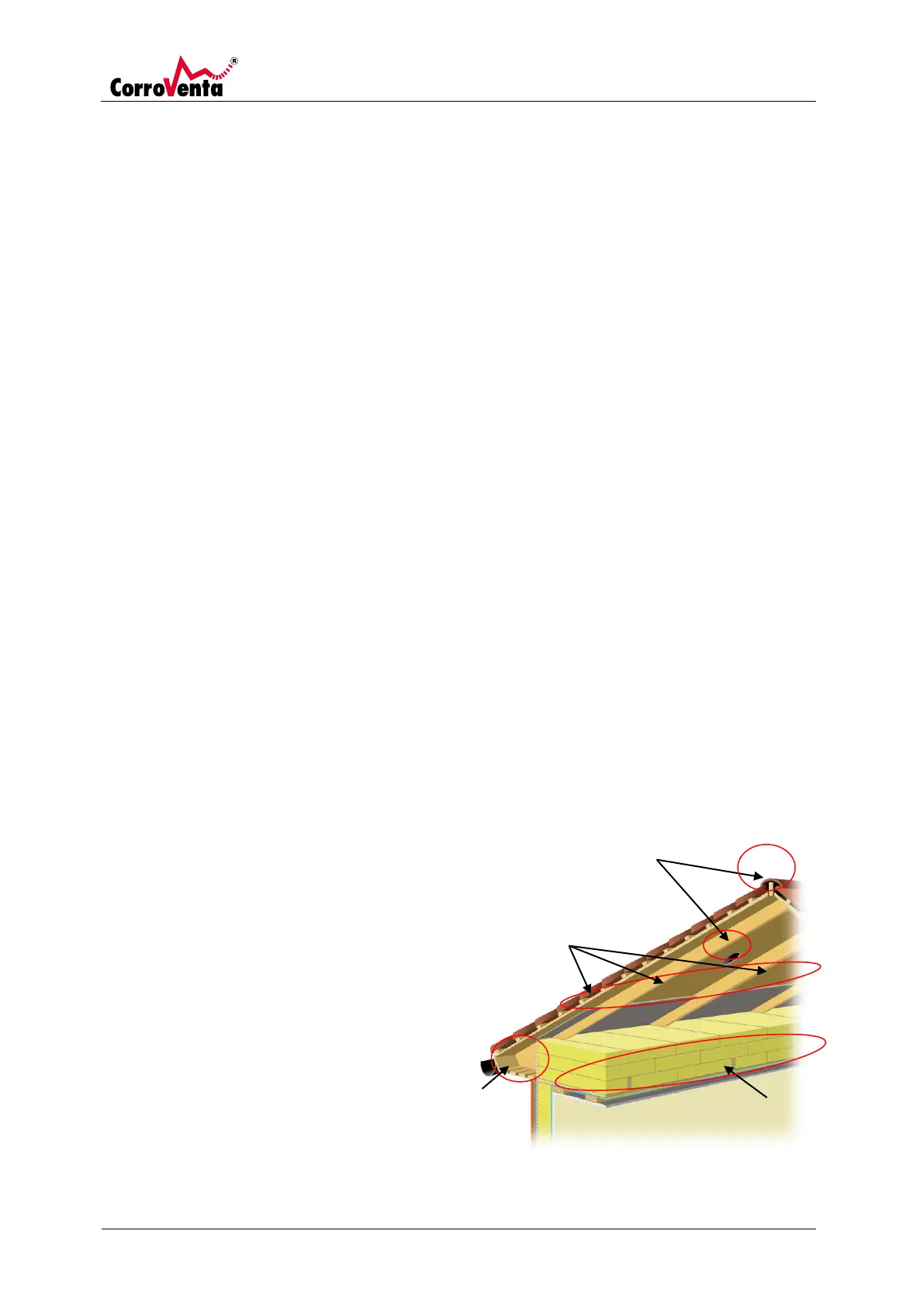
Gable and ridge vents
Vents that are not to be used for supply or exhaust air are best sealed using insulating board, bottom
strip, polyurethane foam, sealant or similar material. When vents in or adjacent to the suspended
ceiling are to be sealed, be careful so that no screws or nails penetrate the suspended ceiling and
penetrate roofing such as baseboard, surface board or similar.
Air gaps
There are several alternatives for sealing air gaps.
Of course, the house design determines which of
the following is most suitable and feasible:
1. Screw painted wooden strips over
the joist openings.
2. Caulk/seal the ventilation gap to the eaves
using suitable material.
3. Attach age-resistant construction plastic
over the inlet or outlet for ceiling ventilation.
4. Seal the vapour barrier downwards to the
living area with PE tape, polyurethane foam
and age-resistant construction plastic.



 To Next Page