ENGLISH
6. GENERAL RULES FOR THE REALIZATION OF THE FLUE
Here are illustrated a few simple yet important rules to follow for the safe construction of the flue (for further
information, please read the UNI 10683 regulation)
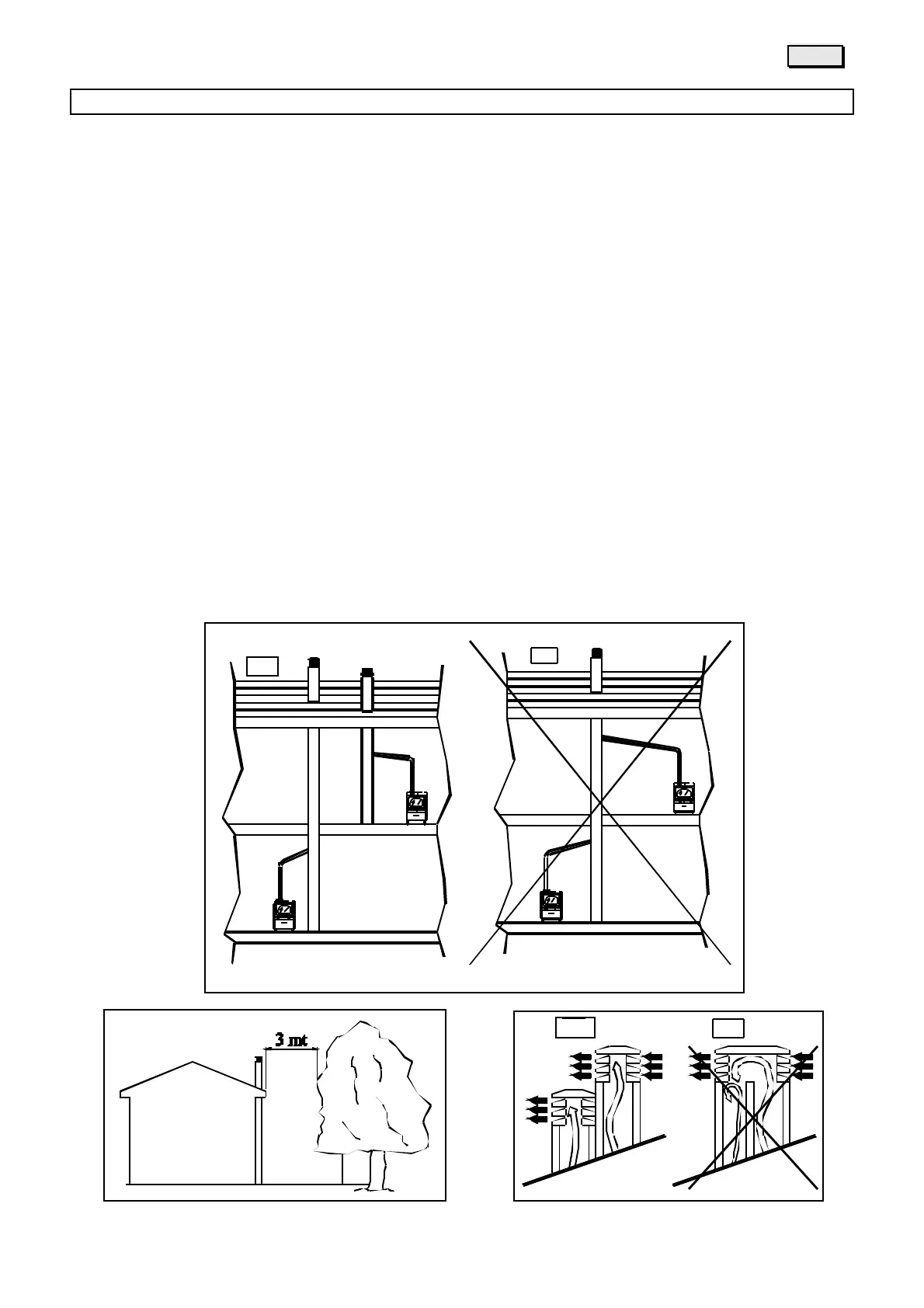
• The safe and correct functioning of the pellet stove is dependant on the connection to a single and
independent flue. No other fireplace, stove, boiler, aspiring hoods etc... are to be connected to the same
flue (see fig.3).
• This machine needs to expel products resulting from combustion via a vertical flue that has a suction
pressure between 6 and 10 Pa, in order to constantly guarantee the expulsion of smoke, even with the
absence of electric power or adverse conditions.
• The part of the flue that extrudes from the roof or remains in external contact must be covered with tiles or at
least well insulated.
• The stack must be wind resistant, have an internal section that is equal to that of the flue, a useful section at
least twice the size of the flue, and prevent entering of rain.
• Any other building parts, plants or other obstacles that are higher than the roof must be positioned at least
3m away from the flue.(see fig.4).
• Whenever two flues with parallel exits are used, it is advisable to lift the wind resistant flue (see fig. 5).
The flue section must be uniform, with smooth surfaces that do not narrow down, and the curves must be
regulated, without discontinuity.
It is advisable that the smoke conduct has a solid material and eventual condensation collecting box,
positioned under the smoke conduct intake, so that it is easily accessible and can be inspected from the
airtight door.
Fig.5
SI NO
NO
SI
Fig.3



 To Next Page