thicker shims). When testing nozzle, never
put your hand under the jet of a spraying
nozzle. The jet will penetrate into the skin
which is dangerous.
2. CHECK NOZZLE FOR LEAKAGE
Push nozzle tester lever down slowly until
needle on pressure gauge shows 20 kg/cm’
below opening pressure. The nozzle is leak
proof if no drop comes out of nozzle tip
within 10 seconds.
In the event of leak, disassemble injection
nozzle and clean as per procedure. If the
leak could not be repaired by careful cleaning
of seats or nozzle body and nozzle needle,
replace nozzle.
(When testing injectors with the pressure
gauge in circuit, operate nozzle tester lever
slowly as otherwise gauge may get
damaged.)
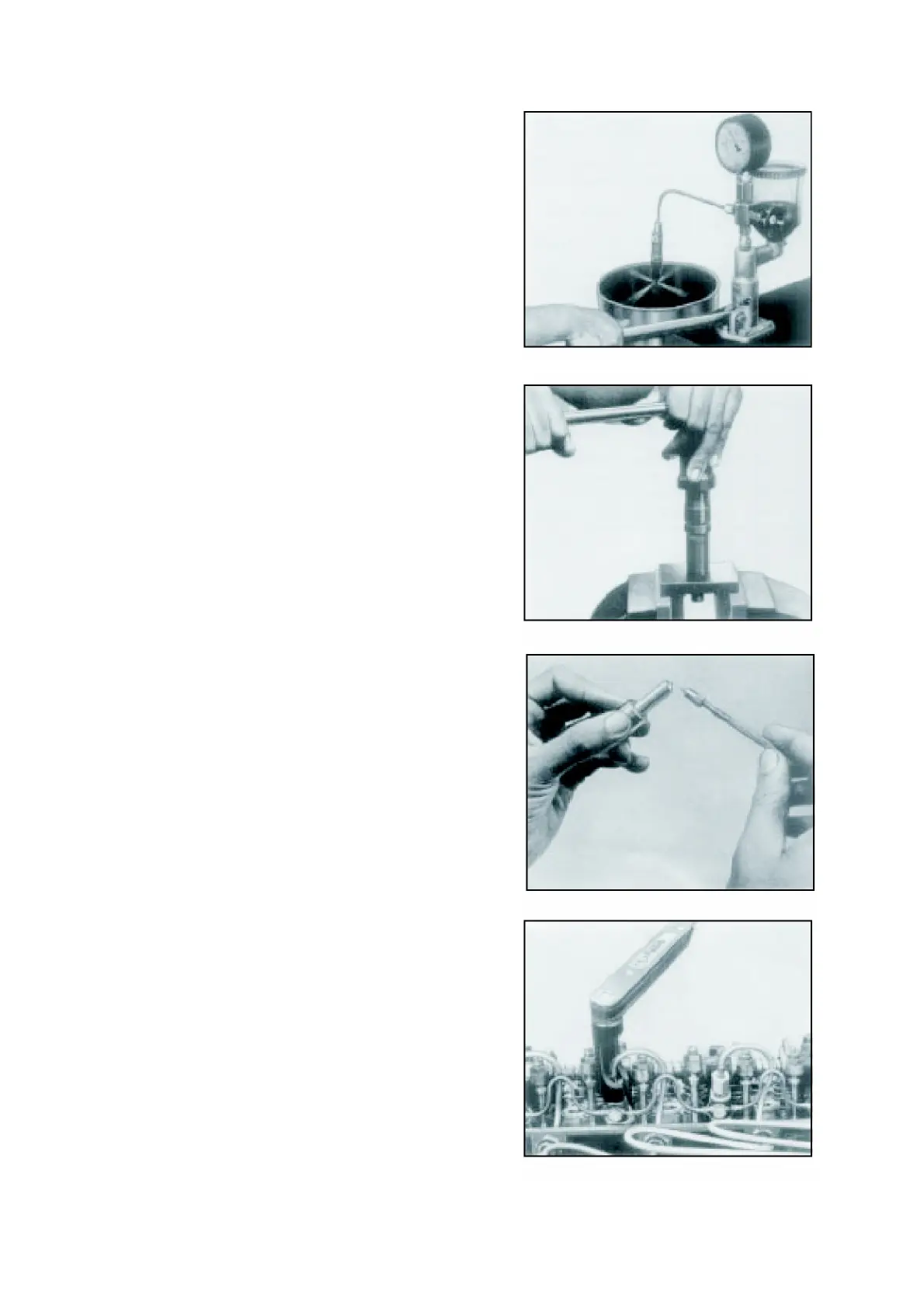
3. CHECKING NOZZLE SPRAY (Fig. 22)
Cut off the pressure gauge from the circuit
by closing shut off valve. Move pump lever
up and down approx. 4 to 5 times per
second. The nozzle will then buzz very softly.
Atomization is satisfactory when the 4 jet
cones have uniform closed contours and are
finely atomized. There should be no lateral
streams. The presence of small non-buzzing
ranges with non-atomized cones is of no
significance. The test oil will emerge in the
shape of a non-atomized cone until the
buzzing range is attained.
DISASSEMBLY,REPAIR ANDASSEMBLYOF
NOZZLE HOLDER AND INJECTION NOZZLE
(Nozzle holder removed)
1 Insert nozzle holder in to holder 403 589 00
31 00 and unscrew pressure nut with special
wrench 000 589 01 13 00 from nozzle body.
Fig. 23.
2 Clean nozzle externally and internally in
diesel fuel, particularly the middle seat and
the ring groove by means of a small piece
of wood. Clean injection holes of nozzle body
with a cleaning needle from special tool 000
589 00 68 00. Fig. 24.
Workshop Manual
S3.8 Engine
A030K288 (Issue 2)
01-2010



 To Next Page