3
Read Before Operation
Safety Precautions
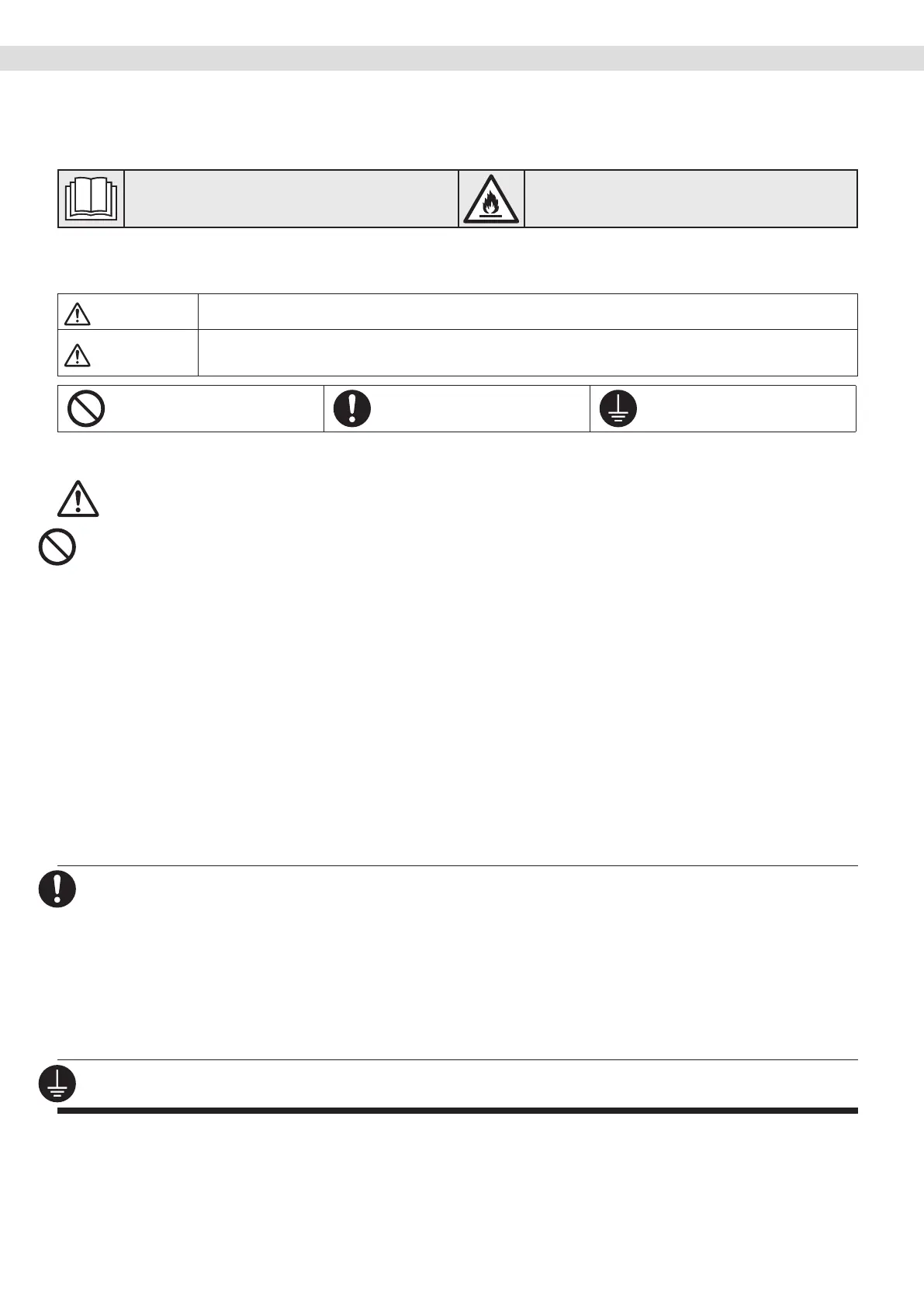
Read the precautions in this manual carefully
before operating the unit.
This appliance is lled with R32.
• Keep this manual where the user can easily nd it.
• The precautions described herein are classied as WARNING and CAUTION. They both contain important information
regarding safety. Be sure to observe all precautions without fail.
WARNING
Failure to follow these instructions properly may result in personal injury or loss of life.
CAUTION
Failure to observe these instructions properly may result in property damage or personal injury,
which may be serious depending on the circumstances.
Never attempt.
Be sure to follow the
instructions.
Be sure to establish an earth
connection.
• After reading, keep this manual in a convenient place so that you can refer to it whenever necessary. If the equipment is
transferred to a new user, be sure also to hand over the manual.
WARNING
• Do not use means to accelerate the defrosting process or to clean, other than those recommended by the manufacturer.
• The appliance must be stored in a room without continuously operating ignition sources (for example: open ames, an
operating gas appliance or an operating electric heater).
• Do not pierce or burn.
• Be aware that refrigerants may not contain an odour.
• The appliance must be installed, operated and stored in a room with oor area larger than –*m
2
.
*
Since the maximum refrigerant charge of the models is below 1.22kg, it does not have any limitation for the minimum oor area.
Maintain an installation height of 2.5m or more from the oor surface to the bottom of the appliance.
• To avoid re, explosion or injury, do not operate the unit when harmful gases (e.g. ammable or corrosive) are detected
near the unit.
• Be aware that prolonged, direct exposure to cool or warm air from the air conditioner, or to air that is too cool or too warm,
can be harmful to your physical condition and health.
• Do not place objects, including rods, your ngers, etc., in the air inlet or outlet. Product damage or personal injury may
result due to contact with the air conditioner’s high-speed fan blades.
• Do not attempt to repair, dismantle, reinstall or modify the air conditioner yourself as this may result in water leakage,
electric shock or re hazards.
• Do not use ammable spray near the air conditioner, or otherwise re may result.
• Do not use a refrigerant other than the one indicated on the outdoor unit (R32) when installing, moving or repairing.
Using other refrigerants may cause trouble or damage to the unit, and personal injury.
• To avoid electric shock, do not operate with wet hands.
• Beware of re in case of refrigerant leakage. If the air conditioner is not operating correctly, i.e. not generating cool or warm
air, refrigerant leakage could be the cause. Consult your dealer for assistance. The refrigerant within the air conditioner is
safe and normally does not leak.
However, in the event of a leakage, contact with a naked burner, heater or cooker may result in generation of noxious gas.
Do not use the air conditioner until a qualied service person conrms that the leakage has been repaired.
• Do not attempt to install or repair the air conditioner yourself. Improper workmanship may result in water leakage, electric
shock or re hazards. Please contact your local dealer or qualied personnel for installation and maintenance work.
• If the air conditioner is malfunctioning (giving off a burning odour, etc.), turn off power to the unit and contact your local
dealer. Continued operation under such circumstances may result in a failure, electric shock or re hazards.
• Be sure to install an earth leakage circuit breaker. Failure to install an earth leakage circuit breaker may result in electric
shock or re.
• Be sure to earth the unit. Do not earth the unit to a utility pipe, lightning conductor or telephone earth lead.
Imperfect earthing may result in electric shock.


 To Next Page