or sound pressure ratio.) if the number of
"dB's
"
are referenced
to a
given level, then
the value of the dB number becomes
spe-
cific.
dBV expresses
a
voltage ratio.
OdBV is
usually referenced
to
1.0V RMS. Thus 0dBV=1V RMS,
+6dBV=2V
RMS.
+20dBV=10V RMS, etc.
dB SPL expresses a Sound Pressure Level ratio.
dB
SPL
is a
measure of
acoustic pressure (loudness), not acoustic power,
which would be measured in
acoustic watts. OdB
SPL
is
equal to 0.0002 dynes/square centimeter (the threshold of
human
hearing at 1 kHz). As with dBV, an increase of
6dB
SPL
is twice
the
sound pressure, and an increase of
20dB
SPL
is an increase of
10
times
the sound pressure.
dBm
expresses a power ratio. OdBm is 1 milliwatt
(.001
watts), or 0.775V rms delivered
to a
600-ohm load. +3
dBm=2
milliwatts, or
1 .096V into 600 ohms
(\/2
times
OdBm),
+
10dBm=10 milliwatts, or
2.449V into 600 ohms (3.16 times
OdBm
),
etc. dBV and dBm differ
by 2.21 when dealing
with
600-ohm circuits.
However,
when the impedance
is
other
than
600
ohms, the value of
dBV
remains
the same if the
voltage is the same, whereas the value of dBm decreases with
increasing
impedance.
dB alone, without any suffix, doesn't mean
anything unless
it is associated with a
reference.
It may express the differ-
ence between two levels. Thus, the difference
between
lOdBV and 15dBV, the difference between
OdBm
and
5dBm, and the difference
between 90dB SPL and 95dB
SPL
are all differences of 5dB.
Decay Time
Decay time may mean different things, depending on the con-
text.
A
compressor's
decay
time
is
also known
as its
release
time
or recovery time.
After
a compressor (or expander) changes its
gain
to
accommodate an incoming signal, and
the
signal
is then
removed, the decay time is the amount of time required for the
circuitry
to return to "normal." More precisely, the decay
time
is the interval (usually measured
in microseconds or milliseconds)
during
which the compressing or expanding amplifier returns
to
90% of the normal gain. Very fast
decay times can cause "pumping"
or "breathing" effects,
whereas ver\ slow decay
times may cause
moderate-level
program which follows
high-level program or pro-
gram peaks
to be too
low
in level.
Decoder
When
a
circuit restores
an
original
program
from
a specially
treated version
of
that program, the circuit may be said
to decode
the program. The equipment or circuit which performs
this
function
is known as a decoder. Decoders must be used only with
programs
which
have
been encoded by complementary encoding
circuitry. Typical decoders include: FM tuners that use multiplex
decoders
to extract
left
and right stereo signals from left-plus-right
and left-minus-right signals, matrix quadraphonic
decoders that
extract
four
channels
of
program from the stereo program on
encoded recordings, and dbx
decoders that retrieve wide-dynamic
range programs from
the compressed programs on dbx-encoded
recordings.
De-emphasis
&
Pre-emphasis
De-emphasis and pre-emphasis are related processes that are
usually done
to
avoid audio noise
in some storage or transmission
medium. Pre-emphasis is a boost
at
specific higher frequencies,
the
encoding part of an encoding/decoding
system. De-emphasis is an
attenuation
at the same frequencies, a reciprocal decoding that
counteracts the pre-emphasis. In dbx noise reduction,
de-emphasis
is performed
by the
decoder
(the play circuitry). The de-emphasis
attenuates high frequencies, thereby reducing
tape modulation
noise and
restoring the original frequency response of the program
before it
was
dbx encoded. There
are other types of pre-emphasis
and de-emphasis. For
example, in FM tuners, de-emphasis
is used
to compensate for special
equalization (known as 75-microsecond
pre-emphasis) applied
at
the station's transmitter.
Dynamic Range
The dynamic range of
a program is the range of signal levels
from
the lowest to the highest level. In equipment,
the dynamic
range is the
"space,"
in
dB, between the residual noise level
and
the
maximum undistorted signal level.
A program with wide
dynamic range has
a
large
variation from the softest to the loudest
passages, and will tend
to
be more lifelike than
programs with
narrow dynamic range.
Encoder
When
a
circuit processes
an original program to create
a
specially treated version of
that program, the circuit may
be said
to encode
the program. The equipment
or circuit which performs
this function is known as
an encoder. Encoded programs
must
decoded only with complementary decoding
circuitry. Typical
encoded programs
include: FM multiplex broadcasts, matrix
quadraphonic recordings, and dbx
encoded recordings.
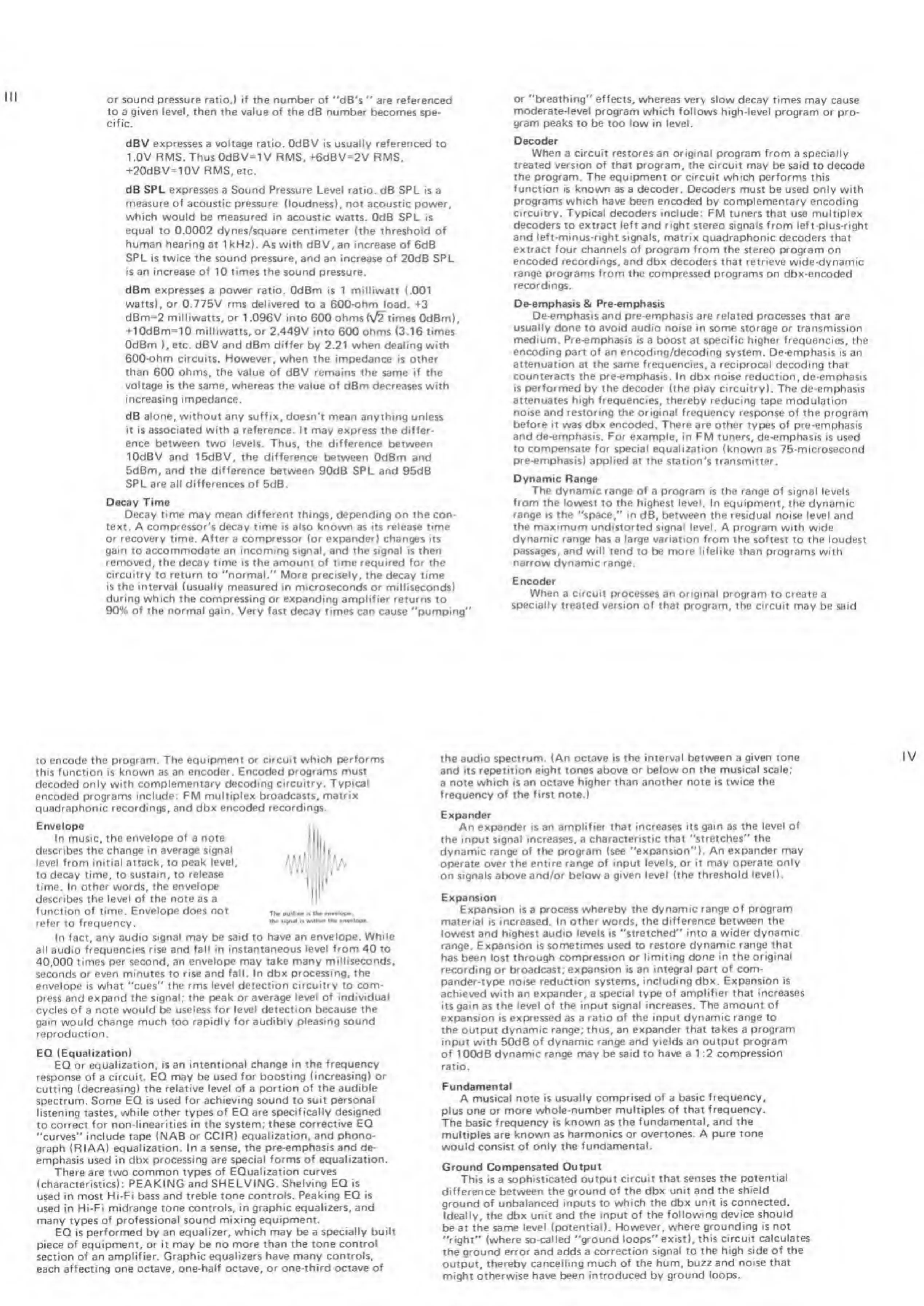
Envelope
In music,
the envelope of a note
describes
the change in average signal
level from initial attack, to
peak level,
to decay time, to
sustain, to release
time.
In other words, the
envelope
describes the level
of
the
note
as a
function
of time. Envelope does not
refer to frequency.
Th* outline it
ihe envelop*,
the nonel it
within
th*
envelop*
In fact, any audio
signal may be said to have an envelope.
While
all audio
frequencies rise and fall in instantaneous
level from 40
to
40,000
times per second, an
envelope
may
take many milliseconds,
seconds or even
minutes
to
rise and fall. In dbx
processing,
the
envelope is what "cues" the rms
level detection circuitry to com-
press and expand the
signal; the peak or average
level of individual
cycles
of
a
note would be useless for
level detection because the
gain would change much too
rapidly for audibly pleasing sound
reproduction.
EQ (Equalization)
EQ
or equalization, is
an intentional change in the
frequency
response
of
a
circuit. EQ may be used
for boosting (increasing) or
cutting
(decreasing) the relative level
of
a portion
of the audible
spectrum. Some EQ is used
for achieving sound to suit
personal
listening tastes,
while other types
of
EQ are
specifically designed
to
correct for
non-linearities in the system; these
corrective
EQ
"curves" include tape (NAB
or CCIR) equalization, and phono-
graph (RIAA) equalization. In a
sense, the pre-emphasis and de-
emphasis used
in dbx processing are special
forms of equalization.
There are two common types
of EQualization curves
(characteristics):
PEAKING and SHELVING.
Shelving EQ is
used in most Hi-Fi bass
and treble tone controls. Peaking EQ is
used in Hi-Fi
midrange tone controls, in graphic
equalizers, and
many types
of professional sound mixing
equipment.
EQ is performed by
an equalizer, which may be a
specially built
piece
of equipment, or it may be no more than
the tone control
section of an
amplifier. Graphic equalizers have many controls,
each affecting one
octave, one-half octave, or
one-third octave of
the audio spectrum.
(An octave is the interval between a
given tone
and its
repetition eight tones above or below
on the musical scale;
a
note which is an octave higher
than another note is twice the
frequency of the first note.)
Expander
An expander is an
amplifier
that increases
its gain as the level
of
the input signal increases, a
characteristic that "stretches" the
dynamic range
of the program (see "expansion").
An expander may
operate
over the entire range
of
input
levels, or it may operate only
on signals above
and/or below
a
given level (the
threshold level).
Expansion
Expansion
is a
process whereby the dynamic
range of program
material is increased. In
other words, the difference between the
lowest
and highest audio levels is "stretched"
into
a
wider dynamic
range. Expansion is sometimes
used
to
restore dynamic range that
has been lost through compression or limiting
done in the original
recording or broadcast;
expansion
is
an integral part of com-
pander-type noise reduction systems,
including dbx. Expansion is
achieved with an expander, a
special type of amplifier that increases
its gain as the
level of the input signal increases. The
amount of
expansion is expressed as a ratio
of
the input
dynamic range to
the output dynamic
range; thus, an expander that takes a
program
input with 50dB of dynamic range and
yields
an
output program
of
lOOdB dynamic
range may be said to have a 1 :2 compression
ratio.
Fundamental
A musical note
is usually comprised
of
a basic
frequency,
plus one or
more whole-number
multiples of that frequency.
The basic frequency is
known
as
the fundamental, and
the
multiples are
known as harmonics or
overtones. A pure tone
would consist
of only the fundamental.
Ground Compensated
Output
This is a
sophisticated output circuit that
senses the potential
difference between the ground
of
the
dbx unit and the shield
ground of unbalanced
inputs to which the dbx
unit is connected.
Ideally, the
dbx unit and the input
of the following device
should
be at
the same level
(potential). However, where
grounding is not
"right" (where
so-called "ground loops" exist),
this circuit
calculates
the
ground error and adds a
correction signal to the high side
of the
output, thereby
cancelling much of the hum,
buzz and noise that
might
otherwise have been introduced by
ground loops.


 To Next Page
 Loading...