INTRODUCTION
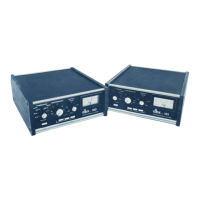
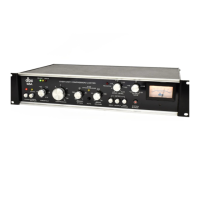
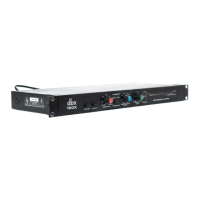
2 The dbx 160 and 161 are
single-channel compressor/
limiters combining
sophisticated technology and user-
oriented
features in a compact package.
Unique circuit
designs, such
as
true rms
level-detection and feed-forward
gain
reduction
,
place the 160
and 161 in
a
completely
different class
from conventional
compressor/limiters.
The dbx technique of true rms
level-detection gives you
audible benefits.
Most compressor/limiters use some form
of
peak detection, with fast response characteristics that
can have a disturbing effect on
program material. True rms
level detection closely
simulates the response of the human
ear.
Even
at
high compression ratios, the gain
changing
action
of
the 160
Series is highly listenable and natural
sounding.
Because of the
unique feed-forward approach, dbx 160
and
161
limiters can achieve infinite
compression with
complete stability and
inaudible distortion. The dbx
approach
is
quite unlike gain reduction in a conventional
compressor/limiter. Traditional gain
reduction
is
accom-
plished by sensing
signal level
at
the device's output and
applying
a
correction signal, via a feedback loop.
At
progressively higher compression ratios,
the feedback loop's
gain increases,
distortion increases, and eventually instability
or oscillation occurs. To avoid this problem,
many con-
ventional units restrict
the maximum amount of feedback,
thus
restricting the maximum compression ratio to some
lower ratio, such
as
10:1 or 20:1. The dbx 160 and 161
are
free of the instability
of excessive
loop
gain, and can
provide
infinite compression (approximately 120:1).
In
addition to
increasing the stability and the available
range of compression, dbx's
feed-forward approach makes
it possible for the
attack and release times to
"track" the
signal envelope.
In conventional
compressor/limiters, the
attack and
release times depend on feedback loop
gain,
which means they constantly
must be readjusted for
optimum results at
different compression ratios. Since the
attack and
release times of dbx units vary
automatically
with the rate of level change in the
program material (the
envelope shape),
operation
is
simplified; no manual
attack/
release
adjustments are required. At the same
time, the
"naturalness" of any given sound is better
preserved.
GENERAL
INFORMATION
Models
The Model
160 is a fully
professional compressor/limiter
with
a
balanced
differential input,
with an automatic
ground-loop
compensated
output (hum
resulting from any
ground loop
at
the
output is automatically
sensed and
attenuated
at least
40dB), and with
a special protection
circuit
that blocks power
turn-on and turn-off
transients
from
the output.
The Model
161 is nearly
the same
as
the
160,
but is
priced
for the smaller
studio,
or the semi-pro
user. It has
the same
advanced rms
detection and
feed-forward
circuitry
as
Model
160,
but
it lacks turn-on/turn-off
transient
protection,
and ground-loop
compensation.
The
1 61
's
input
and output are
unbalanced and
terminated in
RCA-type phono
jacks.
Both
models have
adjustable threshold,
and a pair of
LED's that
indicate when
the input level is
above or below
the
threshold. An
illuminated meter
displays
a full 60dB
range and
is
switchable
to read input
level, output
level, or
gain
change. The meter's
sensitivity
is continuously
variable,
so "zero VU"
can be adjusted
to equal your
system's
nominal operating
level, anywhere from
+10
to
-10dB. Output line
level is also
adjustable, ±20dB.
Maximum
output on the
160 is +26dB
(1 5.5V) into a high impedance,
or
+24dBm (12.3V) into
600 ohms. Maximum
output on
the Model
161 is +18dB
(6.14V) into a high impedance,
or
+16dBm (4.89V)
into 600 ohms.
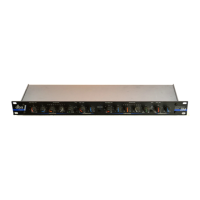
Attractively styled
and functionally
designed, either
model
can stand alone or
can be mounted in
a standard
19"
rack. Two units
can be mounted
side-by-side in
just 2V2
'
of
panel space with the
optional dbx
RM-150-C rack mount
kit; the
RM-150-D
is
for
rack mounting of
a single unit.
Applications
dbx noise
reduction systems
now make it
possible to
process programs
with lOOdB,
or greater, dynamic
range.
Unfortunately,
in some
applications it
is necessary
to
restrict dynamic
range. While dbx
noise reduction
systems
are used
in the studio, for
record production,
to maintain
wide dynamic
range, this
range must often be
restricted
to
optimize
the sound
for broadcast and
home playback.
The
restriction
of dynamic range
is usually
done with a com-
pressor, in the final
stages of
recording (or record master-
ing). In
the broadcast field,
where many
stations compete
for
an audience,
a high average
audio level can
make a big
difference
to radio
station ratings.
Compression is
used to
attain
high average
levels. However,
unless
a high-
quality
compressor/limiter
is utilized,
distortion
and
unwanted
audible
side-effects
may degrade
the sound
so badly
that the
advantages of
high average
level are
overcome,
and audience
interest
can be lost. The
160
and 161
do
a
great
job in
both recording
and broadcast
applications.
The
dynamic range of
a live musical
performance
can be
even greater
than lOOdB.
A high-quality
compressor/limiter,
used judiciously,
can restrict the
dynamic range,
raise the
average
level, help the
operator
avoid clipping
distortion,
and improve
the overall
sound quality.
Because the
160 and
161 sound
so natural, they
won't displease
performers,
making
them especially
well suited
to sound reinforcement
applications.
Compressor/limiters
can
be useful in
other applications
too. The 160 and
161 are ideal for
use as
a
high
quality line
amplifier
because of their
low noise
and distortion
and high
output
drive. The 160
and 161 have the
added advantage
of
allowing you
to conveniently
dial in compression
at any
time.
In any application
requiring
high-quality compression


 To Next Page
 Loading...