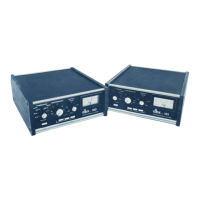
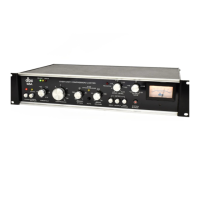
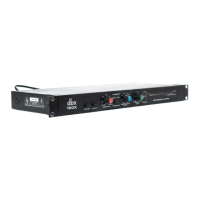
or limiting the dbx 160
and
161
provide superior perfor-
mance at a
reasonable price.
Stereo
Tracking
Some compressor/limiters
have jacks that
ostensibly
equip the units for stereo
operation. The jacks "strap"
the
gain control
sections of the two
single-channel units
together so
that the stereo image remains
stable even when
the signal level is radically
different in the two channels,
dbx's
Model
160
and
161,
are not equipped
for stereo
operation. The lack of "strapping"
provisions is no over-
sight; it is a well thought out
engineering decision. The
reason for this decision
is
simple, if not
immediately obvious.
Stereo tracking between two
separate compressor/limiters
requires great accuracy. This
tracking accuracy has little to
do with the
quality or the ability of a
single-channel unit
to
meet its specifications. Even with
better than average com-
ponent tolerances,
component-to-component variation is
typically 10%;
most potentiometers have 20% tolerances.
Such tolerances are perfectly acceptable, and
will not
degrade the performance of an
individual single-channel
unit. Internal trimmers are
adjusted to provide any needed
correction, and any critical
components are matched or
have precision tolerances.
While the front panel settings of two
"strapped" units
may be identical, component
tolerances can cause the actual
performance to vary from unit to
unit by as much as 20%.
Even small tolerance differences will cause the
stereo image
to shift rapidly from right to left.
These normal component
tolerances only become a problem if two units are
strapped
together
for
stereo operation.
If any given pair of single-channel units ever manufac-
tured could be strapped together for accurate stereo
tracking, individual component tolerances in
each unit
would have to be very tightly controlled.
This approach
would not
improve the performance of any
one single-
channel unit, but it would
make
the
cost of all units
prohibitive.
There
are
three other ways to build compressors with
stereo strapping jacks: (The easy
way out) Put
in the jacks
on production units that are
not critically matched, and
ignore the resulting problems: (The
expensive
way
out)
install highly accurate, precision components throughout
the compressor for accurate stereo tracking performance,
and charge every purchaser for the stereo capability, whether
or not it is needed, or (The
hard way out for you) install
enough external trim-pots
so
that, if you had the right test
equipment, you could adjust the tracking accuracy
yourself
...
as often as required by
component aging or
touring
abuse.
None of the above
solutions were very palatable to dbx
(nor would the results have been to you, the user), dbx
decided that
omitting
the stereo
tracking feature would
improve the
overall
value
of the product, and would help
dbx
to
keep its commitment to product excellence at
reasonable
cost.
There is no reason for people who need
a
single-channel compressor/limiter to pay for precision
parts or matching that they do not
need. Neither is there
any reason
for
someone
who needs
a
stereo compressor/
limiter
to accept
inferior performance from units with
strapping jacks but no matched or precision components
that would provide precise stereo
tracking accuracy.
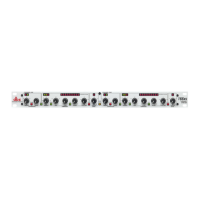
Instead, dbx decided
to
offer another model, the
162,
which is
a
two-channel compressor/limiter designed and
built for the user who needs precise stereo tracking. The
162 utilizes matched components and close-tolerance parts
to
achieve
precise tracking, with easy, single-knob adjust-
ments. The
162 does the job at an attractive price.
It
makes
a
lot of sense when
you
think
about it: a
precise
dbx
compressor/limiter
for single-channel
jobs,
and another for
precise stereo
operation.
The
Compressor/Limiter
as
a
Tool
Set
up properly,
a compressor can
be a useful device.
Figure
4,
Curve
A shows
the envelope of an input
signal
with no
compression.
(The "envelope" of
a signal is
a graph
of its instantaneous
level.)
Curve B shows the
envelope of
the same signal
after 2:1 compression
has reduced
its level.
Curve
C shows the
results of extreme
20:1 compression
(limiting). At this
extreme compression
ratio, the
output
level is
essentially
constant for any
input above the
threshold.
Much of
the character of
music is contained
below the
attacks or peaks. If
the threshold
is set 10dB or more
above
the
average level of
the input signal,
then compression
will
take place
primarily on the
uppermost peaks
or attacks of
the
signal, minimizing
musical
alteration. However, if
the
threshold
is set to
a level that is lower
with respect
to the
average level,
noticeable
musical alteration may
occur.
With a 2:1 compression
ratio,
a 2dB increase in input
level
(above threshold)
causes the output
to rise only IdB.
With a 4:1 ratio,
a 4dB
increase at the input
results in a IdB
increase at the
output. With
a
10:1
ratio, a 10dB
increase
at
the
input results
in a IdB increase
at
the
output, and
so
forth. Therefore,
the amount
of musical
alteration also
depends
on the compression
ratio used,
as
well
as the
threshold
setting.
Music
listening pleasure
is greatest with
full, unaltered
dynamic
range. Because
dbx noise reduction
systems afford
a useable
dynamic range
of over lOOdB,
dbx recommends
their use whenever
practical. Limiting
or compression
can
be used in conjunction
with dbx noise
reduction
systems,
for effect
only.
A
compressor/limiter,
as with any useful
tool, can be
misused. In fact,
many
people refuse
to use compression,
even when it
would improve
the audio quality,
because they
have
heard compression
being
misused all to often.
One of
the nicest
aspects of
dbx compressor/limiters
is the
fact that
they
are easy
to use and they
sound better than
competitive
units
. . . even when
using more
extreme compression.


 To Next Page
 Loading...