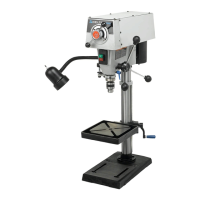
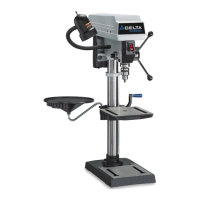
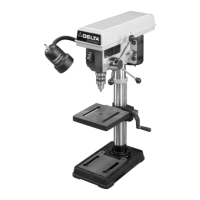
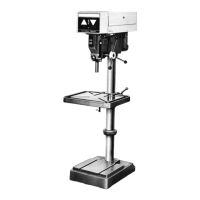
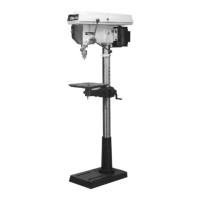
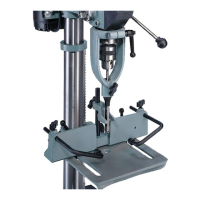
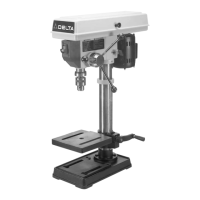
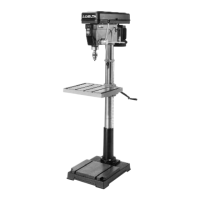
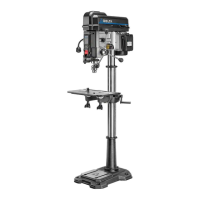
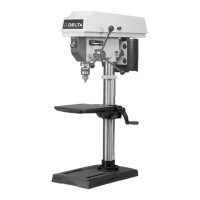
The Delta ShopMaster Model DP350 is a 12-inch variable speed bench drill press designed for a variety of drilling and boring operations. This tool is equipped with a flexible work lamp, allowing users to quickly and easily change drill speeds without needing to remove the cover or adjust belts.
Function Description:
The primary function of the Delta ShopMaster Model DP350 is to drill holes in various materials, including wood and metal, with precision and control. Its variable speed control allows for optimal drilling performance based on the material type, hole size, and desired cut quality. The drill press features a chuck for holding drill bits, a column for vertical adjustment, a table for supporting workpieces, and a base for stability. The quill mechanism allows for controlled vertical movement of the drill bit, and a depth stop ensures consistent drilling depth for repetitive tasks. The flexible work lamp provides illumination to the work area, enhancing visibility and accuracy.
Important Technical Specifications:
- Model: DP350
- Type: 12" Variable Speed Bench Drill Press
- Power: Wired for 120 Volt, 60 Hz alternating current.
- Speed Range: 500 rpm to 3100 rpm (variable speed).
- Chuck Capacity: Designed for drill bits with a shank of 1/2" or less in diameter.
- Table Adjustments: The table can be raised, lowered, and rotated 360 degrees on the column. It can also be tilted right or left, with a tilt scale indicating the degree of tilt.
- Work Lamp: Flexible lamp, independently operated, requires a 40 watt or less, 120 volt, reflector track type light bulb (not supplied).
- Fastening: The machine base can be secured to a supporting surface using M8x1.25x125mm carriage head screws, washers, and hex nuts.
- Safety Features: Equipped with a power switch that can be locked in the "OFF" position using a padlock (3/16" diameter shackle) to prevent unauthorized use. The chuck key includes a self-ejecting pin to minimize the hazard of leaving the key in the chuck.
Usage Features:
- Variable Speed Control: The pilot wheel handles allow for easy adjustment of drilling speed. Turning clockwise increases speed, while counterclockwise decreases it. This feature is crucial for adapting to different materials and drill bit types, preventing damage to the drive belts and pulleys. It is important to only adjust speed when the motor is running.
- Depth Control: For drilling multiple holes to the same depth, the threaded stop rod and stop nut system can be utilized. Users can lower the chuck to the desired depth, lock the quill, and then adjust the stop nut to contact the stop. This ensures consistent depth across all drilled holes.
- Quill Adjustments: The spindle is raised and lowered using the pilot wheel. The quill can be locked at any desired point in its travel by tightening the quill locking lever. This lever is spring-loaded and can be repositioned as needed.
- Table Adjustments: The table's versatility is a key feature. It can be moved vertically along the column by loosening a clamp and turning a handle, allowing for different workpiece heights. The ability to rotate the table 360 degrees and tilt it right or left (up to 90 degrees to the spindle) provides flexibility for various drilling angles and workpiece configurations. An alignment pin helps to quickly return the table to a 90-degree position.
- Workpiece Support: For drilling metal, clamps are essential to hold the workpiece firmly against the table, preventing it from seizing or spinning, which could cause injury or damage. For long or wide workpieces, it is recommended to position one end against the left side of the column to prevent rotation.
- Boring in Wood: While twist drills can be used, machine spur bits are preferred for wood boring as they create flat-bottom holes and efficiently remove wood chips. Slow feeding is advised when the bit is about to cut through wood to prevent splintering, and a scrap piece of wood as a base block can protect the workpiece and bit.
- Safety Lock-Out: The power switch can be secured with a padlock in the "OFF" position, preventing accidental or unauthorized operation, which is a critical safety feature.
Maintenance Features:
- Cleaning: The machine and all loose items should be unpacked and cleaned of any protective coating using a soft cloth moistened with kerosene. Unpainted surfaces should then be covered with a good quality household floor paste wax. Periodically, all air passages should be blown out with dry compressed air. Plastic parts should be cleaned with a soft damp cloth, avoiding solvents.
- Lubrication: The variable speed pulleys require weekly oiling with a few drops of light machine oil in the designated oil holes. This should be done when the drill press is OFF, followed by running the machine through its speed ranges a few times. The machine table and extension table should be waxed weekly with household floor paste wax.
- Rust Protection: To protect cast iron tables from rust, a specific procedure is recommended: apply WD-40, polish with a Scotch-Brite™ Blending Hand Pad and a pushblock, degrease the table, and then apply TopCote® Aerosol.
- Spindle and Chuck Maintenance: The spindle taper and chuck's tapered hole must be kept clean and free of grease, lacquer, or rust. Household oven cleaner can be used for this purpose, following manufacturer's safety rules.
- Spindle Return Spring Adjustment: The spindle automatically returns to its uppermost position. While factory-adjusted, instructions are provided for adjusting the spring tension if necessary, which involves loosening nuts, rotating the spring housing, and then re-tightening the nuts. This adjustment should only be performed after disconnecting the machine from the power source.
- Troubleshooting: The manual provides guidance for common issues, such as the machine failing to start, advising users to check cord plug contact, blown fuses, or open circuit breakers. For further assistance, users can visit the Delta Machinery website or call their help line.

 Need help?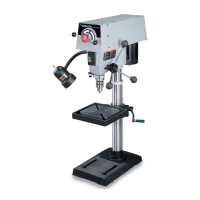

 To Next Page
 General