Need help?
Do you have a question about the Delta ShopMaster DP400 and is the answer not in the manual?
Emphasizes reading all warnings and instructions before use to prevent injury.
Provides advice on using machinery with caution, proper safety equipment, and common sense.
Stresses reading the manual and wearing certified safety glasses and proper apparel.
Covers safe work areas, tool maintenance, and checking for damaged parts.
Details preventing unintentional starting, using guards, and removing adjusting keys.
Advises using the right machine, recommended accessories, and proper extension cords.
Covers securing workpieces, feeding direction, avoiding overreaching, and never standing on the machine.
Emphasizes staying alert, avoiding distractions, childproofing the workshop, and turning the machine off.
Ensures complete assembly, wiring codes, and securing the machine to prevent tipping.
Covers clearing the table, starting the machine, securing bits, and removing chuck keys.
Details tightening handles, using correct accessories and speeds, avoiding awkward positions, and keeping hands clear.
Addresses holding workpieces firmly, proper support for long pieces, and avoiding setup work while running.
Instructs on turning off the machine, disconnecting power, cleaning, and locking the switch.
Explains grounding protects the operator from electric shock in case of malfunction.
Details using the equipment-grounding conductor and plug, and the need for properly installed outlets.
Advises on using proper gauge, condition, and 3-wire extension cords to prevent voltage drop and overheating.
Identifies key components of the drill press with numbered labels and a list of parts.
Warns against connecting power until assembly is complete and manual is read.
Details securing the base to a surface or plywood board to prevent tipping.
Describes attaching the column to the base using hex head screws.
Explains placing the drill press head onto the column and tightening head locking screws.
Advises cleaning spindle and adapter tapers and pushing the spindle adapter into the spindle.
Explains how to turn the drill press ON and OFF using the main switch.
Instructs to disconnect power and lift the belt guard before adjusting belts.
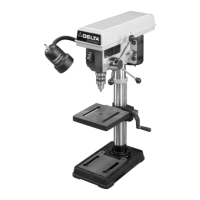
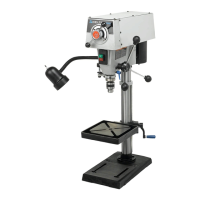
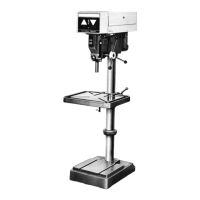
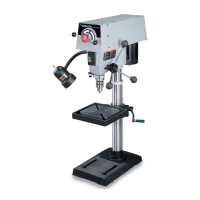
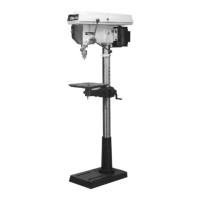
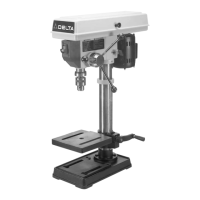
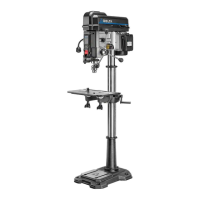
The Delta ShopMaster DP400 is a 16½" floor model drill press designed for a variety of drilling operations in wood and metal. It features a robust induction motor, a flexible work lamp, and a tilting table with c-clamp edges and diagonal slots, providing versatility and precision for both professional and hobbyist woodworkers and metalworkers. The machine offers twelve speed options, ranging from 250 rpm to 3000 rpm, allowing users to select the optimal speed for different materials and drill bit types, ensuring efficient and high-quality drilling performance.
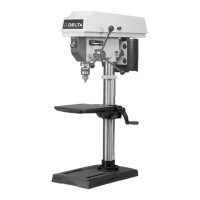
The primary function of the Delta ShopMaster DP400 drill press is to accurately drill holes to specified depths in various materials. The machine's head, column, table, and base are designed to provide a stable and rigid platform for drilling, minimizing vibration and maximizing precision. The spindle, driven by the motor through a belt and pulley system, rotates the drill bit, while the quill mechanism allows for controlled vertical movement of the spindle to engage the workpiece.
The drill press is equipped with a depth stop mechanism, enabling users to drill multiple holes to the exact same depth, which is crucial for repetitive tasks and achieving consistent results. The depth stop scale is calibrated in both inches and millimeters, offering flexibility for different measurement preferences.
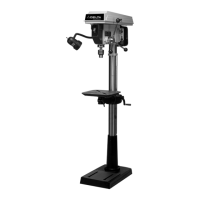
The flexible work lamp illuminates the work area, improving visibility and accuracy, especially in dimly lit environments. This feature helps reduce eye strain and ensures that the operator can clearly see the drilling point and workpiece.
The tilting table is a key feature that allows for angled drilling. It can be tilted right or left, providing versatility for projects requiring holes at specific angles other than 90 degrees. The table also features c-clamp edges and diagonal slots, which are essential for securely clamping workpieces, preventing them from rotating or shifting during drilling, a critical safety measure, particularly when working with metal or irregular shapes.
Operating the Delta ShopMaster DP400 involves several user-friendly features designed for safety and efficiency. The machine's switch, located on the front of the drill press head, allows for easy "ON" and "OFF" control. A locking switch feature is incorporated to prevent unauthorized use, enhancing safety in a workshop environment. By pulling out the switch toggle, the machine cannot be restarted, ensuring that it remains off when not in use or when maintenance is being performed.
The table adjustments are intuitive, allowing the operator to raise or lower the table on the drill press column to accommodate different workpiece sizes. The table can also be rotated 360 degrees, providing flexibility for positioning the workpiece without having to reposition the entire machine. A table alignment pin ensures that the table can be quickly returned to a perfect 90-degree position relative to the spindle for standard drilling operations. A tilt scale with a witness line and zero mark helps accurately set the desired angle for tilted drilling.
Changing spindle speeds is a straightforward process, guided by a belt positioning speed chart located on the inside top cover of the drill press. This chart illustrates which steps of the pulleys the belts must be placed on to achieve the twelve available speeds. Adjusting belt tension is also facilitated by a tension lock knob and lever, ensuring proper belt tension to prevent slipping and maximize belt, pulley, and bearing life. Correct tension is achieved when the belts can be flexed about 1" out of line midway between the pulleys.
Installing and removing drill bits is made easy with the 5/8" capacity chuck. The chuck key is used to tighten and loosen the chuck jaws, securing the drill bit. An important safety feature is the self-ejecting pin on the chuck key, which helps minimize the hazard of the key being left in the chuck during operation.
When drilling in wood, the manual recommends using machine spur bits for flat-bottom holes and efficient chip removal. For through boring, aligning the table so the bit enters the center hole prevents damage to the table. Slow feeding is advised when the bit is about to cut through the wood to prevent splintering, and using a scrap piece of wood as a base block protects the workpiece and the drill bit.
For drilling metal, securing the workpiece with clamps or a vise is paramount. The workpiece should never be held by hand, as it can seize and whirl out of control, potentially causing injury or damage to the drill bit and machine. Firm clamping prevents tilting, twisting, or shifting, which can lead to rough holes and drill bit breakage.
Regular maintenance is essential for the longevity and optimal performance of the Delta ShopMaster DP400. The manual provides clear instructions for unpacking and cleaning the machine, including removing the protective coating from unpainted surfaces using kerosene and then applying a good quality household floor paste wax.
One specific maintenance task detailed is the removal of the spindle adapter and chuck. This procedure is necessary if the user intends to use shanks with a #2 morse taper. The process involves aligning slots in the quill and spindle, inserting a spindle adapter remover, and tapping it with a hammer until the adapter and chuck fall out. Crucially, the tapered hole in the spindle and the taper on the spindle adapter must be kept clean and free of grease, lacquer, or rust preventive coatings to ensure a secure fit. Household oven cleaner is suggested for effectively removing these coatings, with a reminder to follow the manufacturer's safety rules for its use.
Adjusting the spindle return spring is another maintenance feature. While the spring is factory-adjusted and should not be disturbed unless necessary, instructions are provided for loosening and tightening nuts to adjust spring tension. This ensures that the spindle automatically returns to its uppermost position after each drilling operation, promoting smooth and consistent use.
General safety rules emphasize maintaining all tools and machines in peak condition, keeping them sharp and clean for best and safest performance. Following instructions for lubricating and changing accessories is also highlighted as part of routine maintenance. Checking for damaged parts before use, such as alignment of moving parts, binding, or breakage, is critical. Any damaged parts should be properly repaired or replaced to prevent further damage to the machine or injury.
The machine's design also considers the need for a clean work area, advising users to keep benches and surrounding areas clear to prevent accidents. Disconnecting the machine from the power source before installing or removing accessories, adjusting set-ups, or making repairs is a fundamental safety and maintenance practice.
 General
| Motor Power | 1/2 HP |
|---|---|
| Swing | 12 inches |
| Spindle Travel | 3-1/8 inches |
| Spindle Taper | JT-33 |
| Chuck Capacity | 5/8 inches |

 To Next Page