www.desatech.com
116035-01J18
1. Cut a 11
1
/
2
" square hole in ceiling using
locating hole as a center point. The open-
ing should be framed to 11
1
/
2
" x 11
1
/
2
"
(292 mm x 292 mm) inside dimensions,
as shown in Figure 12 on page 11 using
framing lumber the same size as ceiling
joists. If area above ceiling is an insulated
ceiling or an attic, nail restop from top
side. This prevents loose insulation from
falling into required clearance space. If
area above ceiling is a living space, in-
stall restop below framed hole. Firestop
should be installed with no less than three
nails per side (see Figure 28).
2. Assemble desired lengths of pipe and
elbows necessary to reach from replace
ue up through restop. Be sure all pipe
and elbow connections are fully twist-
locked (see Figure 11, page 12).
3. Cut a hole in the roof using locating hole as
a center point. (Cover any exposed open
vent pipes before cutting hole in roof.) The
11
1
/
2
" x 11
1
/
2
" hole must be measured on
the horizontal; actual length may be larger
depending on pitch of roof. There must
be a 1" clearance from the vent pipe to
combustible materials. Frame opening as
shown in Figure 12, page 12.
4. Connect a section of pipe and extend up
through hole.
VENTING INSTALLATION
Continued
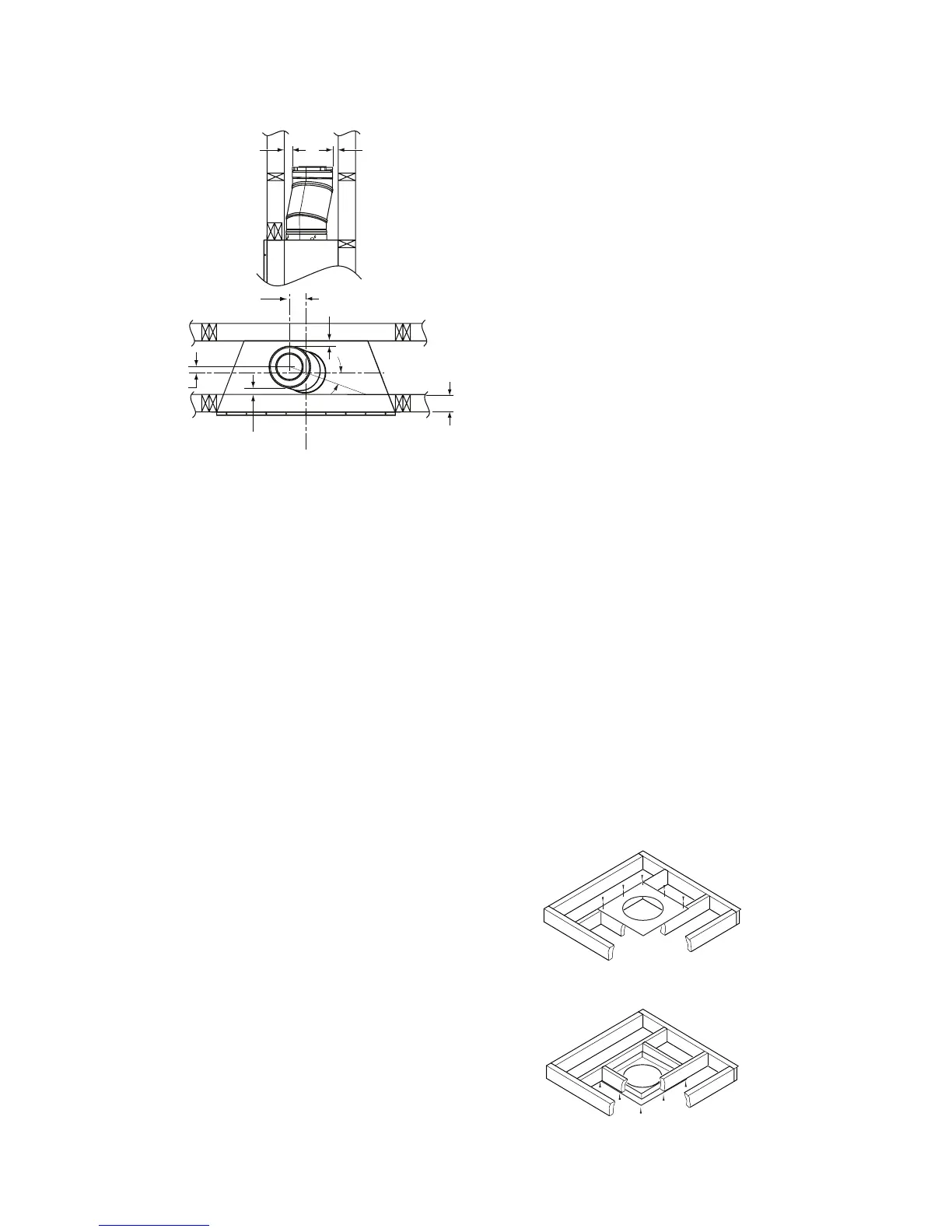
Figure 28 - Installing Firestop
If area above is a living space, install
restop below framed hole.
If area above is an attic or insulated area,
install restop above framed hole.
Note: If an offset is needed to avoid obstruc-
tions, you must support vent pipe every 3
feet. Use wall straps for this purpose (see
Figure 26, page 17). Whenever possible,
use 45° elbows instead of 90° elbows. The
45° elbow offers less restriction to the ow
of ue gases and intake air.
5. Place ashing over pipe section(s) ex-
tending through roof. Secure base of
ashing to roof and framing with roong
nails. Be sure roong material overlaps
top edge of ashing as shown in Figure
26, page 17. There must be a 1" clearance
from vent pipe to combustible materials.
6. Continue to add pipe sections until height
of vent cap meets the minimum building
code requirements described in Figure 10
on page 9.
Note: You must increase vent height for
steep roof pitches. Nearby trees, adjoining
rooines, steep pitched roofs and other
similar factors may cause poor draft or
down-drafting in high winds. Increasing
vent height may solve this problem.
7. Twist-lock vent cap onto last section of
vent pipe.
Note: If vent pipe passes through any oc-
cupied areas abovethe rst oor, including
storage spaces and closets, you must enclose
pipe. You may frame and sheetrock enclosure
with standard construction material. Make
sure and meet minimum allowable clearances
to combustibles. Do not ll any required air
spaces with insulation.
Figure 27 - OSR58-30 Offset and Return
for (V)CD36T Series Units



 To Next Page