PREINSTALLATION
PREPARATION
CLEARANCES
Minimum clearances to combustibles are:
• Top of Spacers . . . . . . . . . . . . . .0" min.
• Back and Sides of Outer
Surround. . . . . . . . . . . . . . . . . . .0" min.
• Drywall to Sides of Front
Face (Nailing Flanges) . . . . . . . .0" min.
• “B” Vent Surfaces . . . . . . . . . . . .1" min.
• Ceiling to Opening . . . . . . . . . .42" min.
• Floor . . . . . . . . . . . . . . . . . . . . . .0" min.
• Perpendicular Wall See Figure 6, page 8
CAUTION: Do not block re-
quired air spaces with insulation or
anyothermaterial.Donotobstruct
effective opening of appliance with
anytypeoffacingmaterial.
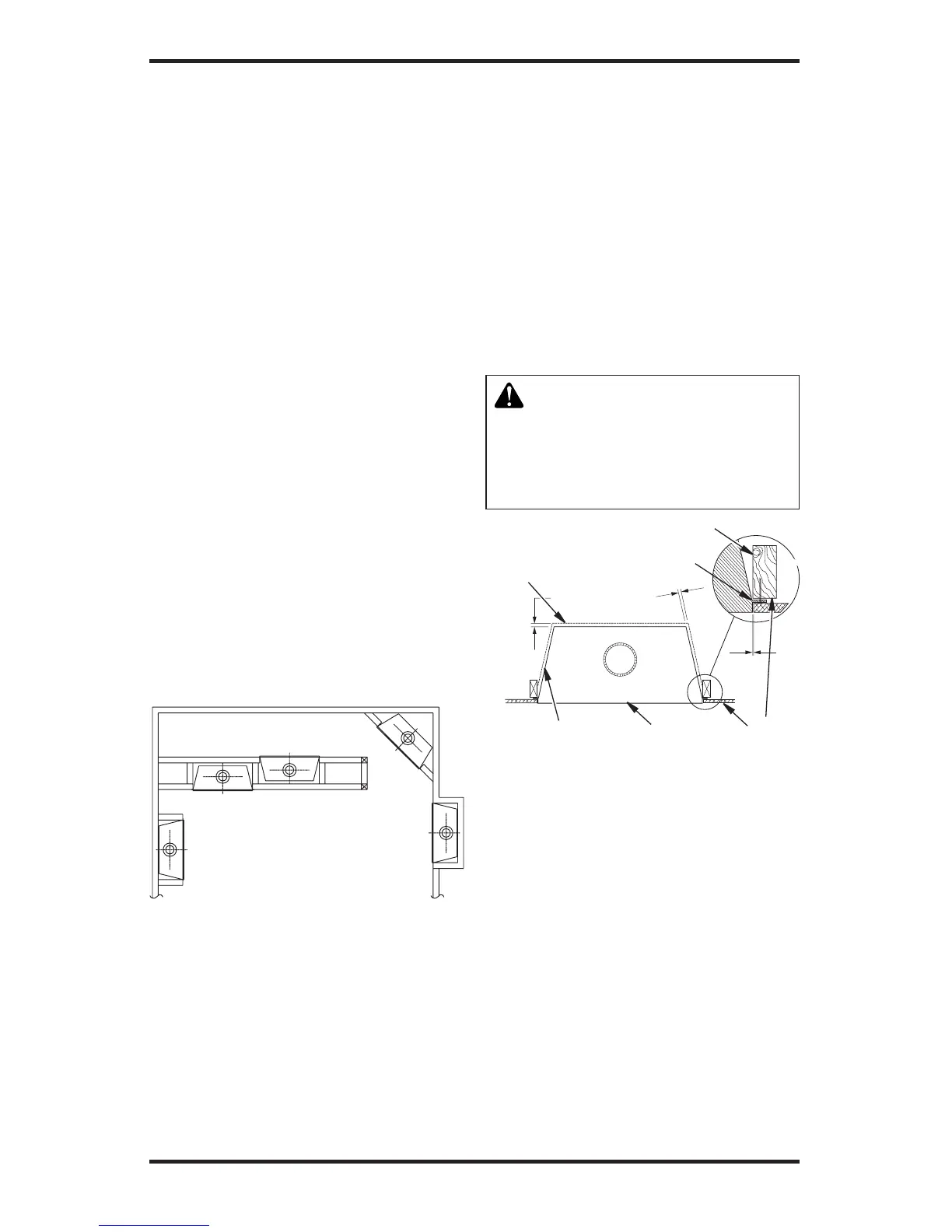
Figure 3 - Minimum Clearances
(Top View)
Nailing
Flange
Front Face
Left Side Surround
Back
Drywall
2 x 4 Stud
SELECTING LOCATION
To determine the safest and most efcient
location for your appliance, you must take into
consideration the following guidelines:
1. The location must allow for proper clear-
ances (see Clearances).
2. Consider a location where heat output
would not be affected by drafts, air con-
ditioning ducts, windows, or doors.
3. A location that avoids the cutting of joists
or roof rafters will make installation easier.
Figure 2 shows a plan view of a few com-
mon locations.
Flush installations are recommended where
living space is limited or at a premium, and
since the space required to enclose the ap-
pliance would be located beyond an outside
wall, this would also reduce the cutting of
joists, roof rafters, and such. Check local
codes for any restrictions.
Projected installations can extend any
distance into the room. A projection may
be ideal for a new addition on an existing,
nished wall.
Corner installations make use of space
that may not normally be used and provides
a wider and more efcient range for radiant
heat transference.
Internal wall installations provide a discreet
option for room separation and can also be
ideal as an addition to an existing wall.



 To Next Page