2 95-85561.1
OPERATION OVERVIEW
THEORY OF OPERATION
The OPECL transmitter module illuminates a direct lin-
ear path ending at the OPECL receiver module. As
flammable hydrocarbon gases intersect the light beam
between the two modules, certain IR wavelengths are
absorbed by the gas, while other IR wavelengths are
not. The amount of IR absorption is determined by the
concentration of the hydrocarbon gas. A pair of optical
detectors and associated electronics located in the
receiver module measure the absorption. The change
in intensity of the absorbed light (active signal) is mea-
sured relative to the intensity of light at a non-absorbed
wavelength (reference signal). The microprocessor
computes the gas concentration and converts the value
into a 4 to 20 milliampere current output signal, which is
then communicated to external control and annunciation
systems. No filter wheel motors or other moving parts
are utilized in either module.
LAMP REDUNDANCY
The OPECL transmitter provides a unique operational
feature. A xenon lamp illuminates the linear detection
path from the transmitter to the receiver. In the event
that the primary lamp fails, the back-up lamp is brought
into service. The receiver recognizes this condition by
the change in flash pulse coding and responds by initi-
ating a “failed lamp” warning signal to indicate that the
back-up lamp is in use. Total system operation is main-
tained, with no loss of sensitivity or detection perfor-
mance. In this mode of operation, the following occur:
1. The indicator LED turns amber.
2. The 4-20 mA signal drops from a normal 4 mA to 2.4
mA. The analog output value is overridden if the gas
level exceeds 0.5 LEL-meters. All gas alarm signals
will occur as when operating with the primary lamp.
3. HART and MODBUS communication warn of a
“failed lamp” condition.
Service should be arranged as soon as possible. A
new transmitter module should be installed.
DETECTABLE GASES
OPECL is capable of detecting most hydrocarbon
gases and vapors including methane, ethane, propane,
butane, and propylene. Gas type and other operational
parameters are selected via digital communications.
The factory calibrated setting is methane.
OUTPUTS
An isolated 4 to 20 mA current loop corresponding to 0
to 5 LEL-meters is provided for connection to analog
input devices such as gas controllers, logic controllers,
or distributed control systems (DCS). (Relay outputs will
be available in a future release.)
COMMUNICATION
The standard OPECL system provides an analog 4-20
mA signal output, with HART and RS-485 MODBUS seri-
al communication from the receiver module.
RECORDING CAPABILITY
Non-volatile memory is provided to save the 10 most
recent calibrations, alarm/fault events, and
minimum/maximum operating temperature history. A
real time clock is provided to record operating service
time and to time stamp events. This information is
accessible using HART and MODBUS communication.
OPERATION
MODULE IDENTIFICATION
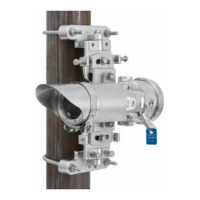
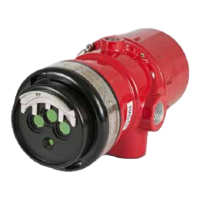
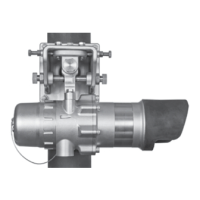
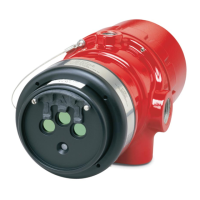
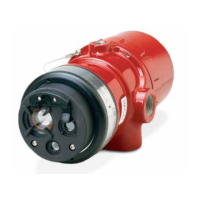
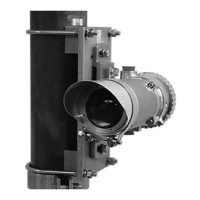
While the OPECL transmitter and receiver modules
appear physically identical, each module is labeled as
“transmitter” or “receiver” on the rear cover. The physi-
cal mounting requirements for both modules are gener-
ally identical. However, there are functional and electri-
cal characteristic differences as identified in Table 1.




 To Next Page