EasyManua.ls Logo

DeVilbiss FLG4 - User Manual

DeVilbiss FLG4
7 pages
Print Icon
To Next Page IconTo Next Page
Loading...
SERVICE BULLETIN
SB-2-775-A
Replaces SB-2-775
Gun Repair Kit FLG4-488-K
IMPORTANT: Before using this equip-
ment, read all safety precautions on
page 2 and instructions. Keep for
future use.
GUN DESCRIPTION
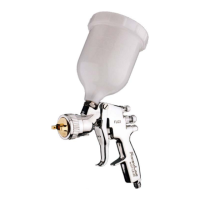
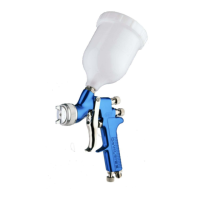
The FLG4 is a light weight, anodized alumi-
num, general purpose gravity feed spray
gun designed for use in various types of
spraying applications. Various models are
available to handle HVLP, water based, and
solvent based spraying applications.
These guns are sold with either a 900 cc
aluminum cup (702576) or a 20 oz. Acetal
cup (GFC-501). These guns are suitable
for use with water based materials ONLY
if used with a Acetal cup, or with a
disposable cup system.
Halogenated hydrocarbon sol-
vents - for example; 1, 1, 1- trichlo-
roethane and methylene chloride
- can chemically react with the
aluminum in this gun and cause
an explosion hazard. Read the
label or data sheet for the material
you intend to spray. Do not use
spray materials containing these
solvents with this spray gun.
IMPORTANT: This gun may be used with
most common coating and finishing
materials. It is designed for use with
mildly corrosive and non-abrasive materials.
If used with other high corrosive or
abrasive materials, it must be expected
that frequent and thorough cleaning will
be required and the necessity for replace-
ment of parts will be increased.
HVLP MODELS:
HVLP models of this gun were manufactured
to provide maximum transfer efficiency by
limiting air cap pressure to 10 psi (complies
with rules issued by SCAQMD and other air
quality authorities).
HVLP models of this gun will produce
approximately 10 psi cap pressure at 23 psi
gun inlet pressure, as measured at the gun
inlet. An air cap test kit (see Accessories)
should be used to insure 10 psi cap pressure
is not exceeded.
FLG4 GRAVITY FEED SPRAY GUN AND CUP
The No. 3 (HVLP) air cap requires a 13 cfm
air supply at the gun inlet of 23 psi max.,
measured with the trigger pulled.
CUP DESCRIPTIONS
702576 – 900 cc Aluminum Cup
The cup is constructed from durable
aluminum to provide trouble-free operation.
The cup insert is electroless nickel plated
brass. The disposable cup lid is recyclable
and is constructed with recycled polyeth-
ylene. The lid has a unique drip check to
prevent paint from dripping out of the vent
in the lid.
190252 (GFC-501) – 20 oz. Acetal Cup
The cup and screw-on lid are constructed
from durable Acetal to provide trouble-free
operation. The lid has a unique drip check
to prevent paint from dripping out of the
vent in the lid. The cup also has a high
grade stainless steel connector which is
compatible with water based and all com-
mon coating materials.
ASSEMBLY OF CUP TO GUN
This gun has been assembled with a cup
gasket (12) (blue) in the fluid inlet of the
gun body. Place filter (15) in the cup outlet
at this time if desired. See Cup Drawing on
page 4. Assemble cup to gun and tighten
hand tight.
INSTALLATION
Note
Protective coating and rust inhibi-
tors have been used to keep the
gun in good condition prior to
shipment. Before using the gun,
flush it with solvents so that these
materials will be removed from
fluid passages.
For maximum transfer efficiency, do not
use more pressure than is necessary to
atomize the material being applied.
Connect the gun to a clean, moisture and oil
free air supply using a hose size of at least
5/16" I.D. hose. Do not use 1/4" I.D. hose.
(25' x 1/4" hose at 18 CFM has a pressure
loss of 25 psi. 25' x 5/16" hose at 18 CFM
has a pressure loss of 8 psi.)
(continued on page 3)
Note
Depending on hose length, larger
I.D. hose may be required. Install a
DeVilbiss air adjusting valve at the
gun handle and air cap test kit over
tip. When gun is triggered on, ad-
just regulated pressure to desired
setting to provide a maximum of
10 psi at the air cap. Do not use
more pressure than is necessary
to atomize the material being ap-
plied. Excess pressure will create
additional overspray and reduce
transfer efficiency.
Note
If quick connects are required,
use only high flow quick connects
approved for HVLP use, such as
DeVilbiss HC-4419 and HC-4719.
Other types will not flow enough
air for proper gun operation.
Note
If an air adjusting valve is used
at the gun inlet, use a DeVilbiss
model. Some competitive
adjusting valves have significant
pressure drop that can adversely
affect spray performance.
DeVilbiss air adjusting valves
have minimal pressure drop,
which is important for HVLP
spraying.
OPERATION
Mix, prepare and strain the material to
be sprayed according to the paint maufac-
turer's instructions.
FILLING WITH PAINT
Fill the cup with paint to the full mark (702576)
or to bottom of the threads (GFC-501). Do
not overfill.
INSTALLING THE LID
Place plastic lid on the top of the cup, and
push in the center of the lid to assemble lid
(702576) or screw lid onto cup (GFC-501).
Fold vent cap and push onto center portion
of lid (if vent cap is not already assembled).
ENGLISH

Questions and Answers

  • M
    Mrs. Elizabeth GuerreroSep 12, 2025
    Why is the finish from my DeVilbiss Paint Sprayer thin and sandy?
    • E
      Elizabeth WangSep 12, 2025
      A thin, sandy, coarse finish that dries before it flows out when using your DeVilbiss Paint Sprayer can occur if the gun is too far from the surface, there's too much air pressure, or an improper thinner is being used. Check the distance (approximately 8 inches), reduce air pressure and check the spray pattern and follow the paint manufacturer's mixing instructions.
  • J
    julie23Sep 12, 2025
    Why is my DeVilbiss FLG4 Paint Sprayer creating excessive fog?
    • Q
      qgreenSep 12, 2025
      Excessive fogging with your DeVilbiss Paint Sprayer is often due to too much or too fast-drying thinner, or too much atomization (air pressure). Remix properly or reduce the air pressure to resolve this issue.
  • B
    buchananjoannaSep 10, 2025
    What causes a heavy center pattern with DeVilbiss FLG4 Paint Sprayer?
    • W
      Whitney RochaSep 10, 2025
      A heavy center pattern with your DeVilbiss Paint Sprayer can occur if the fluid flow is too high for the atomization air, the material flow exceeds the air cap's capacity, the spreader adjustment valve is set too low, the atomizing pressure is too low, or the material is too thick. Balance air pressure and fluid flow, increase the spray pattern width with the spreader adjustment valve, thin or lower fluid flow, adjust the pressure, and thin the material to the proper consistency.
  • Z
    Zachary ParkerSep 9, 2025
    Why does my DeVilbiss FLG4 have a split spray pattern?
    • A
      anelsonSep 9, 2025
      A split spray pattern from your DeVilbiss Paint Sprayer can be caused by atomization air pressure being too high, fluid flow being too low, or the spreader adjusting valve set too high. Reduce the air pressure at the transformer or gun, increase fluid flow to increase gun handling speed and adjust the spreader adjusting valve.
  • J
    Jacqueline CohenSep 8, 2025
    What to do if DeVilbiss FLG4 has jerky spray?
    • A
      arellanojoshuaSep 8, 2025
      A jerky or fluttering spray from your DeVilbiss Paint Sprayer can be caused by a loose or damaged fluid tip/seat, a low material level, the container being tipped too far, an obstruction in the fluid passage, or a dry or loose fluid needle packing nut. Try tightening or replacing the fluid tip/seat, refilling the material, holding the container more upright, backflushing with solvent, or lubricating or tightening the fluid needle packing nut.
  • R
    Regina MartinAug 23, 2025
    Why is there excessive overspray from my DeVilbiss FLG4?
    • A
      Anthony BaldwinAug 23, 2025
      Excessive overspray with your DeVilbiss Paint Sprayer can occur if the atomization air pressure is too high, the gun is too far from the work surface, or if your stroking technique is off (arcing or moving the gun too fast). To fix this, reduce the pressure, adjust to the proper distance from the surface, and move the gun at a moderate pace, parallel to the work surface.
  • K
    Kelly DanielsSep 6, 2025
    What causes a starved spray pattern in my DeVilbiss Paint Sprayer?
    • C
      Chad RodriguezSep 6, 2025
      A starved spray pattern from your DeVilbiss Paint Sprayer is often caused by inadequate material flow or low atomization air pressure. To resolve this, back the fluid adjusting screw out to the first thread, or change to a larger tip size. Also, increase the air pressure and rebalance the gun.
  • P
    Patricia CarrilloSep 5, 2025
    Why is fluid leaking from the front of my DeVilbiss FLG4 Paint Sprayer?
    • S
      Sara HallSep 5, 2025
      Fluid leaking or dripping from the front of your DeVilbiss Paint Sprayer could be due to a packing nut that is too tight, dry packing, a worn or damaged fluid tip or needle, foreign matter in the tip, a broken fluid needle spring, or the wrong size needle or tip. Adjust the packing nut, lubricate the packing, replace the tip and needle, clean the tip, and replace the needle or the tip.
  • S
    Susan MatthewsSep 4, 2025
    What causes 'orange peel' with DeVilbiss FLG4 Paint Sprayer?
    • M
      Martin ChristensenSep 4, 2025
      A thick, dimpled finish or "orange peel" when using your DeVilbiss Paint Sprayer may occur if the gun is too close to the surface, too much material is coarsely atomized, air pressure is too low, an improper thinner is being used, the material is not properly mixed, or the surface is rough, oily, or dirty. Check the distance (normally approximately 8 inches), follow the paint manufacturer's mixing instructions, increase air pressure or reduce fluid flow and properly clean and prepare the surface.
  • C
    Christopher PalmerSep 3, 2025
    Why does my DeVilbiss FLG4 have a heavy right or left side pattern?
    • D
      Dr. David ThomasSep 3, 2025
      A heavy right or left side pattern is caused by left or right side horn holes that are plugged or dirt on the left or right side of the fluid tip. To fix this, clean the affected parts and ream with a non-metallic point.

Summary

Gun Description and Cups

HVLP Model Specifications

Details HVLP models' air cap pressure limits and CFM requirements for efficient spraying.

900 cc Aluminum Cup

Describes the durable aluminum cup with nickel-plated brass insert and recyclable lid.

20 oz. Acetal Cup

Details the acetal cup with drip check lid and stainless steel connector for water-based materials.

Cup Assembly, Installation, and Operation

Cup Assembly Procedure

Instructions for attaching the cup to the gun body, including gasket and filter.

Installation and Setup

Covers initial flushing, air supply connection, pressure adjustment, and quick connects for optimal spray.

Spray Operation Guidelines

Instructions for mixing materials, filling the cup, and installing the lid for proper spray gun use.

Safety Precautions

General Safety Symbols and Warnings

Explains warning, caution, and note symbols used in the manual for user safety.

Equipment Hazards and Safeguards

Details hazards like fire, solvent spray, toxic substances, explosion risks, and general safety practices with safeguards.

California Proposition 65 Warning

Informs about chemicals known to cause cancer or birth defects in California products.

Painting, Cleaning, and Maintenance

Painting Adjustments

Guides on adjusting spreader valve, fluid needle, and air pressure for optimal spray patterns.

Cup Lid Caution

Warning against soaking cup lids in solvent for extended periods to prevent sealing issues.

Cleaning Procedures

Instructions for routine cleaning, fluid passage cleaning, and air cap cleaning.

Preventive Maintenance: Lubrication

Daily lubrication points for trigger, air valve, fluid needle, and baffle for optimal gun performance.

Parts Replacement Guidance

Recommendations for replacing fluid tips, needles, and seals simultaneously, including torque specifications.

Parts Identification and Troubleshooting

Spray Gun Parts List

Lists all components of the FLG4 spray gun with part numbers for 702576 and GFC-501 cups.

Troubleshooting Common Issues

Identifies common spray patterns like heavy top/bottom or split spray and provides corrective actions.

Troubleshooting Leaks and Finish Defects

Addresses issues like fluid leaks, runs, sags, and thin, sandy finishes with specific solutions.

Accessories and Warranty

Recommended Accessories

Lists optional accessories like cleaning kits, cups, regulators, air cap test kits, and gun holders.

Warranty Information

Details the 1-Year Limited Warranty provided by DeVilbiss Automotive Refinishing.

DeVilbiss FLG4 Specifications

General IconGeneral
TypeGravity Feed Spray Gun
Nozzle Size1.4 mm
Cup Capacity600 ml
MaterialAluminum
Pressure29 psi
Fluid Tip1.4 mm
Air Inlet1/4 inch
ApplicationAutomotive, Industrial
Operating Pressure29 psi

Related product manuals