EasyManua.ls Logo

Dräger Bodyguard 7000 - User Manual

Dräger Bodyguard 7000
4 pages
Print Icon
To Next Page IconTo Next Page
Loading...
$'33DJH
Bodyguard
®
7000
Electronic monitoring system
,QVWUXFWLRQVIRUXVH
Bodyguard
®
7000Electronic monitoring system
1 Safety-related information
Before using this product, carefully read these instructions for use
and those of the associated products.
Strictly follow the instructions for use. The user must fully understand
and strictly observe the instructions. Use the product only for the
purposes specified in the intended use section (see section 3.4).
Do not dispose of the instructions for use. Ensure that they are
retained and appropriately used by the product user.
Only trained and competent users are permitted to use this product.
Comply with all local and national rules and regulations associated
with this product.
Only specialist, trained personnel are permitted to check, repair and
maintain the product as described in these instructions for use and
the technical manual. Further maintenance work that is not detailed in
these instructions for use or in the technical manual must only be
carried out by Dräger or personnel qualified by Dräger. Dräger
recommend a Dräger service contract for all maintenance activities.
Only use genuine Dräger spare parts and accessories when
performing maintenance work, or the proper functioning of the
product may be impaired.
Do not use a faulty or incomplete product. Do not modify the product.
Notify Dräger in the event of any component fault or failure.
2 Conventions in this document
2.1 Meaning of the warning notes
The following warning notes are used in this document to notify users of
possible dangers. The meanings of the warning notes are defined as
follows:
2.2 Typographical conventions
2.3 Registered trademarks
The trademarks listed are only registered in certain countries and not
necessarily in the country in which this material is sold.
2.4 Abbreviations
3 Description
3.1 Product overview
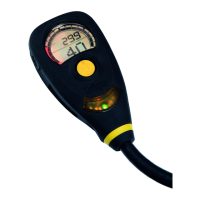
The Dräger Bodyguard
®
7000 (Fig. 1) is an electronic monitoring system
with an integral DSU. The system provides visual and audible information
about the status of the breathing apparatus. Visible signals are provided
by LEDs in the LED panel and on the LCD screen of the user interface
(Fig. 2). Audible signals are emitted from an electronic sounder in the
user interface. The audible signals are easily recognized with varying
sound patterns to distinguish between different alarm types.
The product is configured as a button version (Bodyguard
®
7000) or a
tally version (Bodyguard
®
7000T). The main difference between the
version types is the functionality of the distress signal unit. The button
version can be used with the motion sensor of the automatic distress
alarm deactivated. The tally version can only be used with the motion
sensor activated.
Fig. 1 Bodyguard
®
7000
Fig. 2 User interface
3.2 Feature description
3.2.1 Power pack
The power pack connects to the pressure module to supply power to the
electronic monitoring system. The power pack types available for
Bodyguard
®
7000 have 5 replaceable 1.5 V batteries or a single 6.5 V
rechargeable battery.
Further details about the power pack and how each type is used is in the
maintenance information (see section 6.5).
3.2.2 User interface
The user interface has an LCD screen which shows the cylinder
pressure, the time until the whistle activates, and other operational
information. The screen has a backlight which illuminates when a user
interface button is pressed, when an alarm activates, and when a status
message appears on screen. The LED panel has one green, two blue,
and two red LEDs which illuminate or flash to provide operational
information.
The left-hand and right-hand press buttons are used to control operating
features of the electronic system. The button functions are described
where applicable in these instructions for use.
An internal sounder emits audible signals to notify the user about
breathing apparatus alarms and status messages. The sound patterns
include continuous alarms and single or multiple tones. The sounder
uses the tally slots as amplification chambers to provide clear and loud
alarms.
3.2.3 Cylinder pressure monitoring
The pressure module is connected to the breathing apparatus pneumatic
system through the high-pressure hose. The electronic monitoring
system displays cylinder pressure and TTW, and provides alarm signals
at preset pressure levels.
Time to whistle
The TTW is the calculated time in minutes until the EOST alarm
activates. The system uses the breathing apparatus air cylinder pressure
and the current consumption rate of the wearer to calculate and display
TTW. An initial calculation is made using a default consumption rate of
40 L/min. The calculation is then updated once per second based on the
actual consumption rate of the wearer (a minimum consumption rate of
40 L/min is applied to the calculation).
At the preset pressure, the EOST alarm commences (see section 4.2.3).
The mechanical whistle on the breathing apparatus also commences at
approximately the same time.
Retreat alert
Retreat alert is an alternative warning protocol that is available if it is
applicable in the country of use (see section 4.5.5).
3.2.4 Distress signal unit
The DSU provides automatic and manual distress alarms. The automatic
distress alarm uses an internal motion sensor and timer to measure the
time that the wearer has been motionless, in order to indicate that the
wearer may be unconscious or trapped. The motion sensor activates a
pre-alarm and a full alarm at predetermined intervals when the wearer
does not move in excess of normal breathing movement. The manual
distress alarm is activated by pressing the manual alarm button to call for
help or attention. The alarm activation times are in section 9, and the
alarm patterns are in section 4.2.3.
A limitation of the automatic distress alarm is that the motion sensor
detects movement or vibration to which the wearer is subjected. If the
wearer is motionless but on a moving platform (on moving or vibrating
machinery for example) the automatic distress alarm might not activate.
3.3 Optional features and equipment
3.3.1 Dräger PC Link
Dräger PC Link is an RF communication device and software application
which can read and configure Dräger electronic monitoring systems.
Configurable settings and parameters include alarm patterns, warning
levels, timings, and the start-up options (see section 4.4.3). Readable
information includes the product identification details, the firmware
versions, and a datalog (see section 3.3.2).
PC Link can also read and write information on user ID cards which are
available from Dräger for use with Bodyguard
®
7000 (see section 4.5.2).
See the PC Link instructions for use or contact Dräger for more
information.
The settings specified in these instructions for use (pressures, alarm
patterns, start-up options, etc.) are the default configuration settings for
Bodyguard
®
7000.
3.3.2 Datalog
The datalog is a record of the event history which is automatically
recorded in the system memory. The datalog stores approximately
20 hours of the most recent system events (based on typical operational
use of the system and the default datalog recording interval of
20 seconds). The datalog can be downloaded and viewed using Dräger
PC Link.
3.3.3 Telemetry (Dräger PSS
®
Merlin
®
)
Dräger PSS
®
Merlin
®
is a telemetry system which can be used with
Dräger electronic monitoring systems. When fitted, the telemetry system
is used to monitor and control breathing apparatus wearers that are
deployed at an incident. The telemetry system uses radio communication
to transmit status and information signals between deployed breathing
apparatus wearers and an external entry control board or software
system. See the PSS
®
Merlin
®
instructions for use or contact Dräger for
more information.
3.3.4 Head-up display
The Dräger FPS
®
7000 HUD is a wireless head-up display which can be
used with Dräger electronic monitoring systems. The HUD is a battery
powered device that fits inside the mask, and has LEDs which display
breathing apparatus cylinder pressure and battery status information.
See the FPS
®
7000 HUD instructions for use or contact Dräger for more
information.
3.4 Intended use
Bodyguard
®
7000 is intended for use as an electronic monitoring system
on compatible Dräger breathing apparatus. The monitoring system
provides accurate cylinder pressure and remaining time information, and
activates alarm signals at critical pressures. The integrated DSU provides
clear, distinct, and easily recognized alarm signals that indicate wearer
immobilization or a call for help or attention.
3.5 Use in potentially explosive atmospheres
Bodyguard
®
7000 is type tested as suitable for use in potentially
explosive atmospheres. Electronic sub-assemblies are ATEX certified. All
combinations are suitable for use in hazardous areas up to and including
zone 0 and zone 20.
3.6 Approval information
The European standards, guidelines, and directives according to which
this product is approved are specified in the declaration of conformity
(see the declaration of conformity or www.draeger.com/product-
certificates).
In addition, the product conforms with the following regulations.
DSU approval: BS 10999:2010 (specification for distress signal units
for the fire and rescue service). The product only conforms with this
standard when configured as a tally version.
RF compliance: EN 61000-4-3 CE; and 30 V/m to ISO 11452 Part 2.
Alert
icon
Signal word Consequences in case of non-obervance
WARNING Indicates a potentially hazardous situation. If
not avoided, it could result in death or serious
injury.
CAUTION Indicates a potentially hazardous situation. If
not avoided, it could result in physical injury. It
may also be used to alert against unsafe prac-
tices.
NOTICE Indicates a potentially hazardous situation. If
not avoided, it could result in damage to the
product or environment.
A triangle is used in safety statements to indicate possible ways of
avoiding the hazard.
An information symbol is used for notes and additional useful
information.
1. Numbered paragraphs indicate that the information is sequential.
Dashed paragraphs indicate that the information is non-sequen-
tial.
Trademark Trademark owner
Bodyguard
®
Dräger
Duracell
®
Duracell U.S. Operations, Inc.
FPS
®
Dräger
Merlin
®
Dräger
PSS
®
Dräger
Abbreviation Explanation
DSU Distress signal unit
EOST End of service time
HUD Head-up display
ID Identity
LCD Liquid crystal display
LED Light-emitting diode
RF Radio frequency
TTR Time to retreat
TTW Time to whistle
41137
1 User interface
2 Connecting cable
3
Backup battery holder (not used on Bodyguard
®
7000)
4 Pressure module
5 Power pack
6 High-pressure hose
41138
7 Cylinder pressure
8 Right-hand button
9 TTW in minutes
10 Tally
11 LED panel
12 Manual alarm button
13 LCD screen
14 Left-hand button
15 Radial segments

6
1
2
3
4
5
15
14
13
12
11
10
9
8
7
Question and Answer IconNeed help?

Do you have a question about the Dräger Bodyguard 7000 and is the answer not in the manual?

Summary

Safety-related information

Conventions in this document

Meaning of Warning Notes

Explains warning symbols (Alert, WARNING, CAUTION, NOTICE) and their meanings.

Product Description and Features

User Interface and Display

Describes the LCD screen, LED panel, and buttons of the user interface.

Intended Use and Safety

Specifies the product's intended use and suitability for explosive atmospheres.

Operation and Functions

Alarms and Status Messages

Explains how the system signals alarms like low battery or distress.

Advanced Functions and Troubleshooting

Troubleshooting Guide

Provides a table of symptoms, faults, and remedies for common issues.

Functional Testing Procedures

Details the steps for performing essential functional tests on the system.

High-Pressure Leak Test

Describes the procedure for testing the pneumatic system for leaks.

Power Pack and Charging

Overview

The Dräger Bodyguard® 7000 is an electronic monitoring system with an integrated distress signal unit (DSU), designed to provide visual and audible information about the status of a breathing apparatus. This system ensures user safety by monitoring critical parameters and alerting the wearer to potential hazards.

Function Description

The Bodyguard® 7000 provides essential information through its user interface, which features an LCD screen and an LED panel. The LCD screen displays cylinder pressure, the estimated time until the end-of-service-time (EOST) alarm activates (Time to Whistle, TTW), and other operational messages. A backlight illuminates the screen when a button is pressed, an alarm activates, or a status message appears. The LED panel includes one green, two blue, and two red LEDs that illuminate or flash to provide operational information. Audible signals are emitted from an internal sounder, using varying sound patterns to distinguish between different alarm types, such as continuous alarms or single/multiple tones. The sounder utilizes the tally slots as amplification chambers for clear and loud alarms.

The system is available in two configurations: a button version (Bodyguard® 7000) and a tally version (Bodyguard® 7000T). The primary difference lies in the functionality of the distress signal unit. The button version allows the motion sensor of the automatic distress alarm to be deactivated, while the tally version requires the motion sensor to be activated.

Cylinder Pressure Monitoring and Time to Whistle (TTW)

The pressure module connects to the breathing apparatus pneumatic system via a high-pressure hose. The electronic monitoring system continuously displays cylinder pressure and TTW. Alarm signals are provided at preset pressure levels.

The TTW is a calculated time in minutes until the EOST alarm activates. The system uses the breathing apparatus air cylinder pressure and the wearer's current air consumption rate to calculate and display TTW. An initial calculation uses a default consumption rate of 40 L/min, which is then updated every second based on the actual consumption rate (with a minimum of 40 L/min applied). The EOST alarm commences at a preset pressure, coinciding with the mechanical whistle on the breathing apparatus. An alternative warning protocol, the Retreat alert, may be available depending on the country of use.

Distress Signal Unit (DSU)

The DSU provides both automatic and manual distress alarms. The automatic distress alarm uses an internal motion sensor and timer to detect wearer immobility, indicating potential unconsciousness or entrapment. A pre-alarm and a full alarm activate at predetermined intervals if the wearer remains motionless beyond normal breathing movement. The manual distress alarm is activated by pressing the manual alarm button to call for help or attention. It's important to note that the automatic distress alarm's motion sensor may not activate if the wearer is motionless but on a moving or vibrating platform.

Optional Features and Equipment

  • Dräger PC Link: This RF communication device and software application allows for reading and configuring Dräger electronic monitoring systems. Configurable settings include alarm patterns, warning levels, timings, and start-up options. It can also read product identification, firmware versions, and a datalog. PC Link can also read and write information on user ID cards for use with Bodyguard® 7000.
  • Datalog: The system automatically records event history in its memory, storing approximately 20 hours of recent system events (based on typical operational use and a default recording interval of 20 seconds). The datalog can be downloaded and viewed using Dräger PC Link.
  • Telemetry (Dräger PSS® Merlin®): This telemetry system monitors and controls breathing apparatus wearers deployed at an incident. It uses radio communication to transmit status and information signals between wearers and an external entry control board or software system.
  • Head-up display (Dräger FPS® 7000 HUD): This wireless head-up display fits inside the mask and uses LEDs to display breathing apparatus cylinder pressure and battery status information.

Usage Features

The Bodyguard® 7000 is designed for ease of use during operations.

  • Preparation for Use: Before use, a visual inspection should be performed, and the breathing apparatus assembled according to its instructions. Functional testing of the Bodyguard® 7000 should be carried out when instructed. Once the cylinder valve is opened, the self-test and start-up sequences run, and the system enters active mode. For the tally version, removing the tally activates the motion sensor; for the button version, removing the tally is optional if the motion sensor is required.
  • During Use: Users should regularly check the LCD screen for cylinder pressure and TTW. The manual alarm button can be pressed for emergency help. Pressing and quickly releasing the left-hand or right-hand button illuminates the screen backlight. The right-hand button also scrolls any stored user ID information.
  • Alarms and Status Messages: The system emits pre-alarm and full alarm patterns, including increasing-volume 3-tone alarms and high-pitched repeating alarms, accompanied by flashing LEDs and screen backlight. The EOST alarm pattern is an intermittent high-pitched alarm with flashing LEDs and a red sector on the LCD screen, coinciding with the mechanical whistle. Users are warned to evacuate to a safe area immediately if warnings commence.
  • Self-Test and Start-Up Sequences: The system switches on when the power pack is fitted, a button is pressed, the tally is removed, or the pneumatic system is pressurized. During self-test, alarm tones sound, LEDs and screen flash. If the self-test passes, the system enters active mode. If it fails, a cross symbol and fault code, or a low battery/battery error symbol, are displayed, and the system switches off. The start-up sequence provides information and options, such as cylinder type selection, electronic leak test prompts, and motion sensor status.
  • Active Mode: This is the main operating mode, with the normal operating screen displayed and the green LED flashing every second.
  • Switching Off: The system cannot be switched off until the cylinder pressure is below a preset value. The cylinder valve must be closed, and the pneumatic system fully vented. For the tally version, refitting the tally or pressing and holding the left-hand button switches it off. For the button version, pressing and holding both left-hand and right-hand buttons switches it off.
  • User ID (Scrolling Data): Information about the wearer can be uploaded from a user ID card. This information can then be scrolled across the screen by pressing the right-hand button during use.
  • Cylinder Selection: If multiple cylinder types are stored, the user can select the required type during start-up.
  • Quiet Alarm: This feature allows users to select reduced volume alarms for operations in restricted spaces, such as chemical protective suits or repair workshops. The alarm volume is reduced for the current operation only and automatically resets to full volume when switched off.

Maintenance Features

Regular maintenance is crucial for the continued safe and effective operation of the Bodyguard® 7000.

  • Maintenance Table: The maintenance table outlines tasks to be performed after use, including cleaning, inspection, and functional testing.
  • Troubleshooting: The troubleshooting guide provides remedies for common faults, such as low battery, battery error, or system failure. Users are advised to contact Dräger service personnel for faults that cannot be resolved through basic troubleshooting.
  • Power Pack Maintenance: The power pack connects to the pressure module to supply power. Bodyguard® 7000 uses either 5 replaceable 1.5 V batteries or a single 6.5 V rechargeable battery.
    • Fitting the Power Pack: The power pack should be inspected for clean and undamaged battery terminals and sealing rim before insertion. It is then pushed firmly into the backplate recess until the sliding latches lock. For telemetry versions, a screw must be tightened to secure the power pack.
    • Removing the Power Pack: The screw (for telemetry versions) must be loosened, and the power pack released by pressing the two release buttons.
    • Replacing 1.5 V Batteries: For power packs with replaceable batteries, the power pack must be removed, the battery cover unscrewed, and the old batteries replaced with new ones, observing polarity. The sealing ring inside the battery cover should be inspected for damage. Only approved battery types (Duracell® LR6 or Duracell® Plus LR6) should be used.
    • Charging Rechargeable Power Packs: Rechargeable power packs can be charged using the Dräger 4-Way Charger or the Dräger In-Cab Charger (for telemetry versions only).
  • Storage: The product should be stored according to the associated breathing apparatus instructions. If not used for a long period, the power pack or batteries should be removed.

Use in Potentially Explosive Atmospheres

The Bodyguard® 7000 is type-tested for use in potentially explosive atmospheres, with ATEX certified electronic sub-assemblies. All combinations are suitable for use in hazardous areas up to and including zone 0 and zone 20.

Dräger Bodyguard 7000 Specifications

General IconGeneral
ApprovalATEX, IECEx, UL, CSA
Alarm pressureConfigurable
Data logYes
Operating time logYes
Event logYes
Measurement Range H2S0 to 100 ppm
Measurement Range Ex0 to 100 %LEL
Resolution CO1 ppm
Resolution H2S0.1 ppm
Resolution Ex1 %LEL
Resolution PID0.1 ppm
DisplayLCD with backlight
Operating Temperature-20 °C to +50 °C
Measurement RangeDepends on sensor configuration
Temperature range-20 °C to +50 °C
Battery typeRechargeable Li-ion battery
Measurement ParametersO2, CO, H2S, CO2, Ex, IR, PID, Tox
Measurement Range CO0 to 1000 ppm
Measurement Range CO20 to 5 vol.%
Measurement Range IR0 to 5 % vol
Measurement Range PID0 to 2000 ppm
Resolution O20.1 % vol
Resolution IR0.01 % vol
Measurement Range ToxDepends on sensor
Resolution ToxDepends on sensor

Related product manuals