
 Need help?
Do you have a question about the Dräger Polytron 5100 and is the answer not in the manual?
Provides essential safety guidelines for using the Dräger Polytron 5100 instrument and its components.
Explains the meaning of hazard alert icons (DANGER, WARNING, CAUTION, NOTICE) used in the document.
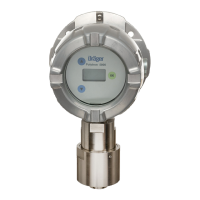
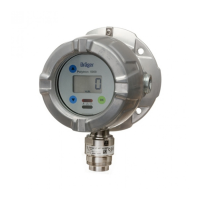
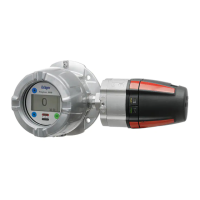
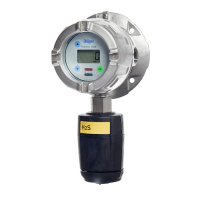
Details the components of the Dräger Polytron 5100, including explosion-proof and increased safety instrument types.
Specifies the intended application, hazardous area classification (zones/divisions), and operating conditions for the instrument.
Covers key considerations for selecting installation sites and ensuring system performance and effectiveness.
Outlines limitations and requirements for power supply, cable specifications, and environmental exposure.
Provides guidance on mounting the instrument on a flat surface, ensuring accessibility and unobstructed sensor view.
Details power and signal wiring, including 2-wire/3-wire configurations, and relay options.
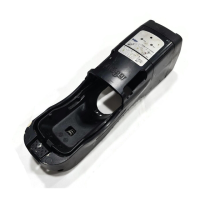
Describes the two-step process for mounting and connecting the Docking Station and main instrument.
Step-by-step instructions for correctly installing the EC sensing head into the instrument or sensing head housing.
Covers mounting kits, sensor installation, and connecting the remote EC sensing head to the Polytron 5100.
Details the start-up sequence, warm-up period, and normal display and LED indications during operation.
Explains the analog output signal (4-20 mA) proportional to the detected gas concentration.
Describes the meaning of display segments and LED indicators for normal operation, faults, and alarms.
Guides users on navigating the instrument's menu using a magnetic wand for configuration and parameter changes.
Provides a flowchart of menu options and describes key functions like zero adjustment, span adjustment, and relay tests.
Defines recommended inspection and check intervals for commissioning, every 6 months, and on demand sensor changes.
Details the general procedure for calibration, including zero and span calibration, and warnings for proper execution.
Step-by-step guide for performing zero calibration using ambient air or nitrogen, ensuring correct zero point adjustment.
Instructions for span calibration using calibration gas, adjusting sensitivity to match known concentration.
Lists common error and warning messages, their causes, and recommended remedies for the instrument.
Provides instructions for safely replacing the sensor, including necessary checks and potential factory default loading.
Details the procedure for replacing the main electronics, including power disconnection and parameter checks.
Guidelines for cleaning the instrument using a soft cloth, water, and mild detergent.
Lists safety approvals (ATEX, IECEx, UL) and explains the serial number key for determining the manufacturing year.
Details analog output signal ranges, power supply requirements, and cable specifications.
Provides dimensions, weight, enclosure details, and environmental operating/storage conditions.
Provides torque values for instrument threads and field wiring terminals for proper installation.
Lists available models of the Dräger Polytron 5100 gas detection instrument with their corresponding part numbers.
Details the available docking station versions, including power-only and power-and-relay configurations.
Lists various accessories and common spare parts available for the Dräger Polytron 5100.
States the product's compliance with EC directives (ATEX, EMC, Low Voltage) and lists applicable standards.
The Dräger Polytron 5100 is an explosion-proof instrument designed for the continuous monitoring of toxic gases and oxygen in ambient air. It is housed in a rugged stainless steel or aluminum enclosure, making it suitable for both indoor and outdoor applications.
The Polytron 5100 operates by measuring the partial pressure of gases using electrochemical sensors. The monitored ambient air diffuses through a membrane into a liquid electrolyte within the sensor. An electronic potentiostat circuit maintains a constant electrical voltage between the measuring electrode and reference electrode. The gas, selected to suit the monitoring requirements, is electrochemically transformed on the measuring electrode, generating a current proportional to the gas concentration. Simultaneously, oxygen from the ambient air reacts at the counter-electrode. This current is then electronically amplified, digitized, and corrected for various parameters, including ambient temperature.
The instrument can be connected to a Dräger monitoring system or a Programmable Logic Controller (PLC) via a sealed conduit or approved cable gland. With an optional alarm relay configuration, it can also function as a stand-alone unit, providing local alarm signaling. It is designed for permanent installation in hazardous, classified areas (Zone 1 or 2, Class I or II, Div. 1 or 2) with specific temperature ranges (T4 or T6) and gas/dust groups (IIA, IIB, IIC or A, B, C, D, E, F, G).
The device is powered by 10 to 30 VDC (or 18 to 30 VDC for 2-wire configuration). Gas concentrations, status messages, and menu choices are displayed on a back-lit 4-digit LC-display and three colored LEDs. The measured gas concentration is converted to a 4 to 20 mA analog output signal per NAMUR recommendation NE43. It supports both 2-wire and 3-wire configurations, though certain features like the back-lit display or relays are not supported in 2-wire mode due to power consumption.
Navigation through the menu is performed non-intrusively by tapping a magnetic wand on the glass at the appropriate indicator. This allows for configuration, calibration, and maintenance without declassifying the area.
 General
| Brand | Dräger |
|---|---|
| Model | Polytron 5100 |
| Category | Measuring Instruments |
| Language | English |


 To Next Page