EasyManua.ls Logo

Dräger JM-105 - User Manual

Dräger JM-105
9 pages
Print Icon
To Next Page IconTo Next Page
Loading...
1
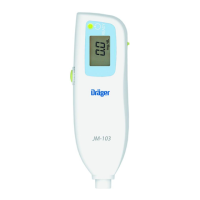
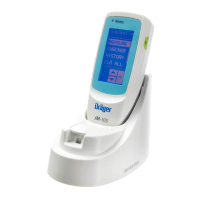
Dräger Jaundice Meter JM-105
Sample Usage Protocol Template
Purpose
This Sample Usage Protocol is provided as a template for creating a facility
or department-specific protocol for using the Dräger Jaundice Meter JM-105.
Description and Intended Use
The Dräger Jaundice Meter JM-105 is intended for use as a screening device
for jaundice in the newborn. The Jaundice Meter JM-105 provides a
transcutaneous measurement of bilirubin in mg/dL or µmol/L, identifying
neonates who require a serum bilirubin measurement.
*1
For the intended use please refer to the instructions for use
Screening for Hyperbilirubinemia
When combined with a systematic assessment of the risk factors for
hyperbilirubinemia, the Dräger Jaundice Meter JM-105 can identify neonates
who are at increased risk for more severe hyperbilirubinemia in the first
week of life, and who might require closer monitoring.
Two protocols are suggested for using the Dräger Jaundice Meter JM-105 as
a screening device for hyperbilirubinemia. One is based on risk factors, the
other is universal screening.

Other manuals for Dräger JM-105

Question and Answer IconNeed help?

Do you have a question about the Dräger JM-105 and is the answer not in the manual?

Summary

Purpose and Intended Use

Description and Intended Use

Explains the Dräger Jaundice Meter JM-105 as a screening device for neonatal jaundice.

Screening for Hyperbilirubinemia

Details how the meter identifies neonates at risk for hyperbilirubinemia based on assessment.

Testing Procedure

Prepare the Jaundice Meter JM 105 for Use

Outlines the daily operational checkout procedure for the Jaundice Meter JM-105.

Configure the Jaundice Meter JM-105

Describes how to configure device settings for memory and measurement averaging.

Take a Transcutaneous Bilirubin (TcB) Measurement

Provides step-by-step instructions for performing a TcB measurement.

Plot the Result on the Transcutaneous Bilirubin Nomogram

Explains how to plot TcB results on a nomogram to determine percentile ranges.

Staff Competency and Validation

Staff Competency Validation

Details the training requirements and process for personnel using the Jaundice Meter JM-105.

New or Serviced Device Validation

Recommends validating the device against serum bilirubin readings for accuracy.

Overview

The Dräger Jaundice Meter JM-105 is a screening device designed for the non-invasive assessment of jaundice in newborns. It provides a transcutaneous measurement of bilirubin (TcB) in mg/dL or µmol/L, helping to identify neonates who may require a serum bilirubin (TSB) measurement. This device is intended to be used as part of a systematic assessment of risk factors for hyperbilirubinemia, allowing for the identification of infants at increased risk for more severe hyperbilirubinemia in their first week of life, thereby prompting closer monitoring.

Function Description:

The primary function of the Dräger Jaundice Meter JM-105 is to measure transcutaneous bilirubin levels. It does this by emitting light into the skin and analyzing the reflected light to estimate the bilirubin concentration. This method offers a quick and non-invasive alternative to traditional blood draws for initial screening. The device is particularly useful for identifying neonates who are at risk for hyperbilirubinemia, a condition characterized by elevated bilirubin levels that can lead to jaundice. By providing immediate TcB readings, the JM-105 helps healthcare professionals make timely decisions regarding further diagnostic testing, such as serum bilirubin measurements. The device is designed to be user-friendly, with a clear display that shows the measured bilirubin values. It can be configured to display results in either mg/dL or µmol/L, accommodating different clinical standards.

Usage Features:

The Dräger Jaundice Meter JM-105 offers several features to facilitate its use in various clinical settings.

  • Screening Protocols: Two main protocols are suggested for its use:

    • Risk Factor-Based Screening: This protocol involves screening neonates who present with specific risk factors for hyperbilirubinemia. These factors include jaundice within the first 24 hours of life, blood group incompatibility, visible jaundice after 24 hours of age, gestational age ≤ 38 weeks, bruising or cephalhematoma, breastfeeding, inadequate feeding or excessive weight loss, a sibling with jaundice, East Asian race, or an ethnic group at risk for G6PD deficiency (e.g., African-American male, Greek/Mediterranean, Italian, Middle Eastern). Neonates with any of these risk factors should be screened with the JM-105 prior to discharge, or earlier if jaundice is observed.
    • Universal Screening: This protocol recommends screening all neonates with the JM-105 prior to discharge. For neonates exhibiting jaundice within the first 24 hours of life, immediate screening with the device is advised, along with sending a serum bilirubin sample to the laboratory.
  • Measurement Site Selection: The device allows for flexibility in choosing the measurement site, depending on the clinical environment:

    • Hospital Nursery/Postpartum/Family Birth Center: The neonate's mid-sternum is the preferred site, but the forehead can also be used.
    • Physician's Office/Clinic/Outpatient Setting/Emergency Room: In these settings, only the neonate's mid-sternum should be used. This recommendation is based on the rationale that these neonates have typically been discharged from the hospital and their faces may have been exposed to more ambient sunlight, which can affect forehead readings.
  • Measurement Procedure: Taking a transcutaneous bilirubin measurement involves a straightforward process:

    1. Clean the tip of the probe with an alcohol swab.
    2. Power on the device.
    3. Select "MEASURE" from the menu.
    4. Place the probe tip flat against the baby's skin (not at an angle) and press lightly until a click is heard.
    5. Lift the device from the skin between measurements and wait for the green READY light to illuminate before repeating the process. This ensures accurate readings and allows for multiple measurements if an averaging function is selected.
    6. The device can be configured to take a single measurement or average multiple measurements (e.g., 2, 3, 4, or 5 times) for increased accuracy. The display will show individual readings and the averaged result.
  • Out-of-Range Indicators: If a measured value falls outside the device's measuring range (e.g., 0 to 20 mg/dL or 0 to 340 µmol/L), a blinking value will appear on the display. The specific blinking indicator (e.g., "-0-", ">20", or ">340") depends on the user's preference settings.

  • Nomogram Plotting: Results from the JM-105 can be plotted on a transcutaneous bilirubin nomogram, specifically designed for neonates up to 96 hours of age (≥35 weeks of gestation). This nomogram helps visualize the baby's TcB value in relation to percentile ranges, aiding in the assessment of risk for hyperbilirubinemia. For example, a TcB of 10 mg/dL at 50 hours of age might place a baby at the edge of the 95th percentile, indicating a need for a TSB measurement. Subsequent TcB measurements can also be plotted to detect trends, such as a rapidly rising TcB.

Maintenance Features:

The Dräger Jaundice Meter JM-105 incorporates features to ensure its proper functioning and reliability, primarily through a daily operational checkout procedure.

  • Daily Operational Checkout: Before each use, a daily operational checkout procedure must be performed:

    1. Remove the JM-105 from its docking station.
    2. Press the power switch on.
    3. Select "CHECKER" and confirm with "OK."
    4. Open the checker lid on the charging unit.
    5. Once the green READY light illuminates, place the tip of the Jaundice Meter perpendicularly on the reading checker circle and press down until a click is heard.
    6. The display screen will show "L" (long), "S" (short), and "Delta" values. These readings must fall within the reference values posted under the checker lid. If the values are within range, the unit is ready for use. If not, the tip should be cleaned, and the check repeated. If values remain out of range, the unit should not be used, and the Dräger service department should be contacted. This routine check ensures the device's accuracy and readiness for clinical application.
  • Configuration Options: The device allows for configuration of several settings:

    • File Storage Option: Users can choose their preferred file storage option (OFF, MEM ONLY, or LINK ON) via the CONFIG > MEMORY menu.
    • Measurement Averaging: The device can be configured to average measurements (SINGLE through 5TIMES) via the CONFIG > AVERAGE menu, which can enhance the reliability of readings.
    • Out-of-Range Display Setting: The current setting for how out-of-range measurements are displayed can be determined via the CONFIG > UNIT menu. For devices with specific software versions, this setting might be editable using data transmission software.
  • Cleaning: The probe tip should be cleaned with an alcohol swab before taking a transcutaneous bilirubin measurement, contributing to hygiene and accurate readings.

  • Staff Competency Validation: To ensure proper use, all clinical personnel responsible for JM-105 testing must undergo training. This includes receiving a demonstration or viewing a training video, reading the Operating Instructions Manual, performing a return demonstration on infants, and completing a Skills Checklist. Successful completion is documented in the employee's education record.

  • New or Serviced Device Validation: It is recommended that users validate new or serviced JM-105 devices within their patient populations. This involves taking TcB readings on infants scheduled for TSB analysis, ensuring the time gap between TcB and blood sample collection is not greater than one hour. Recording these simultaneous readings helps develop a facility-specific protocol for the device's use.

Dräger JM-105 Specifications

General IconGeneral
TypeTranscutaneous Jaundice Meter
DisplayLCD
Data StorageUp to 100 measurements
Power SupplyRechargeable battery
Accuracy±1.5 mg/dL
Storage Temperature-20°C to +50°C

Related product manuals