For Your Safety
For correct and effective use of the respiratory equipment and to avoid
hazards, it is essential to read the following recommendations and to
act accordingly.
Strictly follow the Instructions for Use. Any use of the full-face mask
requires full understanding and strict observation of these instructions.
The mask may only be used for the purposes specified within this
Instructions for Use.
Maintenance: Note the instructions in the section entitled "Maintenance
intervals". Only original Dräger parts may be used for maintenance.
Service or repair may be performed by a trained individual.
Liability for proper function or damage: Liability for the proper
function of the full-face mask is irrevocably transferred to the owner or
operator to the extent that the mask has been serviced or repaired by
personnel not employed or authorized by DrägerService or if it has
been used in a manner not conforming to its intended use. Dräger
cannot be held responsible for damage caused by non-compliance with
the recommendations given above. The warranty and liability provisions
of the terms of sale and delivery of Dräger are likewise not modified by
the recommendations given above.
Dräger Safety AG & Co. KGaA
Markings
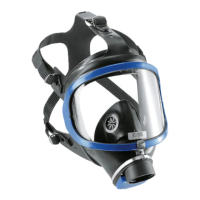
These Instructions for Use apply to masks with the following type
identity markings:
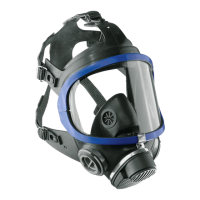
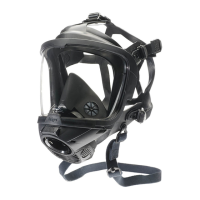
X-plore 5500 R 55 270
● Insert two filters and/or cartridges and fully lock the bayonet
connector by turning the filter downwards until a distinct stop is felt.
They must be turned in the opposite direction to release them.
Use
Preparing the mask: Open the straps as far as they will go.
Fitting the mask: Beards and sideburns in
the sealing area of the face mask will cause
leaks. Therefore, the face mask should not be
used by anyone with facial hair of this sort.
Prescription glasses in the sealing area also
cause leaks. Use special spectacle kits. Insert
chin in chinpiece.
Fit harness over head, pulling back until the
head strap fits smoothly.
Adjust mask until it fits properly.
1 Tighten the neck straps uniformly.
2 Tighten the temple straps uniformly.
3 Tighten front strap as necessary.
Leak and Seal check
Negative pressure test: Seal off boths
respiratory filters and/or cartridges with
your hands and breathe in until negative
pressure (suction) is generated. Hold
your breath for a moment. The negative
pressure should be maintained. If not
readjust the face piece and headstraps
until an successfull fit check is met.
Always make sure the mask forms a tight
seal and the respirator filters and/or
cartridges are fitted prior to entering a hazardous atmosphere.
Exhalation valve check:
While wearing the mask, exhale vigorously. The exhaled air must be
able to escape without obstruction. If not, see "Visual inspection of
exhalation valve".
Positive pressure test: Seal off the
protective cap with your palm and exhale
gently. The mask should inflate slightly.
If the mask does not maintain a slight
positive pressure, readjust the face piece
and headstraps until an successfull fit
check is met.
Extreme operating conditions
In case of low temperatures: Treat the inside of the lens with anti-
misting gel "Klar pilot" to prevent it from fogging up. Hardening of the
exhalation valve disc is possible. Take particular care to check for leaks.
In case of high temperatures: If the lens is damaged, leave the danger
area immediately.
In explosion-hazard: Treat the mask with antistatic spray or work with
a screen of water mist.
After Use
Remove the respiratory filters and/or cartridges and properly
dispose in accordance with local regulations.
Removing mask: Insert index finger behind
the tabs on the neck straps and press the
clamping buckles forward with the thumbs,
pulling the mask off your face and back over
your head.
2
What's What
1 Filter and/or cartridge connector 7 Face seal
2 Control valve 8 Mask body
3 Inner mask 9 Clamp
4 Lens 10 Protective cap
5 Lens frame 11 Front strap
6 Head straps 12 Inhalation valve
13 Exhalation valve
Description/Intended Use
The above full-face mask is part of a NIOSH approved respirator that
also protects the face and eyes against aggressive media.
Only use with filters and/or cartridges of the X-plore series.
Only use NIOSH approved respiratory systems.
Operating temperature: –30 °C to 60 °C (–22 °F to 140 °F). Lower or
higher temperature extremes are permitted with shorter exposure times.
Spectacle kits are available for users who wear spectacles.
Two respiratory filters of the same type from a single package (pair)
must always be used.
Duration of use:
The operating period depends on various factors, including the type
and concentration of pollutant, type of filter and/or cartridges and
environmental conditions such as temperature and relative humidity.
Operation with respiratory filters and/or cartridges
Preconditions: The ambient air must contain at least 19.5 % oxygen
by volume. Do not use respiratory systems in unventilated containers,
trenches, ducts etc. The type of pollutants must be known and the
appropriate filters and/or cartridges selected.
1
3
4
2
5
11
6
7
9
10
8
12
13
2
1
3
X-plore 5500
Full-face mask
enUS / NIOSH


 To Next Page
 Loading...