Handhabung
Atemfilter sorgfältig behandeln: nicht stoßen, nicht fallen lassen usw.!
Nicht mit spitzen Gegenständen in das Atemfilter bohren. Atemfilter
dicht mit dem Atemanschluss verbinden. Gebrauchsanweisung des
Atemanschlusses beachten! Atemfilter und Atemanschlüsse nur in den
beschriebenen Anschlussmöglichkeiten benutzen (siehe Tabelle 1).
Zwei Atemfilter einsetzen
A & B Atemfilter positionieren (1) – Strichmarkierungen gegenüber! –
und bis zum Anschlag verriegeln (2), indem das Atemfilter bis
zum spürbaren Anschlag nach unten gedreht wird
(Strichmarkierung des Atemfilters über dem Pfeilende!).
Das Lösen des Atemfilters erfolgt entgegengesetzt.
Pad-Partikel-Filter befestigen (nur für Gasfilter oder Pad-Platte)
C1 Pad-Partikel-Filter in die Pad-Kappe einlegen (Beschriftung von
außen sichtbar) und rundherum einrasten.
2 Pad-Kappe mit Pad-Partikel-Filter auf dem Gasfilter bzw. der
Pad-Platte einklicken.
Sicherstellen, dass der Sitz des Pad-Partikel-Filters während des
Einsatzes nicht verändert wird.
Vorfilter befestigen (nur für Kombinationsfilter)
D1 Vorfilter in die Vorfilterkappe legen.
2 Zuerst die breite Seite des Kombinationsfilters in die
Vorfilterkappe stecken. Dann die schmale Seite des
Kombinationsfilters in die Vorfilterkappe stecken.
Sicherstellen, dass der Rand der Vorfilterkappe rundherum am
Kombinationsfilter einrastet und dass der Vorfilter die Oberseite
des Kombinationsfilters vollständig überdeckt.
Gebrauchsdauer
Allgemein gültige Richtwerte für die Gebrauchsdauer können nicht
angegeben werden, weil diese stark von den äußeren Bedingungen
abhängt, z. B. von Art und Konzentration des Schadstoffs, Luftbedarf
des Geräteträgers, Luftfeuchte und Temperatur.
— Gasfilter müssen paarweise spätestens ausgetauscht werden, wenn
der Geräteträger den Durchbruch feststellt (Geruchs-, Geschmacks-
oder Reizerscheinungen).
— Partikelfilter, Pad-Partikel-Filter oder Vorfilter müssen paarweise bei
einer deutlichen Zunahme des Atemwiderstandes ausgetauscht
werden. Bei Verwendung der Vorfilter kann es in kurzer Zeit zu einem
für den Träger unangenehmen Anstieg des Atemwiderstandes
kommen. In diesem Fall sind die Vorfilter sofort paarweise
auszutauschen.
— Kombinationsfilter müssen paarweise bei Durchbruch und/oder
erhöhtem Atemwiderstand ausgetauscht werden.
Lagerung und Entsorgung
Atemfilter in Räumen mit normaler Feuchte (<90 % rel. Feuchte),
Temperatur (-10
o
C bis 55
o
C) und nicht belasteter Luft lagern. Die
maximale Lagerzeit erstmalig geöffneter Atemfilter beträgt 6 Monate,
sofern das Filter nach dem Gebrauch gasdicht verpackt, z. B.
eingeschweißt, wird. Atemfilter entsprechend den jeweils geltenden
Abfallbeseitigungsvorschriften entsorgen. Auskünfte hierüber erteilen
die örtlichen Umwelt- und Ordnungsämter.
For your safety
Strictly follow the Instructions for Use
Every respiratory filter operation requires that these Instructions for Use
are understood and observed as well as the Instructions for Use of the
respectively used face piece.
The respiratory filter may only be used for the purposes specified here.
Liability for proper function or damage
The liability for the proper function of the respiratory filter is irrevocably
transferred to the owner or operator whenever the respiratory filter was
used in a manner not conforming to its intended use. Dräger Safety
cannot be held responsible for damage caused by non-compliance with
the recommendations given above. The warranty and liability provisions
of the terms of sale and delivery of Dräger Safety are likewise not
modified by the recommendations given above.
Dräger Safety AG & Co. KGaA
Intended use
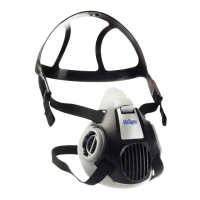
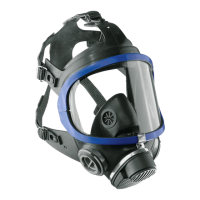
X-plore Bayonet respiratory filters (gas, particle or combination filters)
are combined with Dräger half masks (X-plore 3300/3500) or full
masks (X-plore 5500) into a filter apparatus. A filter apparatus filters
certain gases, vapours and particles from the air breathed by the
wearer within the specified limit values.
Performance and marking of Dräger respiratory filters comply with
EN 14387:2004 or EN 143:2000/A1:2006 as well as other
regulations. As an aid in the selection of the correct respiratory filter the
comprehensive list of pollutants in the Dräger Voice database can be
used (see www.draeger.com/voice).
Prefilters are used to protect particle filters against heavy
contamination (e.g. from paint splashes, chippings, etc.). Prefilters are
not suitable for use against grit.
Explanation of symbols
Attention! Strictly follow the Instructions for Use.
Suitable for storage until …
Temperature range of storage conditions
Maximum humidity of storage conditions
Always use two respiratory filters of the same type.
R The "R" mark means that it has been demonstrated through
additional tests in accordance with EN 143:2000/A1:2006 that
the particle filter or the particle filter component of the
combination filter is suitable for re-use after aerosol exposure
(use during several working shifts).
NR The "NR" mark means that it has been demonstrated through
additional tests in accordance with EN 143:2000/A1:2006 that
the particle filter or the particle filter component of the
combination filter may only be used for a maximum of one
working shift.
Conditions for use
The EN 529 "Instructions for the selection and use of respirators" or the
corresponding national regulations are authoritative for the use of filter
appliances. For Germany these are the BGR 190 "Rules for the use of
respirators" from the German Federation of Institutions for Statutory
Accident Insurance and Prevention as well as EN 14387:2004 and
EN 143:2000/A1:2006. The user of the filter apparatus must be duly
instructed and both physically and mentally fit to use respirator
apparatus in accordance with the appropriate national regulation, e.g.
BGI 504-26 in Germany.
— The ambient conditions (especially the type and concentration of
pollutants) must be known.
— The oxygen content of the ambient air must not drop below the
following limit values:
17 vol -% in Europe except the Netherlands, Belgium, UK
19 vol % in the Netherlands, Belgium, UK, Australia, New Zealand.
For other countries observe the national regulations!
— It must be guaranteed that the surrounding atmosphere cannot
change adversely.
— Do not use filter apparatus sets when there is a suspicion of
contaminants with low warning properties (smell, taste, irritation of
eyes and airways).
— Unventilated reservoirs, pits, canals etc. must not be entered with filter
apparatus sets.
— The suitability of the respiratory device must be checked: Colour
codes, labelling, use-by date.
— Check the need for additional personal protective equipment and its
compatibility.
— Gas filters do not afford protection against particles! Particle filters do
not afford protection against gases and vapours! In case of doubt, use
combined filters!
— Harmful gases which are heavier than air may accumulate in
considerable concentrations near ground level.
— Special regulations (BGR 190 3.3.3.1) and restrictions on use must
be observed for low-boiling organic compounds (boiling point ≤65 C)
(in Germany e.g. BGR 190 3.3.3. 1)!
— Never use a damaged respiratory filter or a respiratory filter with
damaged bag.
— Do not use respiratory filters which have passed their use by date
(details on filter label).
— Both respiratory filters must always be replaced together. Both
respiratory filters must be from the same packaging unit, i.e. of the
same filter type and the same filter category (e.g. A1-P3).
— When re-using respiratory filters ensure that re-use is permitted
(respiratory filter is marked with R) and that the remaining period of
use is adequate.
— When using particle filtrs against particles of radiactive materials, air-
borne biological substances and enzymes check the re-usability; if
necessary, contact Dräger Safety.
— Observe the instructions for use for the dual filter mask.
— Filter pairs weighing more than 300 g must only be used with a full
mask (see table 5).
Legend:
X: can be used with half mask 3300/3500 or full mask X-plore 5500
O: must only be used with full mask 5500
Range for the use of filter apparatus (details in accordance
with BGR 190 Germany)
Handling
Handle respiratory filter with care: do not knock or drop the filter. Do
not insert any sharp implements into the respiratory filter. The
respiratory filter must be tightly connected to the facepiece. Pay
attention to usage instructions of facepiece! Filters and facepieces are
only to be used according to the connection possibilities described
(see table 5).
Fitting the respiratory filter
A & B Position the respiratory filter (1) – The line markings must line
up! – and insert them until they lock into place (2) by screwing
each filter downwards until a stop is felt (line marking of the
respiratory filter above the end of the arrow.).
The respiratory filters are removed by carrying out this sequence
in reverse.
Attach particle filter pad (only for gas filters or pad plate)
C1 Place particle filter pad in pad cap (labeling visible from the
outside) and press into place all round.
2 Click pad cap with particle filter pad onto the gas filter or pad
plate. Make sure that the position of the pad particle filter is not
changed during operation.
Tabelle 4: Partikelfilter
Typ Kenn-
farbe
Klasse Abscheide-
leistung
Höchstzulässige Konzentration
1)
1)Änderungen durch nationale Regelungen möglich
P weiß 1 klein mit Halbmaske X-plore 3300/3500
4 x Grenzwert
mit Vollmaske X-plore 5500
4 x Grenzwert
2 mittel mit Halbmaske X-plore 3300/3500
10 x Grenzwert
mit Vollmaske X-plore 5500
15 x Grenzwert
3 groß mit Halbmaske X-plore 3300/3500
30 x Grenzwert
mit Vollmaske X-plore 5500
400 x Grenzwert
ACHTUNG!
Bajonett nicht einseitig einsetzen! Atemfilter beim Verriegeln nicht
verkanten!
EN - Instructions for Use
WARNING!
The filter apparatus sets are not to be used if there is any confu-
sion about the purpose of their use or the conditions in which they
are to be used. During use the following notices must be observed.
Non-observance can result in severe health injury or even death for
the user.
Table 5:
Filter
type
Designation Item
number
Filter pair With
prefilter
With
particle fil-
ter pad
Gas filters
A1 6738005 X X
A2 6738006 X X
ABEK1 6738007 X X
ABE1 6738359 X X
A2B2 6738358 X X
Particle filters
P3 R 6738011 X
Pad P1 6738001 X
Pad P2 6738002 X
Combined filters
A1-P3 R D 6738015 X X
A2-P3 R D 6738016 X X
ABEK1Hg-P3 R D
6738017 X O
A2B2-P3 R D 6738368 X O
ABEK2Hg-P3 R D
6738369 O O
-10°C
+55°C
<90%
Table 6: Range of filter apparatus
Device type Multiple of
the limit
value
1)
1)Modifications may be possible due to national regulations.
Comments, restrictions
Half mask or quarter mask
with P1 filter
4 Not against carcinogenc
and radioactive materials,
air-borne biological
substances of risk category
2 and 3 and enzymes
Half mask/quarter mask
with P2 filter
10 Not against radioactive
materials, air-borne
biological substances of risk
category 3 and enzymes
Full mask with P2 filter 15 Not against radioactive
materials, air-borne
biological substances of risk
category 3 and enzymes
Half mask or quarter mask
with P3 filter, gas filter
2)
2)Provided that the maximum permissible usage concentrations (see table 7 and 8)
relating to the gas receptiveness have not already been exceeded.
30 –
Full-face mask with P3 filter,
gas filter
2)
400 –
Equipment with combination filters: These are governed by the
respective multiple limit value for the gas or particle filter; the more
stringent value applies in each case.
Table 7: Gas filters
Type Colour
coding
Main area of application Category Maximum per-
missible con-
centration
1)
1)Modifications may be possible due to national regulations
A brown Organic gases and
vapours with boiling point
>65
o
C
1
2
1000 ml/m
3
(0.1 vol. %)
5000 ml/m
3
(0.5 vol. %)
B grey Inorganic gases and
vapours, e.g. chlorine,
hydrogen sulphide,
hydrogen cyanide – not
against carbon monoxide
1
2
1000 ml/m
3
(0.1 vol. %)
5000 ml/m
3
(0.5 vol. %)
E yellow Sulphur dioxide, hydrogen
chloride and other acid
gases
1
2
1000 ml/m
3
(0.1 vol. %)
5000 ml/m
3
(0.5 vol. %)
K green Ammonia and organic
ammonia derivatives
1
2
1000 ml/m
3
(0.1 vol. %)
5000 ml/m
3
(0.5 vol. %)
Hg-
P3
2)
2)Maximum duty period 50 hours (in accordance with EN 14387:2004, marking: Hg-P3
max. 50 h).
red/
white
Mercury –
Table 8: Particle filters
Type Colour
coding
Category Filter effi-
ciency
Maximum permissible concentra-
tion
1)
1)Modifications may be possible due to national regulations
P white 1 low with half mask X-plore 3300/3500,
4x limit value
with full mask X-plore 5500,
4 x limit value
2 medium with half mask X-plore 3300/3500,
10 x limit value
with full mask X-plore 5500,
15x limit value
3 high with half mask X-plore 3300/3500,
30 x limit value
with full mask X-plore 5500,
400x limit value
CAUTION!
The bayonet catch must not be fitted on one side only! The respira-
tory filter must be straight when locked in position!


 To Next Page
 Loading...