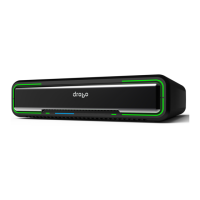
Drobo Mini Getting Started Guide 8
Checking the Hardware You Need
To use your Drobo Mini, you will need at least two drives. If you plan to use Dual Disk
Redundancy, which protects your data against two drive failures, you will need at least three
drives.
This section covers the following topics:
Selecting Drives
Determining Drive Space Requirements
Using Power Protection
Selecting Drives
The Drobo Mini supports both standard 2.5” SATA hard disk drives (HDDs) as well as SATA solid
state drives (SSDs) for added performance. For HDDs, these drives can be from any
manufacturer and with any capacity. For SSDs, please visit our web page for
compatible drive
options.
In addition, the Drobo Mini has a Drobo Accelerator Bay, which accepts an industry-standard
mSATA SSD(Solid State Drive). When the mSATA SSD is installed, Drobo’s Data-Aware Tiering
feature is enabled, accelerating performance when reading data from your Drobo device. Having
an mSATA SSD installed leaves all drive bays available for high-capacity hard disk drives (HDDs)
so that you can get both high-capacity and accelerated performance out of your Drobo device.
Using only SSDs in the main drive bays of your Drobo Mini provides the fastest performance
when reading and writing data to and from your Drobo device.
In summary, here are the recommended number and type of drives you can use with your Drobo
Mini. Note that you need at least two drives in the drive bays to ensure your data is protected in
the event of drive failure.
•
2 to 4 HDD(Hard Disk Drive) s in the main drive bays - enables you to maximize capacity
•
2 to 4 HDDs in the main drive bays plus an mSATA SSD installed - enables you to
maximize capacity and accelerate read performance
•
2 to 4 SSD(Solid State Drive)s in the main drive bays with no mSATA SSD - enables you
to maximize read and write performance
For a performance comparison of these options, see the following illustration.


 To Next Page