EasyManua.ls Logo

Dual 621 - Specific Adjustments and Troubleshooting; Lift, Power Switch, and Alignment Adjustments

Dual 621
18 pages
Print Icon
To Next Page IconTo Next Page
To Previous Page IconTo Previous Page
Loading...
rohr
zunächst
annähernd
und
durch
Drehen
des
Rándelrades
am
Balancegewicht
(11)
exakt
ausbalanciert
1.
Bei
noch
auf
der
Tonarmstütze
verriegel
tem
Tonarm
und
Plattenteller
einige
Um-
drehungen
im
Uhrzeigersinn
von
Hand
drehen.
2.
Auflagekraft
(10)
und
Antiskating
(13)
auf
„0”
stellen.
Tonarm
entriegeln
und
über
die
Tonarmablage
schwenken,
3.
Wenn
der
Tonarm
sich
nicht
von
selbst
horizontal
einpendelt,
Feststellschraube
(12)
lósen
und
das
Balancegewicht
mit
dem
Dorn
so
lange
verschieben,
bis
sich
eine.
ungeführe
Balance
ergibt.
Der
Dom
des
Balancegewicht
ist
dann
durch
Anziehen
der
Feststellschraube
zu
arretieren.
4.
Durch
Drehen
des
Rändelrades
am
Balan-
cegewicht
anschließend
die
exakte
Balan
ce
des
Tonarmes
herstellen
Der
Tonarm
ist
ausbalanciert,
wenn
er
frei
schwebend
in
horizontaler
Lage
verbleibt
dh.
weder
unten
noch
oben
anliegt
und
sich
nach
Antippen
in
vertikaler
Richtung
wieder
von
selbst
in
die
horizontale
Lage
einpendelt
Einstellen
der
Auflagekraft
Jedes
Tonabnehmersystem
erfordert
eine
be:
stimmte
Auflagekraft,
bei
der
optimale
Wie-
dergabe
erzielt
wird.
Für
das
eingebaute
Ton.
abnehmersystem
finden
Sie
diese
Angabe
auf
dem
beiliegenden
Datenblatt
Ist
der
Tonarm
exakt
ausbalanciert,
wird
durch
Verdrehen
der
Auflagekraftskala
(10)
die
für
das
Tonabnehmersystem
erforder:
liche
Auflagekraft
eingestellt.
Die
Auflage.
kraft
läßt
sich
kontinuierlich
im
Bereich
von
O
bis
30
mN
(0
-
3
p)
einstellen,
wobei
die
Ziffernangabe
auf
der
Skala
1
=
10mN
^
ip
2
=
20mN
3
=
30mN
bedeutet,
Analog
dazu
ist
ein
Teilstrich
im
Bereich
von
O
-
15
mN
(0
-
1,5
p)
1
mN
(0,1
p)
im
Bereich
von
15-30
mN
(1,5-3
p)
2,5
mN
(0.25
p)
Das
Gerát
arbeitet
ab
2,5
mN
(0,25
p)
Auf
lagekraft
betriebssicher
20
w
©
puis
avec
précision
par
rotation
de
la
roue
crantée
du
contrepoids.
1
Le
bras
étant
encore
verrouillé
sur
son
support,
tourner
le
plateau
de
quelques
tours
dans
le
sens
horaire
Amener
les
réglages
de
la
force
d'appui
(10)
et
les
réglages
de
l'antiskating
(13)
sur
„0.
Déverrouiller
le
bras
de
lecture
et
le
faire
pivoter
sur
l'appui
3.
Si
le
bras
de
lecture
ne
se
stabilise
pas
de
lui-méme
à
horizontale,
desserrer
la
vis
de
blocage
(12)
et
déplacer
le
contrepoids
avec
la
tige
jusqu'à
ce
que
l'équilibre
soit
à
peu
près
atteint,
La
tige
du
contrepoids
doit
alors
étre
bloqueée
par
serrage
de
la
vis
4.
Regler
l'équilibrage
exact
du
bras
en
tour.
nant
la
roue
crantée
du
contre-poids
Le
bras
est
équilibré,
lorsqu'il
reste
librement
en
position
horizontale,
c-à-d
qu'il
n'est
pas
incliné
vers
le
bas
ou
vers
le
haut
et
qu'il
re
Vient
de
lui-même
en
position
horizontale
aprés
une
légère
pression
verticale
du
doigt
Réglage
de
la
force
d'appui
Chaque
cellule
nécessite
une
certaine
force
d'appui
permettant
d'obtenir
une
reproduc
tion
optimale.
Cette
valeur
est
indiquée
sur
a
feuille
de
caractéristiques
fournie
pour
la
cellule
incorporée
Si
le
bras
est
exactement
équilibré,
on
règle
la
force
d'appui
nécessaire
à
la
cellule
en
tournant
la
graduation
correspondante
(10)
La
force
d'appui
peut
être
réglée
de
manière
continue
de
0
à
30
mN
(0
-
3
g)
suivant
les
données
de
la
graduation
]
=
10mN
^
1g
2
=
20mN
^
3
=
30mN
^
3g
De
méme,
la
sous-division
dans
la
zone
O
-
15
mN
(0
-
1,5
9)
correspond
à
1
mN
(0,1
g)
et
dans
la
zone
15
-
30
mN
(1,5
-
3
g)
à
2,5
mN
(0,25
9)
Le
fonctinnement
de
l'appareil
est
sûr
à
partir
de
2,5
mN
(0,25
g)
de
force
d'appui
knurled
ring
of
the
counterbalance
weight
balances
the
tonearm
exactly.
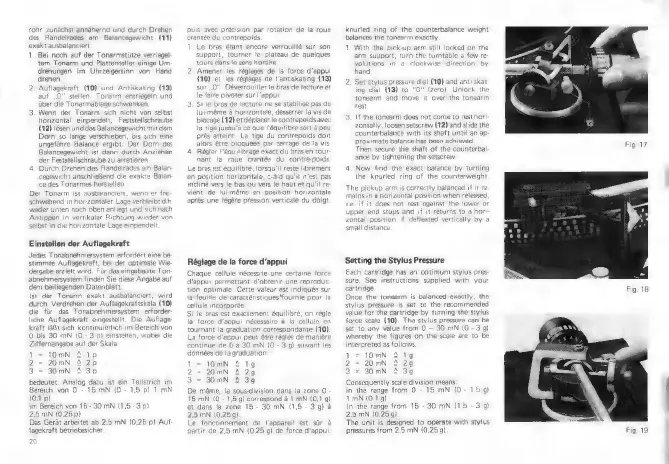
1.
With
the
pick-up
arm
still
locked
on
the
arm
support,
turn
the
turntable
a
few
re
volutions
in
a
clockwise
direction
by
hand
Set
stylus
pressure
dial
(10)
and
anti-skat
ing
dial
(13)
to
"0"
(zero).
Unlock
the
tonearm
and
move
it
over
the
tonearm
rest
N
3. If
the
tonearm
does
not
come
to
rest
hori
zontally,
loosen
setscrew
(12)
and
slide
the
counterbalance
with
its
shaft
until
an
ap-
proximate
balance
has
been
achieved
Then
secure
the
shaft
of
the
counterbal-
ance
by
tightening
the
setscrew.
4,
Now
find
the
exact
balance
by
turning
the
knurled
ring
of
the
counterweight
The
pickup
arm
is
correctly
balanced
if
it
re
mains
in
a
horizontal
position
when
released,
ie.
if
it
does
not
rest
ogainst
the
lower
or
upper
end
stops
and
if
it
returns
to
a
hor
zontal
position
if
defteated
vertically
by
a
small
distance
Setting
the
Stylus
Pressure
Each
cartridge
has
an
optimum
stylus
pres-
sure,
See
instructions
supplied
with
your
cartridge
Once
the
tonearm
is
balanced
exactly,
the
stylus
pressure
is
set
to
the
recommended
value
for
the
cartridge
by
turning
the
stylus
force
scale
(10).
The
stylus
pressure
can
be
set
to
any
value
from
0
30
mN
(0
-
3
g)
whereby
the
figures
on
the
scale
are
to
be
interpreted
as
follows.
1
=
10mN
^
1g
2
=
20mN
4
2g
3
=
30mN
^
3g
Consequently
scale
division
means
in
the
range
from
O
-
15
mN
(0
-
15
gl
1
mN
(0.1
g)
In
the
range
from
15
-
30
mN
(1.5
-
3
g)
2.5
mN
(0.259)
The
unit
is
designed
to
operate
with
stylus
pressures
from
2.5
mN
(0.25
g)
Fig.
17
Fig.
19

Other manuals for Dual 621

Related product manuals