FAIL SAFE SET-UP
The fail safe is designed with a signal fail safe and a battery fail safe.
If the receiver loses contact with the transmitter, the fail safe will set
the throttle to the designated position and the red LED will be
constantly lit. If the battery goes below the preset voltage, the fail safe
will set the throttle to the designated position and the red LED will be
constant and the green LED will flash. If this occurs, shut the
FireHammer MT off and recharge the receiver battery before running
the model again.
The fail safe should be set from the factory, but we recommend that
you double check it before running the FireHammer MT.
1. Check that the fail safe is functioning properly before starting
the engine.
2. With the receiver on, advance your throttle on the transmitter.
Then shut off the transmitter and see if the throttle servo moves
to the desired position (idle).
3. Turn on the radio system and make sure the throttle is positioned
at idle. Press and hold the “SET” button for 2 seconds.
BEFORE EACH RUN
1.Check to make sure that all screws are tight and there are not
any screws missing.
2.Check that the transmitter and receiver batteries are not low.
3.Check that all of the moving parts of the FireHammer MT move
freely and do not bind.
4.Check for broken or damaged parts. Replace any broken or
damaged parts before running the FireHammer MT. Running of
the FireHammer MT with broken or damaged parts could result
in damage to other parts.
5.Check to make sure that all wires are properly connected and secure.
AFTER EACH RUN
1. Clean any large globs of dirt or debris from the chassis and
moving parts.
2. Drain any remaining gas from the tank.
3. Check for any broken or damaged parts. This way parts may be
replaced before the next run.
AFTER EVERY 10 RUNS
1. Check to make sure that the bearings are free of dirt and debris
and roll smoothly.
2. Check the shocks for leakage. If the shocks have leaked any shock
fluid out, you should properly refill the shocks for best performance.
3. Make sure the servo saver does not bind. This will help prevent
stripping of the servo during running. Clean as needed.
4. Check for proper gear mesh between the spur gear and the
pinion gear.
When tuning the FireHammer MT, make sure that you have equal
lengths from one side to the other on the shocks, camber rods and
steering rods. Also, make sure to have the shock pre-load
adjusters at the same setting from left to right. They do not have to
be the same front to rear.
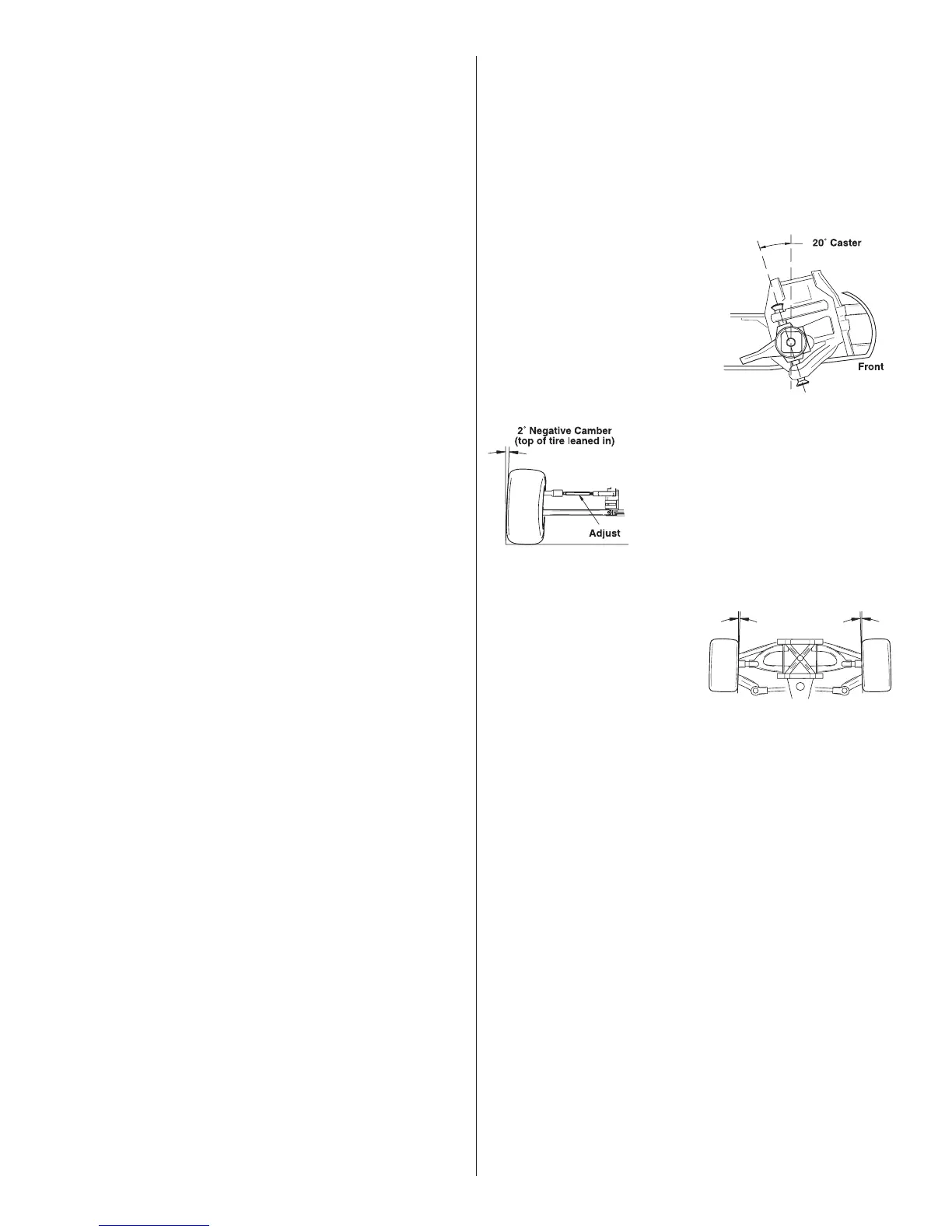
CASTER
Caster refers to the angle which the
kingpin is at in relation to the surface
when viewed from the side.0-degrees of
caster means that the kingpin is straight
up and down.
CAMBER
Camber refers to the angle at which the
tire and wheel ride in relation to the
ground when viewed from the front or rear.
Negative camber is when the tire and
wheel lean inward and positive camber is
when the tire and wheel lean outward.
Typically you want 0 to -2 degrees of
camber. Never put in positive camber.
Make sure that both sides are equal.
FRONT AND REAR TOE-IN AND TOE-OUT
Toe-in and toe-out refers to the angle
at which the tire is at when view from
above. Toe-in increases stability
under acceleration. However, toe-in
also decreases steering when
entering a corner. Toe-out will
increase steering into corners, but will
decrease the overall stability during
acceleration.The front typically is set-up with 0 to -2 degrees of toe-in.
RIDE HEIGHT
The ride height of the FireHammer MT affects how it jumps and
handles. The ride height of the FireHammer MT is adjustable through
the threaded pre-load adjusters on the shock bodies. To measure the
ride height of the FireHammer MT, set the truck up as if you are ready
to run. Push the front of the truck down all of the way and release it.
When the truck returns the front arms should be parallel with the
surface. The rear ride height is set up the same except that the drive
shafts are parallel with the surface. Lowering the front ride height will
increase steering response due to more weight on the front wheels.
Lowering the rear ride height will increase rear traction and reduce
steering response due to more weight on the rear wheels.
REAR SHOCK ADJUSTMENT
Moving the tops of the shocks in will result in more traction in the
corners and smoother handling over the bumps. Moving the tops
of the shocks out will give the truck more steering and better ability
to handle large jumps.
SHOCK OILS
Thinner shock oil makes the shock react faster, but makes the
truck less stable and may cause the truck to bottom out over large
jumps. Thicker shock oil makes the truck smoother over large
jumps and in straights, but less reactive over rough sections.
TUNING
TUNING
GUIDE
GUIDE
MAINTENANCE
MAINTENANCE
TIPS
TIPS


 To Previous Page
 Loading...