
 Need help?
Do you have a question about the ebm-papst K3G355-PV70-01 and is the answer not in the manual?
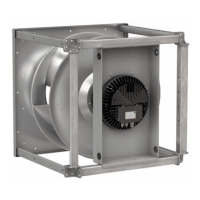
This document provides comprehensive operating instructions for the K3G355-PV70-01 device, a built-in fan designed for conveying air. It emphasizes safety, proper installation, and maintenance to ensure reliable operation and a long service life.
The K3G355-PV70-01 is an integrated fan designed to move air according to its technical specifications. It is intended for use in stationary systems within specific ambient temperature and pressure ranges. The device operates in power systems with grounded neutral (TN/TT), phase conductor grounding, or IT power systems, and is compatible with networks meeting EN 50160 quality characteristics. Its core function involves air conveyance, supported by an integrated motor with electronic protection features.
The fan incorporates a range of protective functions to ensure safe operation. These include rotor position detection error handling, blocked rotor protection, line undervoltage detection, and phase failure detection. In the event of a fault, the motor automatically switches off and attempts to restart once the condition is resolved. The device also features a diagnostic LED that indicates its status (good, warning, or fault) through various colors and flash codes, providing immediate feedback on operational health.
Control of the fan is facilitated through configurable inputs/outputs (I/O), allowing for external parameterization via MODBUS. It supports both analog and digital input signals for set value control and offers an analog output for fan modulation level. The device is equipped with a thermal overload protection for both the electronics and the motor, as well as line undervoltage and phase failure detection.
The K3G355-PV70-01 is designed as a built-in component, requiring careful mechanical and electrical integration into a larger system. It is crucial that the customer's equipment can withstand the mechanical and thermal stresses generated by the fan throughout its service life. The fan must be operated with all protective devices in place and in accordance with these operating instructions.
Proper mechanical connection involves securing the device to a substructure, ensuring it is not subjected to excessive force or vibration. If connected to air ducts, vibration isolation elements like compensators should be used. The fan should only be handled by its frame during transport and installation, avoiding contact with the inlet nozzle to prevent impeller damage. Hoisting equipment and suitable lifting devices, such as round slings, are recommended for safe transportation and installation.
Electrical connection requires adherence to specific guidelines, including checking nameplate data against connection data, using appropriate cables designed for the current level, and ensuring proper protective earth connection. The device is designed for circuits that can be switched off with an all-pole disconnection switch. Control lines should be routed separately from supply lines to prevent interference. The terminal box is designed for secure cable connections, with specific stripping lengths and tightening torques to ensure proper sealing and strain relief.
The device's factory settings include PWM control for speed, with configurable maximum and minimum PWM percentages. It supports analog (linear) set value requirements and positive (heating) direction of action for both parameter sets. The MODBUS interface allows for advanced parameterization and monitoring, providing flexibility in integration with control systems.
Improper use, such as operating the device in an unbalanced state due to dirt or ice, in resonant operation with severe vibration, or in medical life-sustaining equipment, is strictly prohibited. Conveying solids, painting the device, or operating it in an explosive atmosphere are also forbidden. Any modifications or conversions without ebm-papst's approval are not allowed.
Regular maintenance is essential for the K3G355-PV70-01 to ensure optimal performance and longevity. This includes periodic checks of the device's electrical equipment, replacing loose connections and defective cables immediately.
Cleaning: The fan should be checked regularly for proper operation and soiling. The frequency of cleaning should be adjusted based on the degree of dust exposure. Cleaning should only be performed when the fan is not in motion, and the power supply should not be disconnected; instead, the fan should be switched off via the control input to prevent accidental startup. Dry cleaning, such as using compressed air, is the preferred method. Aggressive cleaning agents, high-pressure cleaners, acids, alkalis, solvents, or sharp objects should not be used. Any dirt deposits on the motor housing should be removed to prevent overheating. If severe corrosion is observed on load-bearing or rotating parts, the device must be immediately switched off and replaced, as repairs to these parts are not permitted. If cleaning does not eliminate vibrations, rebalancing by ebm-papst may be necessary.
Vibration Testing: The fan's mechanical vibration should be checked every six months, with a maximum permissible vibration severity of 3.5 mm/s. Measurements should be taken at the motor fastening diameter on the motor support plate, both in axial and perpendicular directions. Low-vibration operation must be ensured across the entire speed control range. If excessively high vibration levels or resonant frequencies are detected during commissioning, these ranges should be quickly traversed with speed control or alternative remedies found.
Safety Inspection: A safety inspection should be performed periodically. This includes visual inspections of the contact protection cover, device blades, housing, cable fastenings, cable insulation, and impeller for wear, deposits, corrosion, or damage. Any damaged components should be repaired or replaced. A high-voltage test should be performed using DC voltage, corresponding to the peak value of the required AC voltage, to comply with legal requirements.
Storage: If the device is not operated for a lengthy period, especially in damp environments, it should be started up and operated at full speed for at least two hours once a month to move the bearings and evaporate any condensate. In dry environments, this interval can be extended to one hour every four months.
Disposal: For disposal, the product should be disassembled by qualified personnel into suitable components. Metallic materials (steel, iron, aluminum, non-ferrous metals like motor windings) are generally recyclable. Plastics, especially those with brominated flame retardants, should be separated according to their marking. Insulating materials, cables, wires, and electronic scrap (e.g., circuit boards) should be disposed of according to proper procedures for electronic scrap. Ferrite magnets can be disposed of like normal iron and steel. All disposal must comply with applicable country-specific legal regulations and standards.
 General
| Frequency | 50/60 Hz |
|---|---|
| Dimensions | 355 mm |
| Min. Ambient Temperature | -25 °C |
| Max. Ambient Temperature | 60 °C |
| Size | 355 mm |
| Bearing Type | Ball bearing |
| Protection Class | IP54 |
| Nominal Voltage | 230 V |
| Voltage | 230 V AC |
| Impeller Material | Plastic |
| Housing Material | Steel |
| Type | Centrifugal Fan |



 To Next Page