
 Need help?
Do you have a question about the ebm-papst R2E280-AF07-09 and is the answer not in the manual?
Explains the meaning of different hazard level indicators used in the manual.
Details the necessary qualifications for personnel handling the device.
Outlines fundamental safety rules to follow when working with the device.
Addresses safety precautions concerning electrical voltage and charged components.
Explains the importance of protective devices and their proper functioning.
Discusses potential electromagnetic interference and necessary measures.
Warns about the risks associated with the device's rotating parts.
Covers noise emission levels and protective measures against hearing loss.
Alerts users to the hot motor housing and the risk of burns.
Provides guidelines for the safe transport of the device.
Offers recommendations for appropriate storage conditions to maintain device integrity.
Presents a detailed technical drawing with dimensions and specifications.
Lists the key nominal technical data and specifications of the motor.
Details the physical and electrical characteristics of the device.
Provides essential data and recommendations for mounting the device securely.
Specifies the permitted ambient temperature ranges for transport and storage.
Details the procedures and precautions for physically connecting the device.
Outlines the steps and safety measures for making the electrical connections.
Lists prerequisites and checks before establishing electrical connections.
Discusses potential issues and considerations with voltage control methods.
Provides guidance on using variable frequency drives with the device.
Details how to connect the external leads and cables of the device.
Explains the importance and connection of thermal overload protection for the motor.
Illustrates the electrical connection diagram for the device.
Lists essential checks to ensure connections are secure and safe.
Describes the correct procedure for switching on the device after installation.
Details the steps for safely switching off the device.
Provides instructions and warnings regarding the cleaning of the device.
Outlines a schedule and methods for conducting safety inspections.
Offers recommendations for the ecological disposal of the product.
Emphasizes the need to observe country-specific legal regulations for disposal.
Describes the procedure and precautions for disassembling the product.
Categorizes components for recycling and provides disposal guidance.
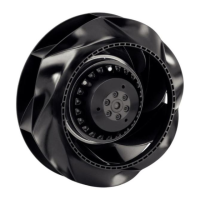
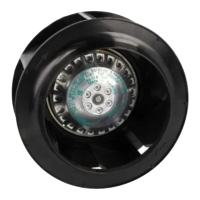
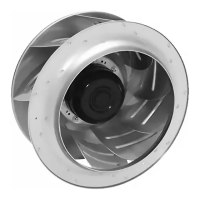
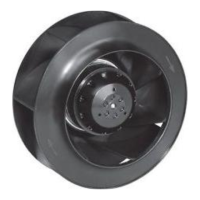
This document describes the R2E280-AF07-09 device, a built-in component designed for conveying air. It is manufactured by ebm-papst Mulfingen GmbH & Co. KG.
The R2E280-AF07-09 is primarily intended as a built-in device for air conveyance. Its operation involves a motor driving an impeller to move air. The device is designed to operate within specific ambient air pressure ranges (800 mbar to 1050 mbar) and temperature limits as detailed in the technical specifications. It is crucial to operate the device with all protective features in place and to follow the provided operating instructions to ensure safe and proper function.
Improper use, such as operating in an unbalanced state (e.g., due to dirt or ice), in resonant operation with severe vibration, in medical life-sustaining equipment, or conveying solids or abrasive/corrosive air, is strictly prohibited and can be hazardous. The device should not be painted, operated with loose connections, or used in explosive atmospheres. It is not designed as a safety component or for safety-related functions.
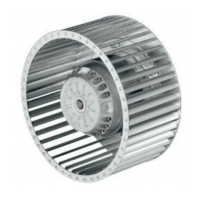
Motor: M2E074-GA Phase: 1~ Nominal Voltage: 230 VAC Frequency: 50 Hz Speed: 2720 min⁻¹ Power Consumption: 420 W Current Draw: 1.83 A Starting Current: 4.8 A Capacitor: 16 µF, 400 VDB Weight: 5.4 kg Size: 280 mm Motor Size: 74 Impeller Material: Sheet steel, hot-dip galvanized Number of Blades: 11 Direction of Rotation: Clockwise, viewed toward rotor Degree of Protection: IP44 (installation- and position-dependent as per EN 60034-5) Insulation Class: "F" Moisture (F) / Environmental (H) Protection Class: H1 Installation Position: Shaft horizontal or rotor on bottom; rotor on top on request Motor Bearing: Ball bearing Touch Current (according to IEC 60990): < 0.75 mA Motor Protection: Thermal overload protector (TOP) with basic insulation Protection Class (with customer connection of protective earth): I Conformity with Standards: EN 60335-1 Approval: EAC Max. Permitted Ambient Temperature for Motor (Transport/Storage): +80 °C Min. Permitted Ambient Temperature for Motor (Transport/Storage): -40 °C
The device's rotating parts are designed for a maximum of one million load cycles under cyclic speed loads. The surface quality conforms to industrial standards, and while color pigments may react to UV light over time, this does not affect technical properties. Protection against UV radiation is recommended.
Safety: The device incorporates several safety features. It is crucial to observe all warnings regarding electrical hazards (e.g., electrically charged device, live terminals, capacitor discharge) and mechanical hazards (e.g., rotating device, hot surface). Protective devices must be present and functional, and the device should only be operated with a fixed protective device and guard grille. The motor is equipped with a thermal overload protector (TOP) for protection against overheating.
Installation: Mechanical connection requires careful handling to avoid damage from vibration or shocks. The device must be securely positioned and all fastening screws tightened. Electrical connection involves checking nameplate data against power supply specifications, ensuring proper cable sizing (recommended 105 °C cables, minimum AWG 26 / 0.13 mm²), and always connecting protective earth first. The device is a built-in component and requires connection to circuits that can be switched off with an all-pole disconnection switch.
Operation: The device is designed for continuous operation (S1 mode). If speed control is implemented using transformers or electronic voltage regulators (e.g., phase control), current overshoots, noise, and vibration may occur, potentially leading to bearing damage. For operation with variable frequency drives, sinusoidal filters (all-pole) are necessary to protect the motor from high-voltage transients and harmful bearing currents. The heating-up of the motor must be checked by the customer when using a variable frequency drive.
General Maintenance: No repairs should be performed on the device by the user; it should be sent to ebm-papst for repair or replacement. Before any work, ensure the device is switched off, isolated from the power supply, and capacitors are discharged.
Cleaning: Cleaning should be done carefully without water jets, high-pressure cleaners, or acidic/alkaline/solvent-based cleaning agents. Pointed or sharp-edged objects should not be used.
Safety Inspection (every 6 months): Regular safety inspections are recommended every six months to ensure proper functioning and prevent malfunctions. This includes:
Malfunction/Fault and Remedies:
Storage: The device should be stored in its original packaging in a dry, clean environment, protected from weather and vibration. It is recommended to store the device for no longer than one year to guarantee trouble-free operation and maximum service life. Even devices intended for outdoor use should be stored as described prior to commissioning.
Disposal: The product is largely made of steel, copper, aluminum, and plastic, which are generally recyclable. Disassembly should be performed or supervised by qualified personnel. Components should be separated into categories for recycling: steel and iron, aluminum, non-ferrous metals (e.g., motor windings), plastics (especially with brominated flame retardants), insulating materials, cables and wires, and electronic scrap (e.g., circuit boards). Ferrite magnets can be disposed of with normal iron and steel. Electrical insulating materials in the product, cables, and wires are to be treated similarly. For specific disposal questions, contact ebm-papst.



 To Next Page
 General