
 Need help?
Do you have a question about the Ecoflam BLU 700.1 LN PAB TC and is the answer not in the manual?
This document provides a comprehensive guide for the Ecoflam BLU series gas burners, covering their function, technical specifications, usage, and maintenance.
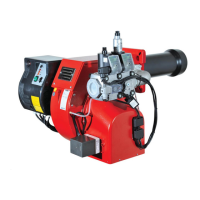
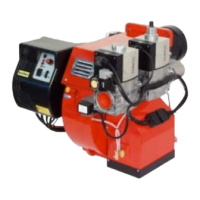
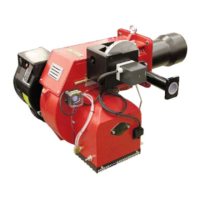
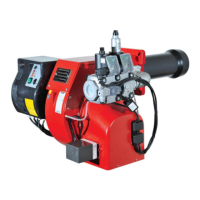
The Ecoflam BLU series burners are fully automatic, two-stage monoblock gas burners designed for efficient and low-pollutant combustion of natural gas and Liquefied Petroleum Gas (LPG). The burner's operation is controlled by a Siemens LME22 control and safety unit, which manages the ignition sequence, flame monitoring, and safety functions.
Upon startup, after a power failure, safety shutdown, gas interruption, or 24 hours of inactivity, a 30-second pre-ventilation period begins. During this period, the air pressure is monitored, and the combustion chamber is checked for flame signals. Once pre-ventilation is complete, ignition is activated, main and safety valves open, and the burner starts.
Flame monitoring is crucial and is performed by an ionization probe. This probe, insulated and fitted to the gas head, extends into the flame zone to detect the presence of a rectified current generated by the ionized gas flame. If a short circuit occurs between the probe and the burner earth, the burner will lock out. Safety functions include automatic shutdown if no flame is detected during startup, if the flame extinguishes during operation, if there is insufficient air, or if there is a lack of gas. In the event of a controller shutdown (e.g., by a thermostat), the gas solenoid valves close, the flame goes out, and the burner motor switches off, leaving the burner ready for the next operation.
The control panel features a fuse, thermal lock-out lamp, first and second stage working lamps, a high-low flame switch, a main switch (I/O), and a reset key. A multicolor signal lamp (LED) on the control unit indicates various operational statuses, such as waiting time, ignition phase, correct operation (green), incorrect operation (flashing green), extraneous light (green-red), undervoltage (yellow-red), and fault/alarm conditions (red or flashing red).
The BLU series burners are available in several models, including BLU 700.1, BLU 1000.1, and BLU 1200.1, with variations for LN (Low NOx) and PAB (two-stage soft start) operation.
Burner Output (max/min kW):
Regulating Ratio: 1:2
Fuel: Natural Gas (L.C.V. 8.570 kcal/Nm³) and LPG (L.C.V. 22.260 kcal/Nm³)
Emission Class NOX:
Control Box: Siemens LME 22
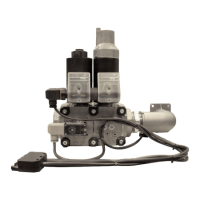
Gas Train: Refer to Gas Train Manual (ionization)
Electric Motor:
Voltage: 230-400 V / 50 Hz
Power Consumption (operation):
Protection Level: IP40
Sound Pressure Level dB(A): 80 (without silencer), 74 (with silencer)
Ambient Temperature for Storage: -20°C to +70°C
Temperature for Use: -10°C to +60°C
Dimensions (mm):
Packaging (mm) and Weight (kg):
The BLU burners are designed for straightforward installation and commissioning, though these tasks must be performed by authorized specialists. The burner is fixed to the boiler using a flange and screws. Proper insertion depth of the blast tube and brickwork (if required) is critical for optimal combustion and to prevent damage. Gas lines and gas trains must comply with EN676 directives and local safety regulations, with additional supports installed to prevent overloading the burner body.
Electrical connections require adherence to EN676 guidelines, including an efficient earthing system and a type A circuit breaker. Burners with motors up to 3 kW can be adapted for 220-230V power supply by modifying the motor's internal wiring from star to delta and adjusting the thermal relay settings.
Burner output adjustment is performed using a combustion analysis tool. This involves setting the air inlet, gas butterfly valve position, and gas governor/adjustable gas valve for both high and low flame stages to achieve optimal combustion values (CO, CO2, soot emissions). The air pressure switch and minimum gas pressure switch also require calibration to ensure correct operation and safety. The ionization current should be measured to ensure it is stable and never below 3 μA.
LPG transformation involves replacing specific components like diffusers and the nozzle, and adjusting the blast tube.
Regular maintenance is essential for the safe and efficient operation of Ecoflam BLU burners. All servicing must be carried out by qualified personnel, and a maintenance contract is recommended for regular servicing. Before any maintenance or cleaning, the electrical supply must be disconnected, and caution exercised as the blast tube and firing head can be hot.
Annual Check:
Burner Maintenance:
Troubleshooting: A detailed troubleshooting table is provided to diagnose malfunctions based on LED blink codes. Common issues include failure to establish flame, air pressure switch faults, extraneous light during startup, and flame loss during operation. Safety-related components must not be repaired but replaced with original parts. After any intervention, combustion values and individual lines should be checked for leaks, and results recorded.



 To Next Page
 General