'/\LU
09$
L'\
J
l
"ad/\1
QN9
am
smlaauuoo
1ndu|
'uo!1e1ed0
|eg1
-ua1aH!p
JO
pepua-a|6ugs
‘pa|dn0o
op
10
oe
10;
8p!/\O.lC|
01
L|O1!/V\S
UO[l[SOd
aanp,
e
qlg/v\
qoee
’s|auueqo
0/v\_|_
S_LdNl
(L)
*
(O)
w
=(>|
01
unwul ooz
40 ww) apvw
l9!1U919H!Cl
SNO|_W3H|33dS
Z1
~
.Aw
'S1Ll9LLl
009$
1(00l
O1 OLJO
SW95)
QPOW
I9!1U919H!C|
(Q)
-H.l1SU[5U!SS800.Id
|eu6!s
qzueasag
paqddv
uolaauud
J9L|1O
.SwJ
A
L Iepow
uowwoc)
(E)
J0;
J9[}!|dLU€G.lC|
2
se
asn
Jo;
palms
||a/v\
sg gll
|apo|/\|
aq_|_
(UL-8
ugugggqns
995)
NO|_LVH3dO
HVBNH
'suogsg/\oJd
1sa1
Malleq
pue
's|011u00
J9A[.lpN\9JI)S
uo!1
H_LlN\
LNELLSISNOD
"lVND|S
.LdNI
INHINIXVI/\l
(17)
'$1!W!l
UO!19.l9dO
pa|dnoo
op
paaoxa
louueo
s101goede:>
6ug|dno:>
5no1
ssed
agq/v\
s1uagsue1_|_
'/\
QQZ
-i)9[9J
apow
uowwoo
pue
Bugmaz
0p
|aued-1u01;
'S1U€-LLIHO
dOO|-pUI'\O.l5
;0
s1oaHa
aql
seonpeu
12141
Angnrugra
|eg0eds
‘qolg/v\s
Ma/\o0aJ-1se;
peope/\0
ue
apn|oug
samlea;
Jaqlg
'UO|1€J8dO
au||
Buunp
A||eo|1eLu01ne
q
[41
q
.
.
.
.
(q)
a61eq:>e1
saualleq
wngwpeo-|a>|9gu
aq_|_
'sag1e11eq
u/v\0
pue1sq1g/v\
ueo
smlpedeo
6u!|dn0a
:pa|dn0:>
av
'/\
9'L¥'|9!1
-umeggq
5/\
Q[_:|:
'apoW-uowwog
:pa|dno:>
sq
El'E)\7’V\|V(]
.LOH_LlN\_LdN|
INHINIXVW
(8)
s13
LUOJ}
10
au!|
oe
eql
LUOJ}
.l8q1[9
pe1e/vxod
aq
Aew
lgun
eq_|_
(9)
'u0gsuedxa
95UBJ
ggx
01
Lx
S9p[AO.|d
.l8[UJ9A
uge
pe1e1qg|eoun
ue
pue
’a0uenbes
9-Z-L
e
ug
tglx
01 QLX
11.101;
e|qe1oa|as
qslg/v\s
sg uge
p91EJC|[|BQ
'uog1e1ed0
papue-e|5ugs
JO
|B[1U9J9H.[p
Jaqlga
/v\0||e
'saqo1g/v\s
5ug|dnoo
pa1unqSluJqO5!5L
zpaldnoa
90
|Bl"|p[/\!pU[
'S1dU[
ON\_]_
'pa0npc->1
eq
O1
L|1p[/V\pUBq
aql
/v\0||e
s;;0||o1
Aouanbaq
/v\o|
pue
qgq
e|qe1sn[pv
'z|_|>|
Wauejed
U!
dd gt
pug
Swqoaw
Om
Lm,“
QQ8
01 op u.|o1;s|eu6gs
pueqep!/v\
40
uogleogmdwe
asgou
/v\0|
pun01
01
palunqs
‘511
1'9
q6noJq1 :pa|dnoo
av
(e)
‘uge
qgq
sap!/\01d
1ag,u|dweeJd
as!o|\|-/v\o"|
gll
|epo|/\|
eq_|_
EIf)NV(]3dV\l|
_LdNl
(Z)
NO|J.I)ClOHJ.N|
L‘
L
SQILSIHHLQVHVHO
I
NOLLOHS
SECTION
I
CHARACTERISTICS
1.1
INTRODUCTION
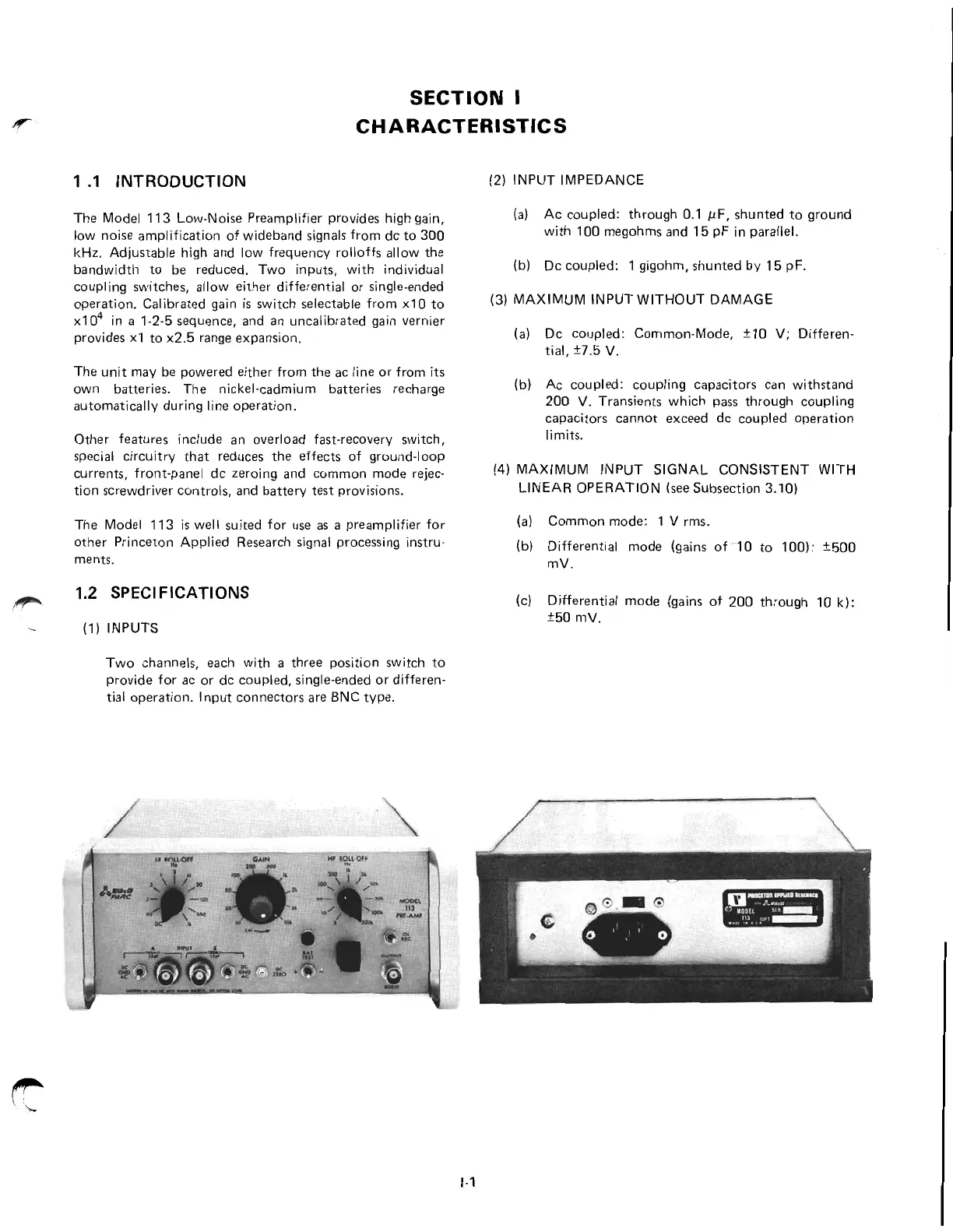
The Model 113 Low-Noise Preamplifier provides high gain,
low
noise
amplification
of
wideband signals
from
dc
to
300
kHz. Adjustable high and
low
frequency
rolloffs
allow the
bandwidth
to
be
reduced.
Two
inputs,
with
individual
coupling switches,
allow
either
differential
or
single-ended
operation. Calibrated gain
is
switch selectable
from
x10
to
X104
in a 1·2-5 sequence, and
an
uncalibrated gain vernier
provides
x1
to
x2.5 range expansion.
The
unit
may
be
powered either
from
the
ac
line
or
from
its
own batteries. The nickel-cadmium batteries recharge
automatically
during line operation.
Other features include
an
overload fast-recovery switch,
special
circuitry
that
reduces the effects
of
ground-loop
currents, front-panel
dc
zeroing and common mode rejec-
tion
screwdriver controls,
and
battery
test provisions.
The Model 113
is
well suited
for
use
as
a preamplifier
for
other Princeton
Applied
Research signal processing instru-
ments.
1.2 SPECIFICATIONS
(1) INPUTS
Two
channels,
each
with
a three position switch
to
provide
for
ac
or
dc coupled, single-ended
or
differen-
tial operation. I
nput
connectors
are
BNC
type
.
/
\-1
(2)
INPUT
IMPEDANCE
(a)
Ac
coupled: through
0.1
J.1F,
shunted
to
ground
with
100 megohms and 15 pF in parallel.
(b) Dc coupled: 1 gigohm, shunted
by
15
pF.
(3)
MAXIMUM
INPUT
WITHOUT
DAMAGE
(a)
Dc coupled: Common-Mode,
±10
V;
Differen-
tial, ±7.5
V.
(b)
Ac
coupled: coupling capacitors can
withstand
200
V. Transients
which
pass
through coupling
capacitors cannot exceed dc coupled operation
limits.
(4)
MAXIMUM
INPUT
SIGNAL
CONSISTENT
WITH
LINEAR
OPERATION
(see
Subsection 3.10)
(a)
Common
mode: 1 V rms.
(b)
Differential
mode (gains
of
10
to
100):
±500
mY.
(c)
Differential
mode (gains
of
200
through 10
k):
±50
mY.


 To Next Page