EasyManua.ls Logo

EG&G 113 - Operating Instructions; Introduction; Noise and Source Resistance

EG&G 113
40 pages
Print Icon
To Next Page IconTo Next Page
To Previous Page IconTo Previous Page
Loading...
7-"
Zq+
L;
Z
“ii
X-=
Z24
M
9N3
:e|nu.u0qaq1
Aq
ua/\q5
sq
L|lp!MpUBq
asqou
1ua|e/\qnba
(sun)
a6e1|0/\
asqou
|eu.uaq1
aomos
. 0L5
Hp
lnduq
‘dune
01
pauaqaq
aelqo/\
asqou
suu
|e1o1
0|
Oz
= amqqq
asq0q\|
(Z)
1
:sau1o:>aq
‘suu:->1
asaql
u|
passaqdxa
amqq
aw’
‘DP
“em
Jaqlo
S!
umas
muanbau
HOHOJ
In
am
4|
asqou
aq_|_
'u|e5
Jaqqqqdwe
9L|l
Aq
Buqpmqqa
Aq
asqou
1ndL'u
"z/M
Aq
paqqdnqnw
Avuanbwq
qqvqqw
:IH
eul
/\|dw!$
S!
suw
'
'
'
'
'
' '
'
'
9H1
Ll1P!/“PUQQ
95!°U
1U9l9'\!"b9
9H1
'(OCI
01
HQIIOJ
;I"l)
paqdnoo
Op
uqleqado
uaq/q/q
'q1pq/v\pueq
Jaqqqqdwe
aq1
10/pue
aql
6uququ.ua1ap
uq
pasn
qlpq/vqpueq
asqou
1ua|e/qqnba
aLq_|_
'
'
'
1ua|e/xqnba
ue
01
pane/\u0o
aq
Aeqw
asqou
1nd1n0
|e1o1
aq_q_
'(o1az aq
01
lnduq
pasnun
a'q1
qoq
qolaaqas
uqqdnoo
aq1
1:-as
‘papua-aquqs
pasn
qq fgqq
qapoq/qq
10;
aouelsqseu
aomos
qeqluaqaqqqp)
swqo
uq
aouelsqsaq
azunos
=
H
sun
s1|0/\
Q3/:||\|
5O||1UB
x
asqou
|BLU.l8L|1
aomos
ZH
U!
LllP!MPUBq
asqou
luaqe/\qnba
=
qv
=
a5e1|o/\
asqou
lnduq
susu
1ua|e/\qnba
qe1o_|_
(3)
5“!"|9>|
U!
amleladwal
amlosqe
=
-L
:(g)
uoqlenba
pue
qdeq
aql
woqq
pauqelqo
aq
ueo
sqqq_|_
‘ls:-ueluq
qo
A1!1uenb
aql Aqqensn
sq
PUB
3
= Su“
asqou
1ndu|
su.u
1ua|e/\qnba
|e1o1
aqa,
‘smoluoo
asaqa,
uqsn
uq
51l°/\
}VHJ.>H7/‘
=
9$!°N
|9U~'19Ll.l_
991"°S
9'41
919W‘/\
>|/saqnoq
8
z_()[
x
331
'1ue1su00
s,uueLuz1q0g
=
>q
(suu)
a6e1|o/\
asqou
|BUJJ8L|1
aomos
x
u|e6
Ol
'
'
60
9“13G°W
3H1
H0’!
8p
1nd1no
Jaqqqqdwe
8L|l
1e
a5e1|0/\
asqou
su.u
|e101
l
Oz
SUn0.|.N00
aunsu
EISION
'|V0ld)\.l.
'l'Ill
@1"5!=l
1H NI
A3N3O3Bi
;OP§
qO|
’O|
{OI
OOI
OI
I
I
OI
2
OI
= aJn6q:q
asq0q\|
(q)
:
amqd
asqo
'
~
ll
N”
F
~~
SP0’
aql
paqqeo
sq
sqql
‘sq:-aqqoap
uq
passaqdxa
fasqou
qeuuaqa,
~=P_<v>fmH
azunos
paqqqqdwe
sq),
01
sppe
Jaqqqqdwe
aql
asqou
qo
lunowe
L
s~
8L|1
Aq
paqqqoads
aq
uea
a:>ueuu0,uad
asqou
qaqqqqdwe
‘laadsaq
7
‘W
sqql
uq
'oq1e1
asqou-01-qeuqs
lnduq
aql
Buquqwqz-nap
uq
10102;
=°'p
20*
lueuqwop
aql
sq
aouelsqsaq
aomos
qeuqs
aql
Aq
paleqaua
—+~
8P9
BPQ
,o|/
‘F
“s
voqg,
HBOHHO
I
BPS
I
90!
9 0|
901
s
9990
*
/vxoqq
||q/v\
95B1|0I\
auqq
e
Lqqq
001 woqq
5Ll[1BJ3dQ
'(u0q1e1ad0
WHON
1
i
90
X062V
i—
+
8""
asqou
|BLUJ8L|1
aql
saouelsuq
Auew
uq
'oq1e1
asqou-01-qeuqs
$0,?
W
V, | qqeqa/\o 8L|1
saseaqoap
lseaq
1q
aqaq/v\
suoqlqpuoo
asoql
J9pUl’\
pazqqeaq
aq
01
papqeaq
uz->140
sq
aoueuuoqqad
J9[].!|dUJB
lsag
*~
I
3ONV.LS|SEl!:|
EIOHHOS
CINV
EISION
Z'S
's1uau0du10:)
lqnoqqo
pue
J8LUJO}SUBJ1
J8MOd
amp,
aewep
Aqqqssod
pue
asnq
auqq
3L|1
A
OEZ
1°}
V
Z8/l
U°!1919d°
A
E-ill
1°}
V
9L/L)
Pallelsul
sq
asnq
auqq
azqs
J8dO.ld
sq],
ems
aq
pue
‘pasn
aq
01
a6e1|o/\
10»
saw
~
~
qoq
auqq
eql
Buqleoqpuq
uoqlqsod
aq.q1
uq
sq
L|31[N\S
|8UBd-.1881
BM
-*?
1
4L-
89?
I
*
"’—1"'
SP9
' T
so‘
/
avov
P9
oqol
o|O'
aql
ems
a>|ew
'J9MOd
auqq
oe
LUOJ}
Buqleqado
aqoqeg
:3_|_Q|\|
¢
'SLUL|O
=|.O
8OUQ1S!S8.l
B
L{5I'\OJl]1
>|OQ[
1nd1n0
aLq1
1e
aqqeqqe/xe
sq
qeuqs
paqqqqdwe
8L|1
!(s)101oauuo:>
‘°‘
em
avo
QPQ
6°‘
1nc|uq
aql
01
paqqdde
sq
paqqqqdwe
aq
01
qeuqs
8L{l
pue
M.
4
‘auqq
oe
aq1
woqq
10
saqqaneq
pauqeluoo-qqas
aql
woqq
Jaqlqa
paqqnbeq
se
paqa/v\0d
sq
luawnnsuq
9L|1
‘A||e1uau1epun:q
'/v\0|aq
passnosqp
aqe
Lqoqq/\/\
qo
qqe
’suoq1
'gqq
qapoq/\|
aq),
10,1
smoluoo
-eqapqsuoo
dooq
punoq
uq
pue
'q.q1pq/vxpueq
aql
6uq1:>a|as
uq
aqnqq
asqou
qo
1as
qeoqd/K1
e
sq
q-|||
a1n6q:q
'/kqqeoqqdeq
'aouepadwq
aamos
qeuqs
8L|1
uqlaaqas
uq
pasqaqaxa
aq
1SLU
pa11o|d
pue
'/kqqeluauqqqadxa
pauqelqo
aqe
samqq
asaq_q_
9199
'8ll
|9P°|N
9H1
W01}
99U9l11J°>l19d
W"W!1d°
Ulelqo
°.L
'aoue1sqsa1
aamos
pue
Aouanbaqq
qo
uoq1aun,q
e se
saqqe/\
qoqq/v\
‘amqq
asqou
oqlsqqalaeqeqo
u/v\0
s1q
seq
Jaqqqqdwe
Lqoeg
|\|()|_|_Q(|()E|_|_|\||
['3
SNOl.I.3H.I.SNl
9NI.l.V!:l3dO
III NOLLOHS
SECTION
III
OPERATING
INSTRUCTIONS
3.1 INTRODUCTION
To
obtain
optimum
performance
from
the
Model 113, care
must
be exercised in selecting
the
signal
source
impedance,
in
selecting
the
bandwidth,
and
in
ground
loop
considera-
tions,
all
of
which
are discussed
below.
Fundamentally,
the
instrument
is
powered
as
required
either
from
the
self-contained
batteries
or
from
the
ac line,
and
the
signal
to
be ampl ified
is
applied
to
the
input
connector(s);
the
amplified signal
is
available
at
the
output
jack
through
a resistance
of
600
ohms.
NOTE: Before
operating
from
ac line
power,
make
sure
the
rear-panel switch
is
in
the
position
indicating
the
line
voltage
to
be used,
and
be sure
the
proper
size line fuse
is
installed
(1/16
A for
115
V
operation
or
1/32
A
for
230
V
operation).
Operating
from
too
high a line voltage will
blow
the line fuse and possibly
damage
the
power
transformer
and
circuit
components.
3.2 NOISE
AND
SOURCE RESISTANCE
Best amplifier
performance
is
often
regarded
to
be
realized
under
those
conditions
where
it
least decreases
the
overall
signal-to-noise ratio. In
many
instances
the
thermal
noise
generated
by
the
signal source resistance
is
the
dominant
factor
in
determining
the
input
signal-to-noise ratio.
In
this
respect, amplifier noise
performance
can
be specified
by
the
amount
of
noise
the
amplifier
adds
to
the
amplified
source
thermal
noise; expressed in decibels, this
is
called
the
"Noise
Figure":
(1) Noise Figure =
20
I
total
rms noise voltage
at
the
ampl ifier
output
0910
gain x
source
thermal
noise voltage (rms) dB
where
the
Source
Thermal
Noise =
V4KTRl'lf
volts
rms
= E,
and
K =
Boltzmann's
constant,
1.38
x
10-
23
joules/K
T
=
absolute
temperature
in kelvins
M =
equivalent
noise
bandwidth
in
Hz
R =
source
resistance
in
ohms
(differential
source
resistance
for
Model
113;
if used single-ended,
set
the
coupling
selector
for
th.e
unused
input
to
ground,
and regard this
part
of
input
resistance
to
be
zero).
The
total
output
noise may be
converted
to
an
equivalent
input
noise
by
dividing
by
the
amplifier
gain.
The
noise
figure,
expressed
in
these
terms,
becomes:
(2) Noise Figure =
20
I
total
rms noise voltage referred
to
amp.
input
dB
0910
source
thermal
noise voltage (rms)
II
1-1
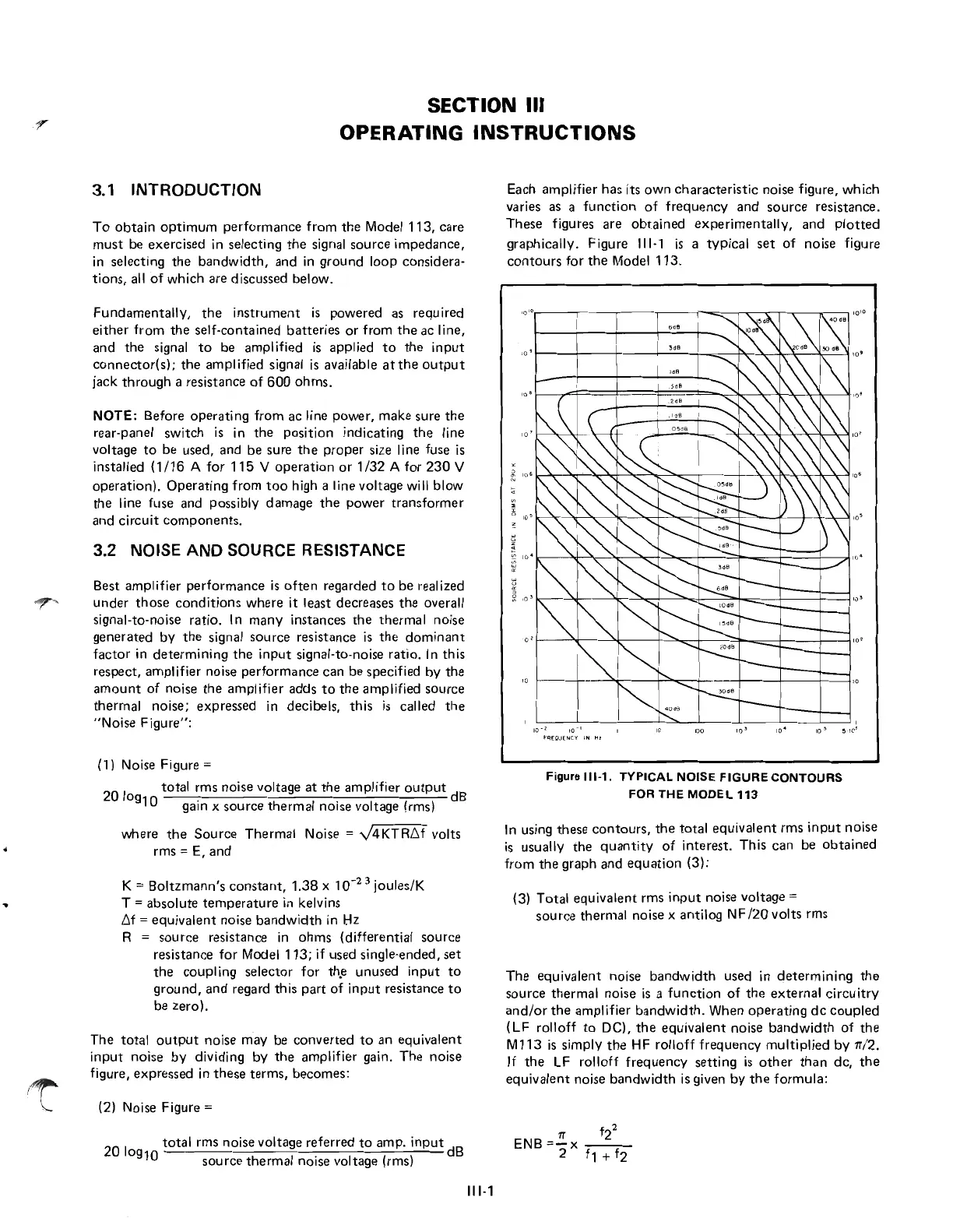
Each ampl ifier has its
own
characteristic
noise figure, wh ich
varies as a
function
of
frequency
and
source
resistance.
These figures are
obtained
experimentally,
and
plotted
graphically. Figure
111-1
is
a
typical
set
of
noise figure
contours
for
the
Model
113.
30dB
--'_---l,
10
-1
10-
1
00
IO~
~
IO~
FREQUfNr
i .N
Hz
Figure
111-1.
TYPICAL
NOISE
FIGURE
CONTOURS
FOR
THE
MODEL
113
In
using these
contours,
the
total
equivalent
rms
input
noise
is
usually
the
quantity
of
interest.
This can
be
obtained
from
the
graph
and
equation
(3):
(3)
Total
equivalent
rms
input
noise voltage =
source
thermal
noise x antilog
NF/20
volts rms
The
equivalent
noise
bandwidth
used in
determining
the
source
thermal
noise
is
a
function
of
the
external
circuitry
and/or
the
amplifier
bandwidth.
When
operating
dc
coupled
(LF
rolloff
to
DC),
the
equivalent
noise
bandwidth
of
the
M113
is
simply
the
HF
rolloff
frequency
multiplied
by
1T/2.
If
the
LF rolloff
frequency
setting
is
other
than
dc,
the
equivalent
noise
bandwidth
is
given
by
the
formula:

Related product manuals