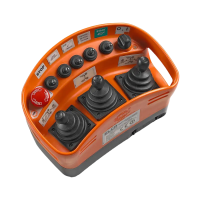
ENG man BRAVO-FUNK-915 00 BRAVO-FUNK-915 Radio remote control system
- Page 6 -
- Use decoupling systems for the receiver outputs when an electrical command other than the radio remote control is
foreseen, except when use of the alternative command is made with the receiving unit of the radio remote control
electrically disconnected from the machine.
- Pay attention to the current in the STOP and SAFETY outputs so that it never exceeds the permitted value of 7.5A.
- The SAFETY relay contact must be connected in series to the common wire of the movement command when
the safety protection is required in relation to the involuntary activation of the control with actuator at rest (UMFS
unintended movement from standstill PL d). This connection is already prearranged internally for the ON/OFF or
PWM outputs of the Joysticks.
- IT IS IMPERATIVE that the two STOP contacts on the receiver are always used.
- It is necessary to always have a positive voltage (8-30 V) in the inputs IN_STP1 (K1), IN_STP2 (J1) and IN_SAFETY
G1), otherwise the receiver cannot function.
- If the machine is congured to manage only one Stop command, connect the input IN_STP1 (K1) to the positive
pole, connect the two STOP contacts in series, connecting OUT_STP1 (K2) to IN_STP2 (J1) with a bridge; output
OUT_STP2 (H1) is now the Stop output. The Stop contact is now located between the terminals IN_STP1 and
OUT_STP2, with the need to have current ow from IN_STP1 toward OUT_STP2.
- Connecting the two STOP contacts separately if the machine is set to manage two separate Stop contacts (use four
wires). In this case, always connect the positive pole to the inputs IN_STP1 and IN_STP2. Current must always
ow from the input to the output. The installer is responsible to perform the wiring able to guarantee the level of
security required.
- Gather up the wiring cables and lock them into place, so that the weight cannot tear the crimped contacts of the
single cables. If need be, use the included spring to be mechanically fastened to the connectors of the receiver and
fasten the wires with a plastic strip.
- After installation, test the machine operated by the radio remote control, checking the actual safety of the machine
by means of the STOP command, the exact correspondence of the command symbols with the actual movement
of the machine.
- Check that operations that render the machine's safety systems ineffective are not performed during installation
(limit switches, interlocks, load limiters, etc..).
- Check that the contact of the SAFETY command is in series with all commands to which a UMFS protection is
required.
- Check also the correct operation of the machine without the use of the radio remote control where possible.
- Make sure that the activation of the auxiliary commands on the machine (if electrical) does not entail the application
of voltage to the outputs of the receiver. If need be, use decoupling systems (see paragraph 5.2). Return voltage
through the outputs may limit or exclude the safety performance of the radio remote control.
- If abnormal operations are experienced, DISABLE the machine until the problem is fully solved.
- When closing the receiving unit again, carefully check the integrity of the sealing gasket and its correct housing.
Press the connector until the two aps on the cover slot into place (conrmed by a clicking sound).


 To Next Page