RIDE. RIDE.
2120
2. Législation française sur les VAE
Afin de circuler sur la voie publique, il est
demandé à l’utilisateur du vélo électrique
ELWING de s’assurer du respect du code de
la route.
L’attention de l’utilisateur porte
particulièrement sur les règles suivantes (liste
non exhaustive) :
• L’utilisateur doit être âgé d’au moins 12
ans.
• Le vélo doit comprendre un dispositif de
freinage.
• La vitesse du vélo ne doit pas dépasser
25 km/h.
• Toute modification du vélo ELWING par
l’utilisateur est de la seule responsabilité
de celui-ci. ELWING décline toute
responsabilité en cas de dommage subi
ou causé par un vélo lorsque le vélo a été
modifié par l’utilisateur.
Règles concernant l’équipement :
• Le port du casque est recommandé.
• Hors agglomération, l’utilisateur doit être
muni d’un gilet haute visibilité ou d’un
équipement réfléchissant équivalent.
• La nuit, ou le jour lorsque la visibilité est
insuffisante, la loi vous oblige en tant que
cycliste à avoir un équipement d’éclairage
avant et arrière sur votre vélo.
Règles concernant les espaces de circulation
en agglomération et hors agglomération.
Sauf toute autre règle locale contraire,
l’utilisateur doit respecter les règles suivantes :
En agglomération
• Circuler avec le vélo sur la bande ou la
piste cyclable.
• En l’absence de bande ou de piste
cyclable, circuler uniquement sur les
routes limitées à 50km/h.
Hors agglomération
• Circuler avec le vélo sur les voies vertes
ou les pistes cyclables.
ELWING est le plus à même pour vous
conseiller et pour réaliser toutes les opérations
de maintenance, mais si vous préférez faire
certaines d’entre elles vous-même, vous
trouverez quelques conseils dans les pages
qui suivent.
You can see the list of compatible accessories
on our website:
https://elwing.co/pages/compatible-
accessories-yuvy
This is a non-exhaustive list of accessories
that we have tested ourselves.
• The racks are designed for a maximum
load of 25kg. Do not attempt to modify
your carrier, its attachment points or to
exceed the maximum load value as this
could damage your bike and result in
a fall and injury. Furthermore, in such
cases, your bike or carrier will not be
covered by the warranty.
• When your luggage rack or basket is
loaded, the behaviour of your bike is
modied. This is because weight is added
to your bike and this leads to changes in
the way your bike handles and brakes. In
order to maintain a good balance, be sure
to distribute the load evenly on the bike
(front/rear, right/left).
• When tting luggage to your luggage
rack, ensure that it is securely fastened
and that no straps are left dangling,
which could get caught in the wheels
and cause a fall. Note that luggage
attached to the carrier must not obscure
the lights and reectors.
• Check the fastening screws of your
luggage rack regularly to avoid any
problems. Hold the carrier and move it
back and forth to check that the various
xing points are tight.
3. Compatible accessories
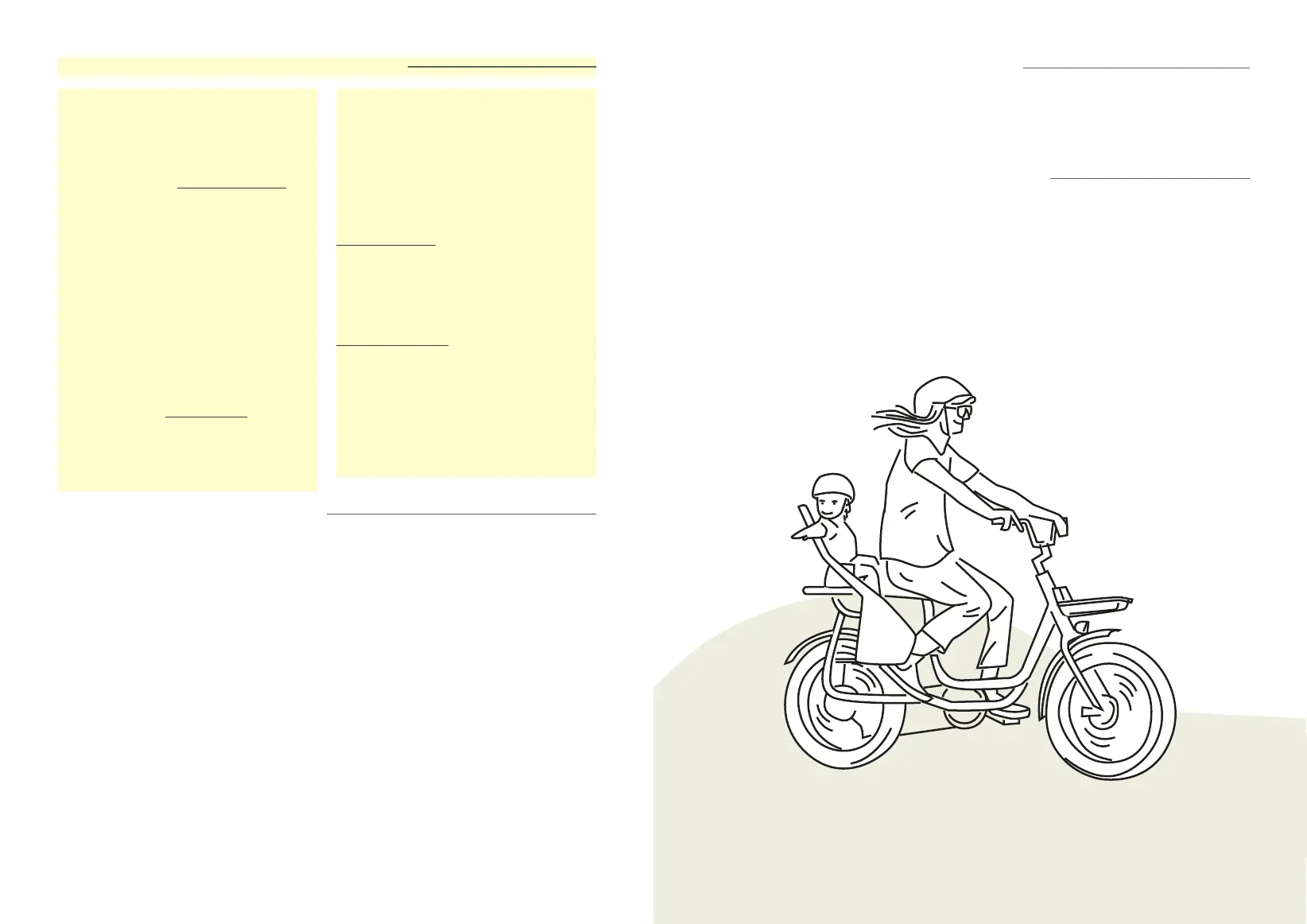
5. Transport of children and loads
• The total permissible weight of the
bike includes the weight of the bike,
the weight of the rider, the weight of
luggage and accessories.
• The weight of the bike is 24kg (excluding
battery and optional accessories). The
total weight of the user and passenger
must not exceed 150kg.
Before riding with the YUVY loaded or
equipped with a child seat, you should check
the following points:
• The basket/bag or child seat must be
correctly installed.
• The child must be properly secured
according to the recommendations of the
seat brand and equipped with a helmet.
• The load must be evenly distributed on
the bike.
• The loaded items must not be able to
slide or move.
• The total permissible weight must be
respected.
• Nothing should be allowed to get caught
in the spokes of the wheel or hide the
lights and reectors.
WARNING!
When transporting a child in a child seat, make sure that the child cannot get its ngers or feet
caught in the wheel. Risk of serious injury! Do not leave the child in the child seat when you put
the bike on the stand.
4. Gross Vehicle Weight Rating
21



 To Next Page
 Loading...