DIGITAL CONDUCTIVITY METER
The information contained in the accompanying document is proprietary and confidential, and
may not be copied in any manner whatsoever without prior written consent of Emcee
Electronics, Inc. The document and the material therein may not be used for any purpose other
than that intended by Emcee Electronics, Inc.
COPYRIGHT 2005 EMCEE ELECTRONICS, INC.
REVISION DATE: October 23, 2014
Page 9 of 11
9. CLEANING PROCEDURES
9.1 In normal use, the probe should be cleaned with toluene or a mixture of heptane
and isopropanol and air-dried after use, to ensure that ionic materials absorbed on the
probe during previous tests will not contaminate the sample and give an erroneous
result. The probe can be disassembled by rotating the outer conductor
counterclockwise. Typically, the probe is cleaned by rinsing it using alcohol
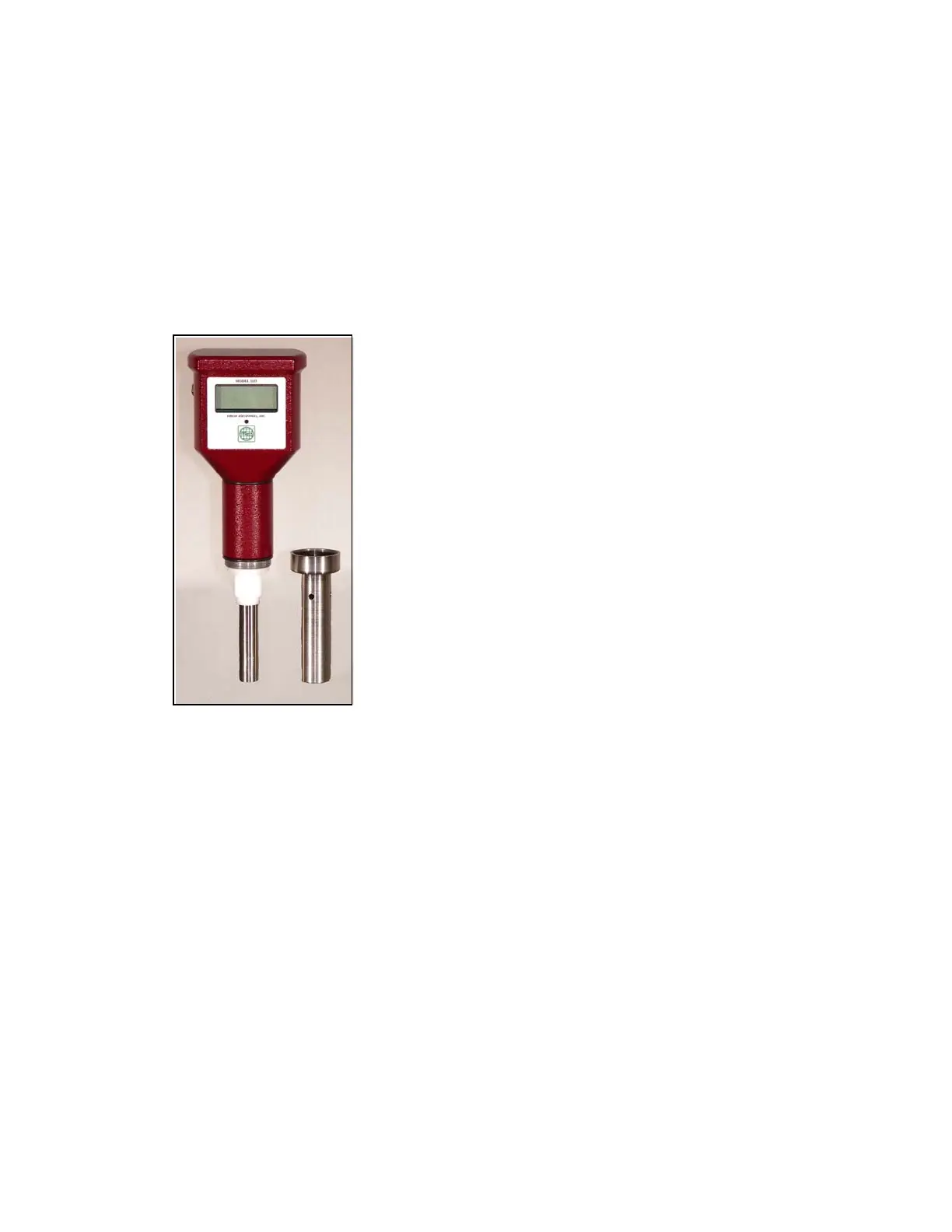
followed by a toluene (or with some of the sample to be tested). Fig. 6 Shows the
Probe disassembled.
9.2 If the cell is in contact with water and the
instrument is switched on, an immediate off scale
reading will be obtained. If the cell has been in
contact with water, it shall be thoroughly rinsed with
cleaning solvent, preferably isopropyl alcohol, and
dried with a stream of air.
9.3 The meter may display a non-zero reading caused
by condensation forming on the cell when the meter
is taken from a cool, dry environment and subjected
to hot, humid conditions. This condition can be
avoided by storing the cell at a temperature 2 to 5°C
in excess of the ambient temperature, when
practicable
Figure 6 – Probe Disassembled
10. BATTERY REPLACEMENT
10.1 The Model 1153 meter has an internal battery check circuit. If the batteries are
weak, the meter will turn on ‘LOW BAT” will be displayed and the meter will turn
off and not allow a measurement to be performed. If the batteries are too weak, the
meter will not turn on.


 To Next Page