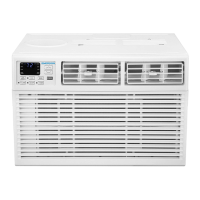
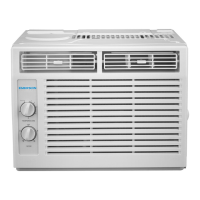
This document provides the operating instructions for the EMERSON QUIET KOOL Model No. EARC5MD1, a 5,000 BTU Window Air Conditioner. It covers important safety instructions, electrical requirements, a packing list, installation and assembly instructions, usage guidelines, care and cleaning procedures, and troubleshooting tips.
Function Description
The EMERSON QUIET KOOL EARC5MD1 is a 5,000 BTU window-mounted air conditioner designed to cool a room. It features manual controls for temperature and mode selection, including cooling and fan-only operations. The unit is equipped with directional louvers to adjust airflow and a power cord with a Leakage Current Detection and Interruption (LCDI) plug for enhanced safety. Its design incorporates features to improve efficiency, such as allowing condensate water to hit the condenser for moisture removal.
Important Technical Specifications
- Model Number: EARC5MD1
- BTU Rating: 5,000 BTU
- Window Width Compatibility: Designed for standard double-hung windows with widths between 23" and 36" (584 mm – 914 mm).
- Vertical Clearance Requirement: The lower sash must allow for 14.5" (368 mm) of vertical clearance when open.
- Electrical Requirements:
- Voltage: 115 volts (103 min. - 127 max)
- Amperage: 0-8 amps
- Circuit Protection: 10-amp time-delay fuse or circuit breaker
- Circuit Type: Use on a single outlet circuit only.
- Power Cord: Equipped with a 3-prong grounded plug and an LCDI power cord for leakage current detection and interruption.
- Drainage: The unit is designed to be slightly tilted outwards (approximately a 1/3 bubble on a level) to allow accumulated rainwater and condensate to drain from the back side of the unit.
- Storm Window Adjustment: If a storm window frame prevents proper tilt, a board or wood piece (at least 1 1/2" deep and approximately 1/2" higher than the storm window frame) should be attached to the sill for proper drainage.
Usage Features
Manual Control Panel:
The air conditioner is operated via two rotary dials: MODE and TEMPERATURE.
- Power On/Off: The unit is turned on by rotating the MODE dial to the desired setting.
- Cooling Modes:
- HIGH COOL (❄️❄️): Provides maximum cooling. The fan automatically operates at high speed to circulate cool air throughout the room.
- LOW COOL (❄️): The fan operates at a low speed for cooling.
- Fan Modes:
- HIGH FAN (?️?️): Fan-only operation at high speed.
- LOW FAN (?️): Fan-only operation at low speed.
- Note: The air conditioner does not cool the room when in fan-only mode.
- Thermostat (TEMP dial): Used to set the desired room temperature. For maximum cooling, the TEMP dial should be set to 7 (Max Cool).
- Directional Louvers:
- Horizontal Wheel: Controls the horizontal direction of the airflow.
- Air Deflector: Controls the vertical direction of the airflow.
- Compressor Protection: To minimize wear and tear, a 3-minute delay is recommended before changing modes. This prevents compressor overheating and circuit breaker tripping.
Normal Operating Sounds:
Users may experience the following sounds during operation:
- Pinging Noise: Caused by water hitting the condenser, especially on rainy days or in high humidity, which helps remove moisture and improve efficiency.
- Thermostat Click: Occurs when the compressor cycles on and off.
- Water Collection: Water will collect in the base pan during rain or high humidity. This water may overflow and drip from the outside part of the unit.
- Fan Operation: The fan may continue to run even when the compressor is off.
Maintenance Features
Care and Cleaning:
Regular cleaning is essential to maintain performance and minimize dust buildup.
- Air Filter Cleaning:
- Frequency: Check at least once a month.
- Procedure:
- Remove the filter by sliding it out from the front right side of the air conditioner.
- Wash the filter with liquid dish soap and warm water. Rinse thoroughly.
- Gently shake the filter to remove excess water.
- Allow the filter to dry completely before reinserting.
- Alternatively, vacuum the filter to remove dust and particles.
- Importance: Trapped particles and dust can decrease airflow and cause frost accumulation on cooling coils.
- Enclosure Cleaning:
- Safety: Unplug the air conditioner before cleaning to prevent shock or fire hazards.
- Procedure:
- Dust the cabinet and front panel with an oil-free cloth.
- Alternatively, wash with a cloth dampened in a solution of warm water and mild liquid soap.
- Rinse thoroughly with a damp cloth and wipe dry.
- Precautions:
- Never use harsh cleaners, wax, or polish on the cabinet front.
- Wring excess water from the cloth before wiping around the controls to prevent damage.
Winter Storage:
When the air conditioner is not in use for an extended period:
- Remove the unit carefully from the window, following the installation instructions in reverse.
- Cover it with plastic or place it in its original box for storage.
Troubleshooting:
The manual provides solutions for common issues:
- Unit Not Starting: Check if the unit is unplugged, if the fuse/circuit breaker is tripped, if there's a power failure (unit restarts automatically after 3-minute delay), or if the LCDI device is tripped (press RESET button).
- Airflow Restriction: Ensure no curtains, blinds, or furniture are blocking the front of the air conditioner.
- Not Cooling Properly: Adjust the TEMP dial to a higher number, clean the air filter, allow time for the room to cool, and check for cold air leaks (open furnace registers, cold air returns).
- Freezing Up: If cooling coils are frozen, set the MODE dial to HIGH FAN or HIGH COOL and the TEMP dial to 1 or 2. Ice blocks airflow and prevents cooling.
- Water Dripping Outside: Normal in hot and humid weather.
- Water Dripping Inside: Ensure the air conditioner is slightly tilted downward from front to rear for proper drainage.
- Water Collecting in Base Pan: Normal as moisture is removed from the air, especially in high humidity.
For technical support, customers can call 1-844-882-2622 or email serviceweb@canac.ca.


 To Next Page
 General