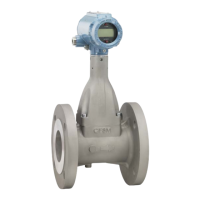
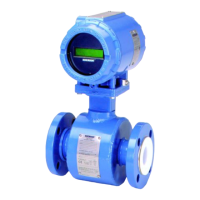
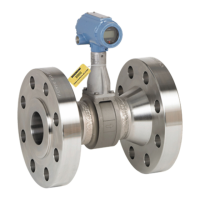
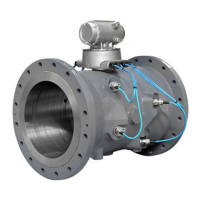
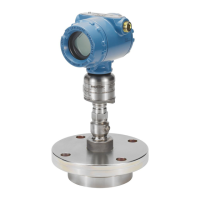
The Rosemount™ 8600 Series Vortex Flowmeter is a device designed for accurate flow measurement in various industrial applications. This quick start guide provides essential information for its installation, configuration, and basic operation.
Function Description:
The Rosemount 8600D Series Vortex Flowmeter measures flow by detecting vortices shed from a bluff body placed in the flow path. It can be used for gas, liquid, and steam applications. The flowmeter is capable of providing 4-20 mA HART output signals and pulse outputs, making it suitable for integration into control systems and for driving electronic totalizers or counters. It supports compensated mass flow measurements when used in conjunction with external pressure and temperature transmitters. The device is designed to operate in various orientations, including vertical and horizontal, with specific guidelines for optimal accuracy and performance in different fluid types and temperature conditions.
Important Technical Specifications:
- Electronics Housing Temperature Limit: The maximum temperature for integral electronics is 185 °F (85 °C). This limit is influenced by both ambient and process temperatures.
- Power Supply: The DC power supply should provide power with less than two percent ripple. The total resistance load in the loop (including signal leads, load resistance of controller/indicator, and intrinsic safety barriers) must be considered.
- Field Communicator Requirement: A minimum loop resistance of 250 ohms is required for the Field Communicator.
- Pulse Output Power Supply: A separate 5 to 30 Vdc power supply is required for the pulse output.
- Maximum Switching Current (Pulse Output): 120 mA.
- Wiring: Twisted pairs are required for 4-20 mA signal and digital communication to minimize noise. Shielded signal wire is recommended for high EMI/RFI environments. Wire size should be 24 AWG or larger. For ambient temperatures above 140 °F (60 °C), wire rated to 176 °F (80 °C) should be used.
- Coaxial Cable (Remote Electronics): The coaxial remote cable cannot be field terminated or cut to length. Any extra cable should be coiled with a minimum 2-inch (51 mm) radius. The maximum allowable length of the interconnecting cable between the transmitter and sensor is 152m (500 ft) for remote installations.
- Conduit Entries: Unmarked conduit entries require a 1/2 - 14 NPT blanking plug thread, while M20 marked entries require an M-20 x 1.5 blanking plug thread.
- Process Temperature Range (Flameproof Certification): -202 °C to +427 °C (for NEPSI E3 certification).
- Ambient Temperature Range (Flameproof Certification): -50 °C ≤ Ta ≤ 70 °C (for IECEx E7 and ATEX E1 certifications).
- Maximum Working Voltage: 42 Vdc (for IECEx N7, NEPSI E3, and ATEX N1 certifications).
- Intrinsically Safe Parameters (IECEx I.S. certification):
- Ui = 30 VDC
- Ii = 185 mA
- Pi = 1.0 W
- Ci = 0 µF
- Li = 0.97 mH
- PED Compliance: Model 8600D Vortex Flowmeters in line sizes 1.5"-8" are PED compliant (Module H Conformity Assessment, ASME B31.3: 2010). Line size 1" flowmeters fall under Sound Engineering Practice (ASME B31.3: 2010) and are outside the scope of PED.
Usage Features:
- Installation Flexibility: The flowmeter can be installed in any orientation without affecting accuracy, though specific guidelines are provided for vertical (upward or downward flow for gas/steam, upward flow for liquids) and horizontal (electronics to the side of the pipe preferred for steam/fluids with small solids) mounting to optimize performance.
- High Temperature Mounting: Recommendations are provided to maintain the electronics housing temperature below 185 °F (85 °C) in high process temperature applications, including installing the electronics head beside or below the process pipe and insulating the pipe and meter body (but not the support tube bracket or transmitter).
- Upstream/Downstream Requirements: Specific straight pipe diameter requirements (e.g., 35D upstream and 10D downstream for no K-factor correction) are outlined to ensure accurate measurement. External pressure and temperature transmitters for compensated mass flow should be installed downstream of the flowmeter.
- Flanged-Style Installation: Instructions for proper bolt tightening and gasket sealing are provided, emphasizing adherence to ASME PCC-1 guidelines.
- Remote Electronics Option: For applications requiring remote electronics, the flowmeter assembly ships in two parts (meter body with adapter and coaxial cable, and electronics housing on a mounting bracket). Detailed instructions are given for connecting the coaxial cable and mounting the components.
- Housing Rotation: The electronics housing can be rotated in 90° increments for easy viewing, with a procedure to safely disconnect and reconnect the sensor cable during rotation.
- HART Communication: The flowmeter supports HART-based communication for configuration and diagnostics. Default alarm conditions (alarm high) and security settings (off) are applied if jumpers are not installed.
- Configuration Review: Before startup, users should review pre-configured variables such as Tag, Transmitter Mode, Process Fluid, K-Factor, Flange Type, Mating Pipe ID, PV Units, Damping, Fixed Process Temperature, Filter, LCD Display, Density Ratio, Process Density, Variable Mapping, Range Values, and Pulse Output Configuration.
- Conduit Installation: Guidelines are provided to prevent condensation from entering the housing, including mounting the flowmeter at a high point in the conduit run or routing conduit below the flowmeter before entry.
Maintenance Features:
- Cover Jam Screw: For transmitter housings with a cover jam screw, instructions are provided for its proper installation after wiring and power-up. This screw prevents unauthorized removal of the transmitter cover in flameproof environments without tooling.
- Product Certifications: The device holds various certifications for hazardous locations, including Canadian Standards Association (CSA), International Electrotechnical Commission Explosive (IECEx), European certifications (ATEX), and Chinese certifications (NEPSI). These certifications detail specific conditions for safe use, such as requirements for transient suppressors, enclosure materials, cable types, and installation practices in explosive atmospheres.
- European Pressure Equipment Directive (PED): Information on PED compliance is provided, differentiating between line sizes that are PED compliant and those that fall under Sound Engineering Practice.
- EurAsian Conformity (EAC): The flowmeter complies with technical regulations of the Customs Union, including electromagnetic compatibility, safety of equipment under excessive pressure, and safety for use in potentially explosive atmospheres. Specific conditions for safe use under EAC are also outlined.



 To Next Page

 General