Table 7-8: Typical current consumption
(continued)
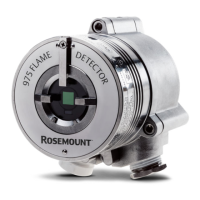
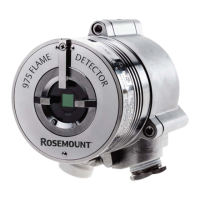
Typical current consumption Rosemount 975MR and 975HR Rosemount 975UF and 975UR
Normal power consumption without
heater with alarm: mA (Watts)
90 (2.2) 120 (2.9)
Low power heater with alarm: mA
(Watts)
140 (3.4) 180 (4.3)
Standard power mode heater with
alarm: mA (Watts)
280 (6.7) 320 (7.7)
Electrical input protection
The input circuit is protected against voltage-reversed polarity, voltage transients, surges,
and spikes according to EN 54-10.
Outputs
Relays
Alarm, fault, and auxiliary
SPST volt-free contacts rated 2A at 30 Vdc
Analog
5 V at detection, 0 V at fault, 2 V at normal
0-20 mA (stepped)
Fault: 0 +1 mA
Built-in test (BIT) Fault: 2 mA ± 0.3 mA
Normal: 4 mA ± 0.3 mA
Warning: 16 mA ± 0.3 mA
Alarm: 20 mA ± 0.3 mA
Heated optics
The front window can be heated to improve performance in ice, condensation, and snow
conditions. The heater increases the temperature of the optical surface by 5 °C to 25 °C
above the ambient temperature. The heated optics can be configured in three ways:
OFF
Heating is always OFF.
ON-LOW
Heating is always ON - low power
ON-HIGH
Heating is always ON - high power
AUTO - LOW
Low power
AUTO - HIGH
High power
Note
In Auto mode, the starting heat temperature can be defined between 32 °F ( 0 °C) and 95
°F (35 °C). The detector stops heating the window when the temperature is 15 °C above the
start temperature.
7.3
Mechanical specifications
Enclosure options
Stainless steel 316 with electropolish finish
Heavy duty copper free aluminum (less than one percent), polyurethane painted
Specifications Manual
September2023 00809-1400-4975
36 Emerson.com




 To Next Page