Need help?
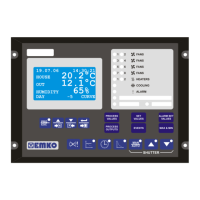
Do you have a question about the EMKO EPC-3 and is the answer not in the manual?
Lists crucial safety warnings and precautions before beginning product installation.
Covers essential steps before installation, safety during installation, and general usage responsibilities.
Describes the steps for mounting the device into a control panel, including safety.
Explains the use of fixing screws for securing the unit to the panel and warns about sharp burrs.
Details the terminal layout and connections for analog/digital inputs and outputs for the EPC-1 model.
Details the terminal layout and connections for analog/digital inputs and outputs for the EPC-3 model.
Details the terminal layout and connections for analog/digital inputs and outputs for the EPC-4 model.
Details the terminal layout and connections for analog/digital inputs and outputs for the EPC-1A model.
Details the terminal layout and connections for analog/digital inputs and outputs for the EPC-3A model.
Details the terminal layout and connections for analog/digital inputs and outputs for the EPC-4A model.
Details the terminal layout and connections for analog/digital inputs and outputs for the EPC-4B model.
Provides a detailed table listing pin descriptions, cable sizes, and notes for unit wiring.
Illustrates the physical connection diagram for the RS-232 cable between the EPC and a PC.
Outlines the technical specifications for the RS-232 serial interface and Modbus protocol.
Explains how shutter analog output relates to set parameters and ventilation outputs.
Describes manual and automatic control modes for the shutter, including feedback control.
Details the HR:MN and FEED<KG> parameters for setting up feeding schedules and amounts.
Explains how the EPC executes feeding steps based on programmed start times and amounts.
Lists the 10 different alarm types supported by the EPC controller.
Explains the conditions and logic for triggering the Differential alarm based on temperature differences.
Continues the explanation of differential alarm triggers based on temperature comparisons.
Explains how cooling affects maximum ventilation based on set parameters and notes.
Describes how low outside temperatures influence minimum ventilation, dependent on specific parameters.
Details how low outside temperatures impact temperature offsets via Influence 1 parameters.
Explains how high outside temperatures affect temperature offsets using Influence 2 parameters.
Shows the Curve Setup screen, defining parameters like Day, House Temp, Min/Max Vent, and Humidity.
Details the HR:MN and FEED<KG> parameters for each curve step, showing factory defaults.
Shows the HR:MN and OUT% parameters for lighting control across different curve steps, with factory defaults.
Explains the purpose of curves in automatically adjusting optimal values day by day.
Details the 10 steps for curve programming and how parameters are selected based on the DAY parameter.
Illustrates the humidity values based on day and curve steps, showing how they change.
Displays graphics for Max. Vent and Min. Vent values based on day and curve steps.
Explains how feeding parameters are applied based on the current day relative to curve step days.
Lists parameters for Heater 1 control, including Sensor, Control mode, Set Point, Hysteresis, Period, Offset, and Ramp.
Explains the ON-OFF control mode for Heater 1, detailing how temperature affects output based on setpoint and hysteresis.
Illustrates the ON-OFF control logic for Heater 1 with a graph showing process output vs. temperature.
Explains the Proportional control mode for Heater 1, including its logic and output filter.
Lists parameters for Heater 2 control, similar to Heater 1, covering Sensor, Control, Set Point, etc.
Explains the ON-OFF control mode for Heater 2, detailing its operation based on temperature and hysteresis.
Illustrates the ON-OFF control logic for Heater 2 with a graph showing process output vs. temperature.
Explains the Proportional control mode for Heater 2, including its logic and output filter.
Lists parameters for Cooling control: Sensor, Control mode, Set Point, Hysteresis, Period, Offset, Ramp.
Explains the ON-OFF control mode for Cooling, detailing its operation based on temperature and hysteresis.
Illustrates the ON-OFF control logic for Cooling with a graph showing process output vs. temperature.
Explains fan stages for tunnel ventilation and how FAN COUNT parameter affects operation.
Describes the fan analog ventilation control that works with tunnel vent, showing output vs. temperature.
Explains fan control for basic and tunnel ventilation types, showing ON/OFF and Proportional algorithms.
Illustrates fan analog control for basic/tunnel ventilation with ON/OFF and Proportional algorithms.
 General
| Brand | EMKO |
|---|---|
| Model | EPC-3 |
| Category | Controller |
| Language | English |


 To Next Page