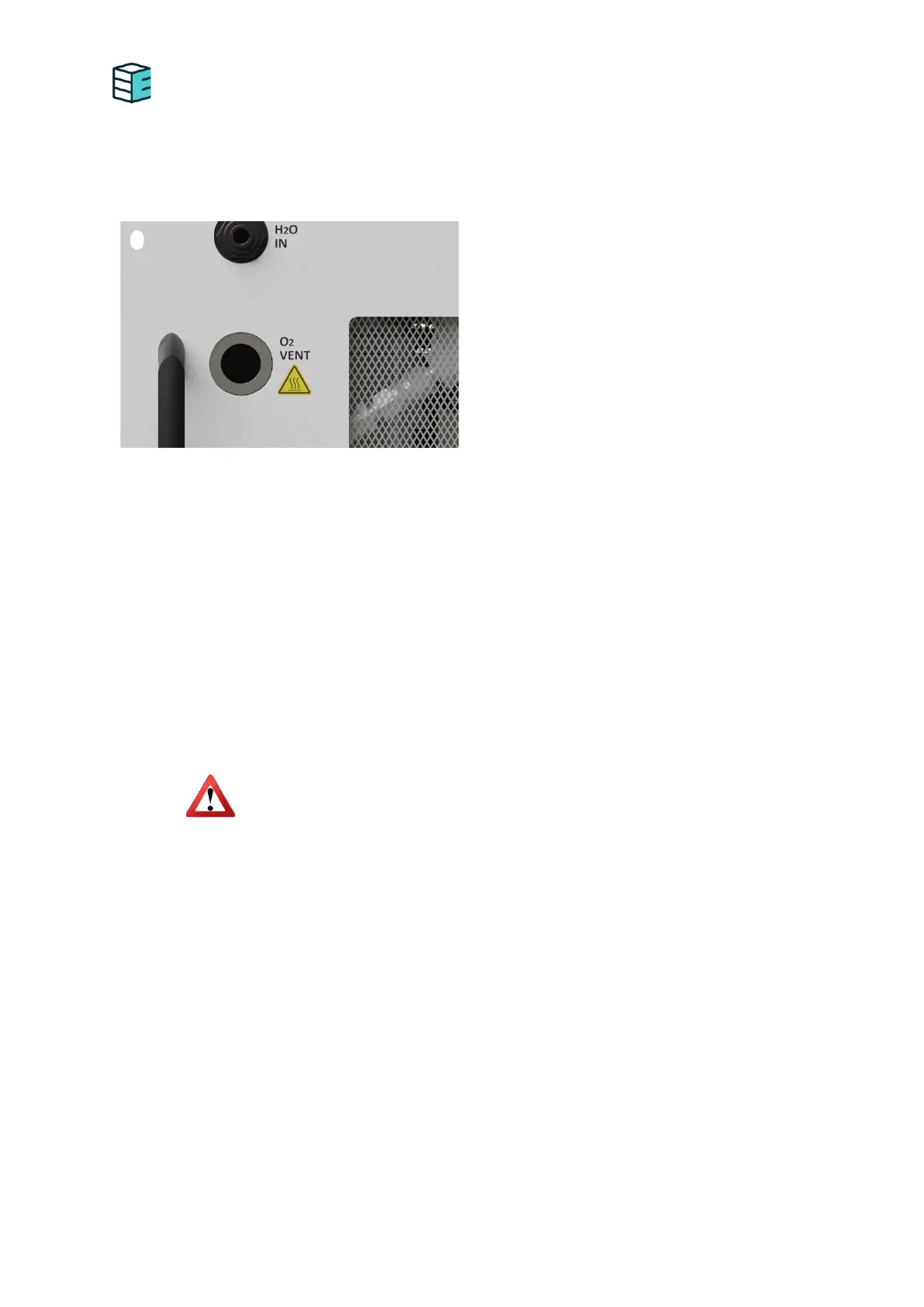
The O
2
vent line requires the most
demanding line management. Please study
this section carefully. The oxygen vent line
carries around 0.25 Nm³/h of oxygen at up
to 225 °C out of the electrolyser. Additional
components are water vapour and a
maximum concentration of 2 % vol
hydrogen. The water vapour sums up to
around 10-38 g/h.
Caution! Never mix the output of the H2 vent line with the output of the O2 vent
line.
Do not combine the O2 vent line of the EL4.0 with the O2 vent line of older
models. This line contains hot gases! Handle the output and the pipe with care,
use insulation if necessary and do not touch it during or directly after operation
as the pipe itself, connected parts and the gases at the outlet are hot and can
create injuries and damages.
Make sure, that there is never building up overpressure or underpressure of more
than 0.2 barg inside the pipe and that it is always at atmospheric pressure!
Otherwise, the device will get permanently damaged.
The line contains water steam and liquid water which is able to freeze and block
the pipe. The pipe of each device and the common pipes for several devices must
be sized appropriately and managed with water traps, heater and good
engineering practices to always allow bidirectional gas exchanges while still
draining the water safely.
The operator must ensure that the outlet satisfies all relevant local safety
guidelines, rules, directives and regulations, in terms of the safe dispersion of the
vented gas, noise emission, risk assessments, maintenance, a satisfactory safety
concept being utilised, and all other relevant areas.
It is the operator’s responsibility to regularly check and maintain all pipes.
Enapter is not responsible for any damage caused to the device from mismanaged
piping arrangements.
To connect the port labelled “O
2
Vent”, use heat and KOH resistant pipes, sealings and connectors only.
If connecting several devices to a common vent line, make sure the diameter of the line is sufficient


 To Next Page