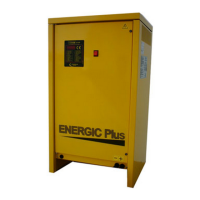
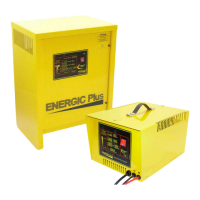
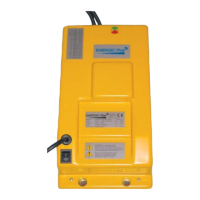
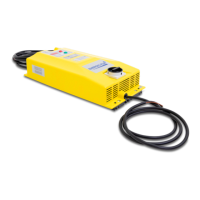
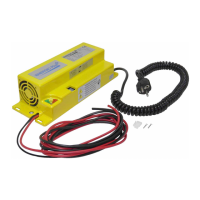
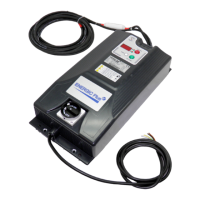
Battery Charger RLD
User's Manual
2. Safety instructions and warnings
GENERAL
Battery chargers can cause injury or death, or damage to other equipment or property, if the user
does not strictly observe all safety rules and take precautionary actions.
Safe practices must be learned through study and training before using this equipment.
Only qualified personnel should install, use, or service this battery charger.
SHOCK PREVENTION
Bare conductors, or terminals in the output circuit, or ungrounded, electrically-live equipments
can fatally shock a person. To protect against shock, have competent electrician verify that the
equipment is adequately grounded and learn what terminals and parts are electrically HOT.
The body’s electrical resistance is decreased when wet, permitting dangerous current to flow
through the body. Do not work in damp area without being extremely careful. Stand on dry
rubber mat or dry wood and use insulating gloves when dampness or sweat cannot be avoided.
Keep clothing dry.
INSTALLATION AND GROUNDING – Electrica equipment must be installed and mantained in
accordance with all the applicable national and local codes.
A power disconnect switch must be located at the equipment. Check the data label for voltage
and phase requirements. If only 3-phase power is available, connect single-phase equipment to
ONLY TWO WIRES of the 3-phase line.
DO NOT CONNECT the equipment grounding conductor to the third live wire of the 3-phase line
as this makes the equipment frame electrically HOT, which can cause a fatal shock.
If a grounding conductor is part of the power supply cable, be sure to connect it to a properly
grounded switch box or building ground. If not part of the supply cable, use a separate
grounding conductor. Don’t remove a ground prong from any plug. Use correct mating
receptacles. Check ground for electrical continuity before using equipment.
The grounding conductor must be of a size equal to or larger than the size recommended by
Code or this manual.
CHARGING LEADS – Inspect leads often for damage to the insulation. Replace or repair cracked
or worn leads immediately. Use leads having sufficient capacity to carry the operating current
without overheating.
Never extend the charging leads without prior approval of the manufacturer. Extending the
charging leads without prior approval of the manufacturer may cause wrong operation of the
charger and voids the warranty.
BATTERY TERMINALS – Do not touch battery terminals while equipment is operating.
SERVICE AND MAINTENANCE – Shut OFF all power at the disconnect switch or line breaker
BEFORE inspecting, adjusting, or servicing the equipment. Lock switch OPEN (or remove line
fuses) so that the power cannot be turned ON accidentally.
Disconnect power to equipment if it is to be left unattended or out of service.
Disconnect battery from charger.
Measure voltage on capacitors and, if there is any voltage reading, wait 5 minutes before to
proceed.
Keep inside parts clean and dry. Dirt and/or moisture can cause insulation failure. This failure
can result in high voltage at the charger output.
OWM-AR-D-[] Page 5 of 23


 To Next Page