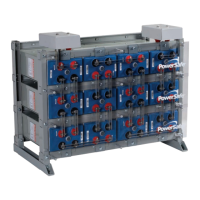
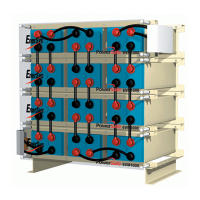
The EnerSys PowerSafe VM is a range of valve-regulated sealed lead-acid batteries designed for reserve power applications. These batteries utilize gas recombination technology, which minimizes gas evolution during normal operation and eliminates the need for topping-up throughout the battery's service life. This design also means that a separate battery room is not necessary, allowing for installation alongside or in the same room as the equipment they support.
Function Description:
The PowerSafe VM batteries are designed to provide reliable reserve power, typically connected in parallel with a charger to support a load. They are supplied filled and charged from the factory, ready for installation. The modular construction allows for flexibility in capacity, voltage, and footprint to suit various application requirements.
Important Technical Specifications:
The PowerSafe VM series offers a wide range of capacities and voltages. For example, 12V modules are available from 200 Ah to 600 Ah, 6V modules from 850 Ah to 1700 Ah, 4V modules from 1000 Ah to 2000 Ah, and 2V modules from 2600 Ah to 5000 Ah.
Dimensions vary by model; for instance, a 12VM-200 module has a length of 665 mm, depth of 330 mm, and height of 218 mm, weighing 104 kg. A 2VM-5000 module, on the other hand, has a length of 972 mm, depth of 558 mm, and height of 278 mm, weighing 382 kg.
The batteries are designed for horizontal installation only.
Charger specifications require a constant potential type with an applied charging voltage at the main battery terminals equivalent to a minimum of 2.25 volts per cell and a maximum of 2.28 volts per cell at an ambient temperature of 25°C (77°F). The maximum charge current available to the battery should be limited to 8% C8 capacity, and the minimum charge current output should be equivalent to 5% C8 capacity. The ripple content of the charging current (rms value) must not exceed 0.10 C8 (Amps).
The nominal operating temperature for a lead-acid battery is 20-25°C (68-77°F). Operating at higher temperatures will reduce battery life.
Usage Features:
- Installation: Installation requires careful attention to safety precautions, including wearing safety glasses, acid-resistant gloves, and protective rubber aprons. Insulated tools, a torque wrench, and a lifting device are necessary due to the weight of the modules. Modules are bolted together and to base channels, with specific torque settings for various connections (e.g., M6 terminal bolts at 6 Nm, M12 external cable connection bolts at 16 Nm). The process involves unpacking, marking the battery's intended position, placing mounting base channels, lifting and positioning modules, and making electrical connections.
- Polarity: All cell terminals are clearly marked with a RED ring for positive and a BLACK ring for negative. Connector contact surfaces should be cleaned and coated with non-oxide grease.
- Commissioning Charge: After assembly and electrical connections, a commissioning charge is required. If the battery is to be immediately put into service, a minimum total continuous charge time of 72 hours is recommended. If a site acceptance test is required, this extends to 144 hours. The charge should continue until the current flow into the battery has fallen to a minimum and remained constant for 3 consecutive hourly readings.
- Float Charge: The normal operating procedure involves maintaining the battery on a "float charge" in parallel with the charger. The applied voltage should be adjusted according to the operating temperature, as detailed in Appendix 'A' (e.g., 2.25-2.28V per cell at 25°C/77°F).
- Faster Charging: Recharge times can be reduced by increasing the applied charging voltage, but it should never exceed 2.4 volts per cell at 25°C (77°F). This method can reduce service life if used frequently, and the charge current must be limited to 8% C8 capacity. This elevated charge may be used for a maximum of 12 hours, after which the charger must be reset to the normal float voltage setting to prevent serious damage.
- Discharging: The minimum average voltage per cell should not be reduced below 1.60V for longer than 2 minutes (for standby times up to 1 hour) or 5 minutes (for standby times over 1 hour). A low voltage disconnect feature is recommended.
Maintenance Features:
- Storage: If not installed immediately, cells/modules should be stored in a cool, clean, dry, well-ventilated area (recommended -18°C to 32°C).
- Freshening Charge: Stored cells require a freshening charge every six months to maintain good condition, applied for 48 hours using a constant potential charger at the correct float voltage.
- Three Monthly Inspection:
- Visual check for electrolyte leakage and corrosion around terminal posts.
- Check and record overall applied voltage across the battery, adjusting as necessary.
- Record individual cell voltages on the battery record sheet and compare with previous readings to identify adverse trends.
- Six Monthly Inspection: Repeat the three-monthly inspection. If any cell shows adverse voltage trends, contact an EnerSys representative.
- Yearly Inspection: Repeat the six-monthly inspection and check the torque settings of all nuts and bolts, correcting as necessary.
- Good Housekeeping: Keep the battery and surrounding area clean and dry. Keep connectors, terminals, and bolted connections covered with non-oxide grease. Occasionally wipe dust or deposits from modules with a soft cotton cloth dampened with clean water; avoid scouring cloths or cleaning fluids/solvents.
- Cell Removal/Replacement: A procedure is outlined for replacing individual cells, involving disconnecting the charger, removing the front panel and inter-cell connectors, releasing pressure from the cell casing, and using specialized tools to extract and replace the cell.
Lead-acid batteries are potentially dangerous. Personnel must be suitably qualified and use appropriate safety equipment. Batteries contain corrosive sulfuric acid and can give off explosive gases. High voltages in multi-cell systems pose electric shock and burn risks. Cells are electrically live at all times. California Proposition 65 Warning indicates that battery components contain lead and lead compounds, known to cause cancer and reproductive harm. Hands must be washed after handling.

 Need help?
 General





 To Next Page