20
NOWPAK LINER-BASED CANISTER SYSTEM
User Manual | Entegris, Inc.
2. Place the closure directly onto the canister neck.
Torque the closure clockwise onto the canister to
the specified value using the appropriate torque
wrench and adapter.
Closure Canister size Closure base torque
NC-W2 20-liter 9.0-9.6 N•m (80-85 in•lbs)
3. The canister is now ready to ship.
CANISTER ASSEMBLY OVERVIEW
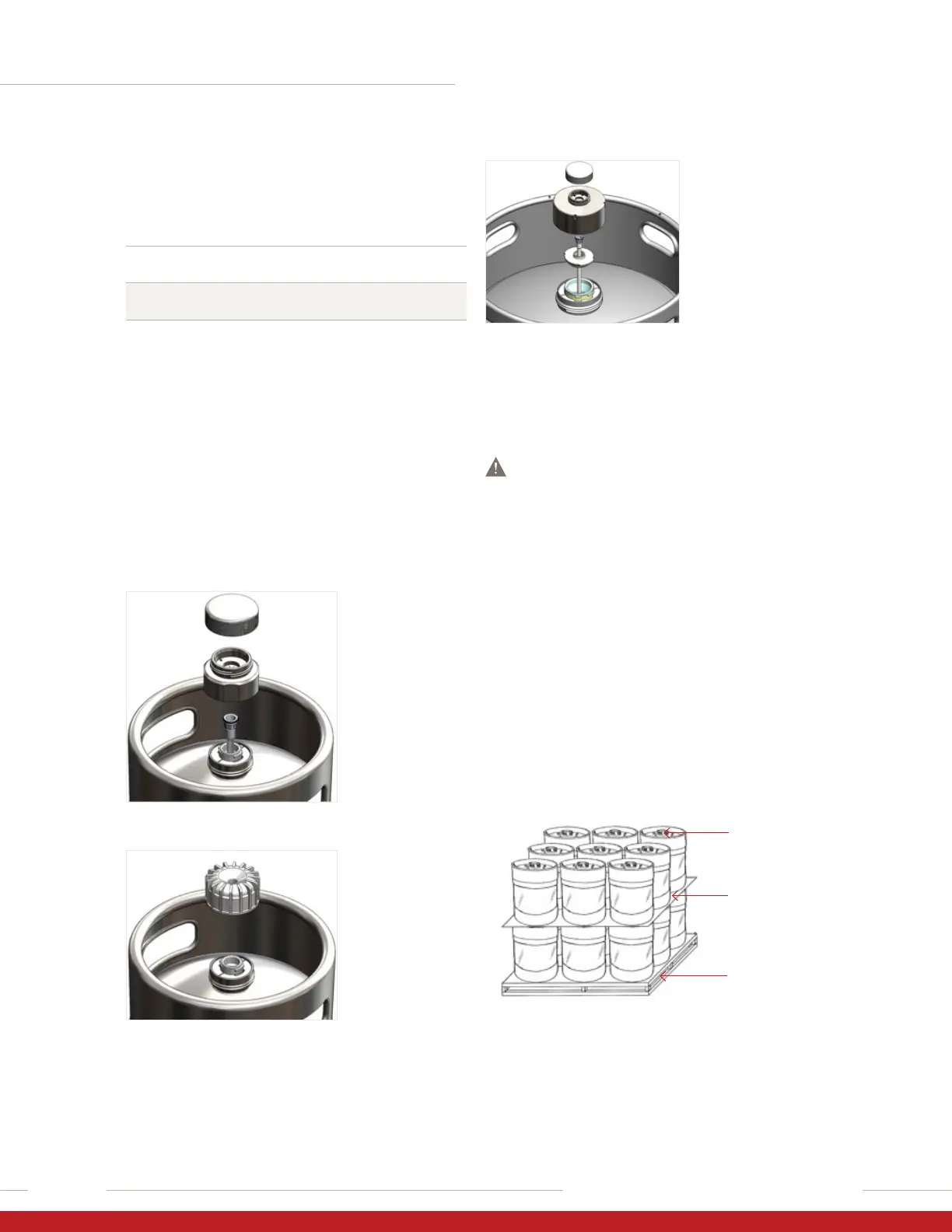
The following illustrations show the diptube and
closure components used to cap a liner-based
canister that is filled with chemical:
• 19-liter canister with NC-03 closure, Figure 35
• 20-liter canister with NC-W2 closure, Figure 36
• 200-liter canister with NC-200-2 closure and
standard fitment adapter, Figure 37
Figure 35. 19-liter with NC-03 closure.
Figure 36. 20-liter with NC-W2 closure.
Figure 37. 200-liter with NC-200-2 closure and fitment adapter.
CANISTER SHIPMENT
Use this information to prepare a set of filled and
capped canisters for shipment to a customer.
WARNING: 200-liter canisters are very heavy
and should only be moved by trained personnel
using proper equipment. See Moving the
Canisters, page 10, for instructions and
mandatory safety procedures.
NOTE: Ensure the cap on the top of the closure is tight
before shipping a canister filled with chemical. Do not drop
filled canisters or place filled canisters on their side. Both
actions can cause damage to the liners and the breakseals.
1. Palletize canisters with closures up.
2. Do not ship canisters lying on side.
3. Use slip-sheet between layers.
4. Stacking two layers high is permissible for canisters
smaller than 200-liters.
5. Stretch wrap and band pallet for stability.
Pallet (stretch
wrap & bond)
Slip sheet between
layers: corrugated
cardboard is
recommended
Closure at top
Figure 38. Canister palletized for shipping.
NOTE: End users should return empty canisters to the
chemical supplier in a similar manner. Be sure to orient
closures up to avoid leakage of any residual chemical into
the area between the shipping cap and closure base.



 To Next Page